







Question: Question 12. Consider the single index model. You are a mean-variance optimizer with coefficient of risk aversion equal to 3. There are two risky assets
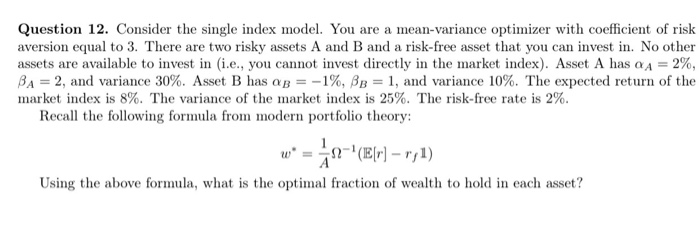
Question 12. Consider the single index model. You are a mean-variance optimizer with coefficient of risk aversion equal to 3. There are two risky assets A and B and a risk-free asset that you can invest in. No other assets are available to invest in i.e., you cannot invest directly in the market index). Asset A has a A = 2%, BA = 2, and variance 30%. Asset B has ab = -1%, BB = 1, and variance 10%. The expected return of the market index is 8%. The variance of the market index is 25%. The risk-free rate is 2%. Recall the following formula from modern portfolio theory: w* = -2- Elr r,1) Using the above formula, what is the optimal fraction of wealth to hold in each asset? Question 12. Consider the single index model. You are a mean-variance optimizer with coefficient of risk aversion equal to 3. There are two risky assets A and B and a risk-free asset that you can invest in. No other assets are available to invest in i.e., you cannot invest directly in the market index). Asset A has a A = 2%, BA = 2, and variance 30%. Asset B has ab = -1%, BB = 1, and variance 10%. The expected return of the market index is 8%. The variance of the market index is 25%. The risk-free rate is 2%. Recall the following formula from modern portfolio theory: w* = -2- Elr r,1) Using the above formula, what is the optimal fraction of wealth to hold in each asset
Step by Step Solution
There are 3 Steps involved in it

Get step-by-step solutions from verified subject matter experts
 Study Help