







Question: Question 13. Suppose you are a mean-variance optimizer with coefficient of risk aversion A. For now, suppose there are only 3 risky assets. You split
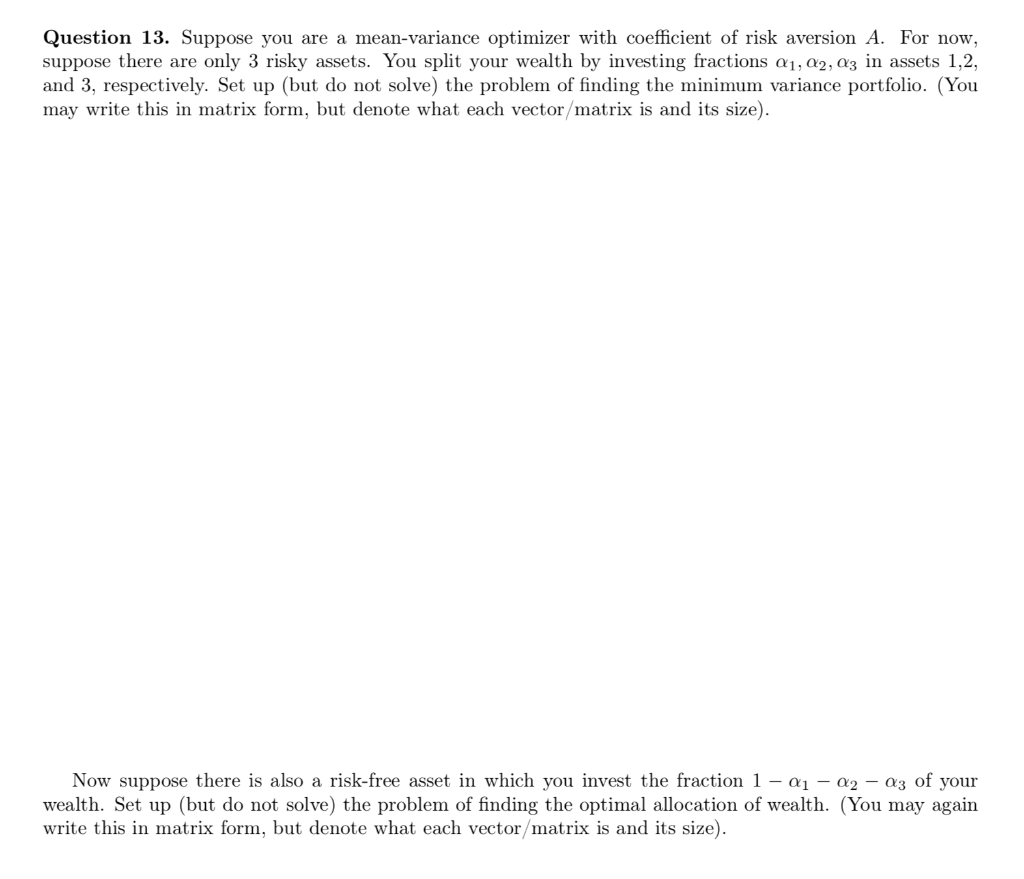
Question 13. Suppose you are a mean-variance optimizer with coefficient of risk aversion A. For now, suppose there are only 3 risky assets. You split your wealth by investing fractions (1, 02, 03 in assets 1,2, and 3, respectively. Set up (but do not solve the problem of finding the minimum variance portfolio. (You may write this in matrix form, but denote what each vector matrix is and its size). Now suppose there is also a risk-free asset in which you invest the fraction 1 - Q1 - 02 Q3 of your wealth. Set up (but do not solve the problem of finding the optimal allocation of wealth. (You may again write this in matrix form, but denote what each vector matrix is and its size). Question 13. Suppose you are a mean-variance optimizer with coefficient of risk aversion A. For now, suppose there are only 3 risky assets. You split your wealth by investing fractions (1, 02, 03 in assets 1,2, and 3, respectively. Set up (but do not solve the problem of finding the minimum variance portfolio. (You may write this in matrix form, but denote what each vector matrix is and its size). Now suppose there is also a risk-free asset in which you invest the fraction 1 - Q1 - 02 Q3 of your wealth. Set up (but do not solve the problem of finding the optimal allocation of wealth. (You may again write this in matrix form, but denote what each vector matrix is and its size)
Step by Step Solution
There are 3 Steps involved in it

Get step-by-step solutions from verified subject matter experts
 Study Help