







Question: QUESTION 13 Variable Relationships and Future Value Consider an investment that pays $1000 today that is deposited in an account the grows over the next
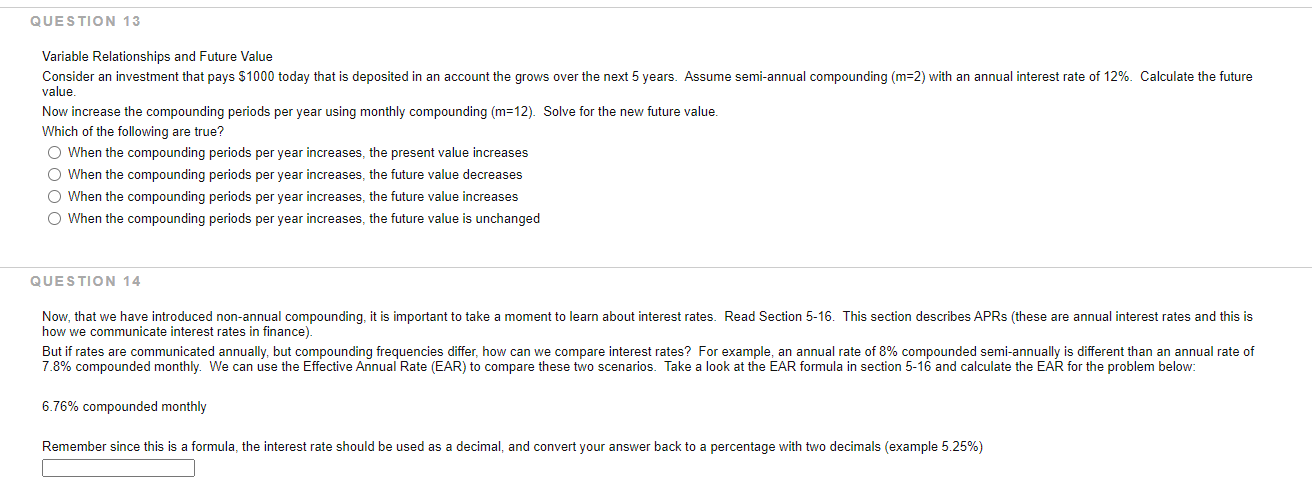
QUESTION 13 Variable Relationships and Future Value Consider an investment that pays $1000 today that is deposited in an account the grows over the next 5 years. Assume semi-annual compounding (m=2) with an annual interest rate of 12%. Calculate the future value. Now increase the compounding periods per year using monthly compounding (m=12). Solve for the new future value. Which of the following are true? When the compounding periods per year increases, the present value increases O When the compounding periods per year increases, the future value decreases When the compounding periods per year increases, the future value increases When the compounding periods per year increases, the future value is unchanged QUESTION 14 Now, that we have introduced non-annual compounding, it is important to take a moment to learn about interest rates. Read Section 5-16. This section describes APRs (these are annual interest rates and this is how we communicate interest rates in finance). But if rates are communicated annually, but compounding frequencies differ, how can we compare interest rates? For example, an annual rate of 8% compounded semi-annually is different than an annual rate of 7.8% compounded monthly. We can use the Effective Annual Rate (EAR) to compare these two scenarios. Take a look at the EAR formula in section 5-16 and calculate the EAR for the problem below: 6.76% compounded monthly Remember since this is a formula, the interest rate should be used as a decimal, and convert your answer back to a percentage with two decimals (example 5.25%)
Step by Step Solution
There are 3 Steps involved in it

Get step-by-step solutions from verified subject matter experts
 Study Help