







Question: Question 2. (1 point) Suppose that a decision-maker has the following preference over three outcomes, x>y>z, with numerical scores, U(x)=1,U(y)= ?, and U(z)=0. The decision
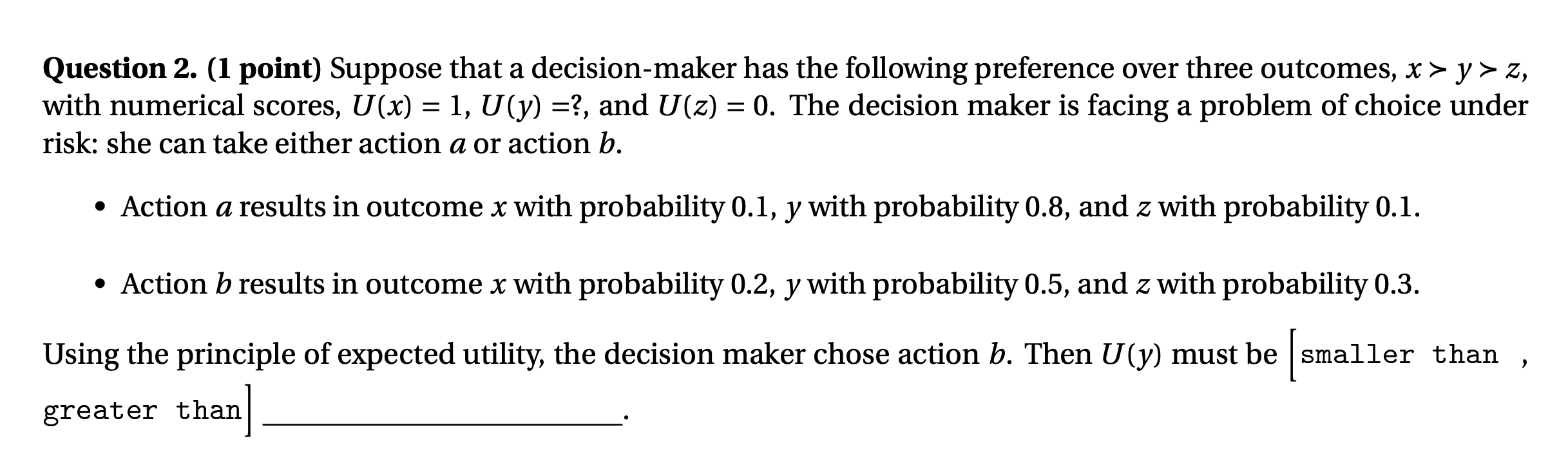
Question 2. (1 point) Suppose that a decision-maker has the following preference over three outcomes, x>y>z, with numerical scores, U(x)=1,U(y)= ?, and U(z)=0. The decision maker is facing a problem of choice under risk: she can take either action a or action b. - Action a results in outcome x with probability 0.1,y with probability 0.8, and z with probability 0.1. - Action b results in outcome x with probability 0.2,y with probability 0.5, and z with probability 0.3. Using the principle of expected utility, the decision maker chose action b. Then U(y) must be [ smaller than , greater than]
Step by Step Solution
There are 3 Steps involved in it
1 Expert Approved Answer
Step: 1 Unlock

Question Has Been Solved by an Expert!
Get step-by-step solutions from verified subject matter experts
Step: 2 Unlock
Step: 3 Unlock
 Study Help