



Question: Question 2 10 Points i-You were given a UV/VIS spectra which has three absorption bands at: max 455 nm, 480 nm and 490 nm respectively
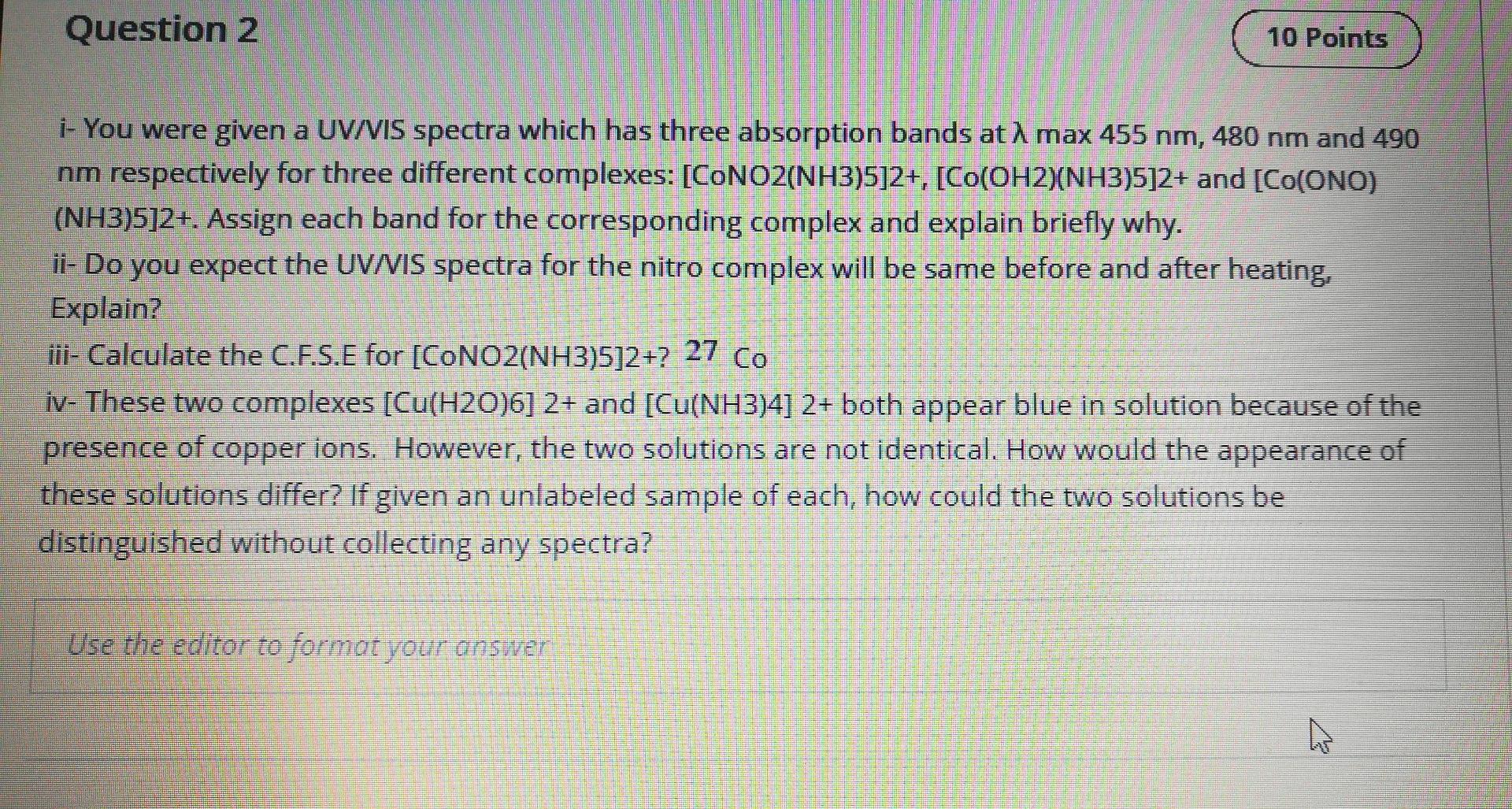
Question 2 10 Points i-You were given a UV/VIS spectra which has three absorption bands at: max 455 nm, 480 nm and 490 nm respectively for three different complexes: [CONO2(NH3)5]2+, [Co(OH2)(NH3)5]2+ and [CO(ONO) (NH3)5]2+. Assign each band for the corresponding complex and explain briefly why. ii- Do you expect the UV/VIS spectra for the nitro complex will be same before and after heating, Explain? iii- Calculate the C.F.S.E for [CONO2(NH3)5]2+? 27 Co iv. These two complexes [Cu(H20)6] 2+ and [Cu(NH3)4] 2+ both appear blue in solution because of the presence of copper ions. However, the two solutions are not identical. How would the appearance of these solutions differ? If given an unlabeled sample of each, how could the two solutions be distinguished without collecting any spectra? Use the editor to format your ons ver Question 2 10 Points i-You were given a UV/VIS spectra which has three absorption bands at: max 455 nm, 480 nm and 490 nm respectively for three different complexes: [CONO2(NH3)5]2+, [Co(OH2)(NH3)5]2+ and [CO(ONO) (NH3)5]2+. Assign each band for the corresponding complex and explain briefly why. ii- Do you expect the UV/VIS spectra for the nitro complex will be same before and after heating, Explain? iii- Calculate the C.F.S.E for [CONO2(NH3)5]2+? 27 Co iv. These two complexes [Cu(H20)6] 2+ and [Cu(NH3)4] 2+ both appear blue in solution because of the presence of copper ions. However, the two solutions are not identical. How would the appearance of these solutions differ? If given an unlabeled sample of each, how could the two solutions be distinguished without collecting any spectra? Use the editor to format your ons ver
Step by Step Solution
There are 3 Steps involved in it

Get step-by-step solutions from verified subject matter experts