







Question: QUESTION 2 (24 marks) In one study, a mixture containing neutral species (X: nonpolar, Y: relatively polar) and ionic species of different masses but similar
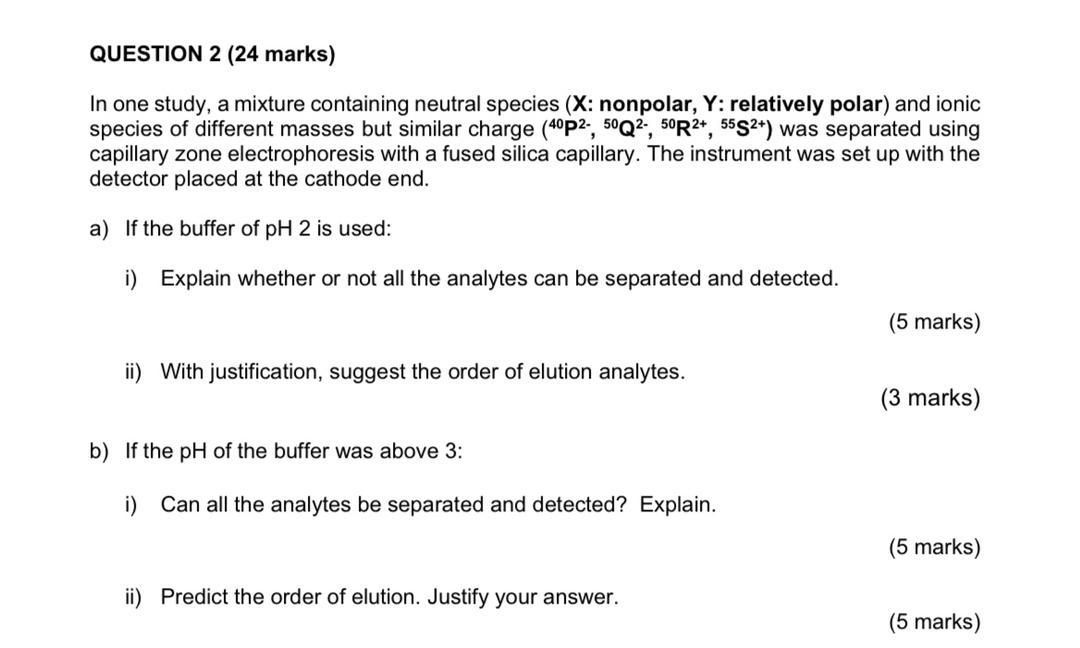
QUESTION 2 (24 marks) In one study, a mixture containing neutral species (X: nonpolar, Y: relatively polar) and ionic species of different masses but similar charge (40p2., 50Q2, 50R2+, 5592+) was separated using capillary zone electrophoresis with a fused silica capillary. The instrument was set up with the detector placed at the cathode end. a) If the buffer of pH 2 is used: i) Explain whether or not all the analytes can be separated and detected. (5 marks) ii) With justification, suggest the order of elution analytes. (3 marks) b) If the pH of the buffer was above 3: i) Can all the analytes be separated and detected? Explain. (5 marks) ii) Predict the order of elution. Justify your answer. (5 marks) QUESTION 2 (24 marks) In one study, a mixture containing neutral species (X: nonpolar, Y: relatively polar) and ionic species of different masses but similar charge (40p2., 50Q2, 50R2+, 5592+) was separated using capillary zone electrophoresis with a fused silica capillary. The instrument was set up with the detector placed at the cathode end. a) If the buffer of pH 2 is used: i) Explain whether or not all the analytes can be separated and detected. (5 marks) ii) With justification, suggest the order of elution analytes. (3 marks) b) If the pH of the buffer was above 3: i) Can all the analytes be separated and detected? Explain. (5 marks) ii) Predict the order of elution. Justify your
Step by Step Solution
There are 3 Steps involved in it

Get step-by-step solutions from verified subject matter experts
 Study Help