







Question: Question 2 25 pts Safety Third Airlines (STA) operates an aging fleet of passenger jets for domestic air service. After numerous complaints from passengers landing
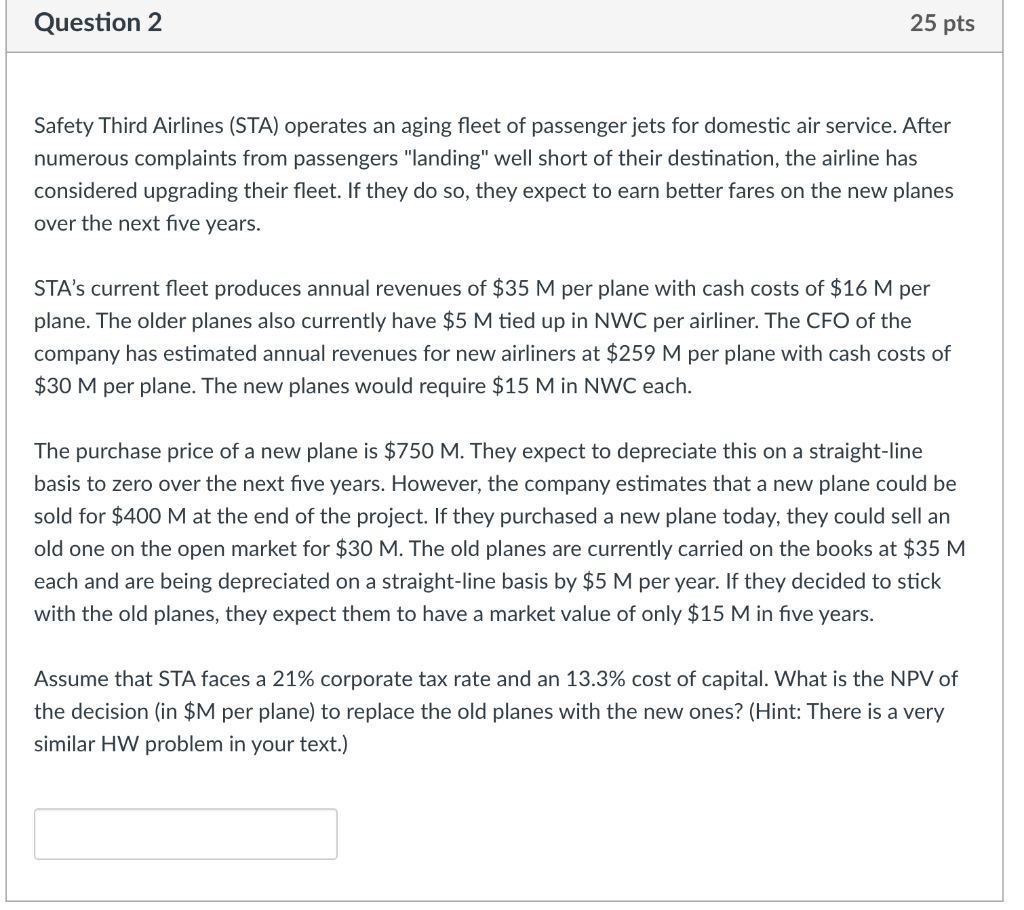
Question 2 25 pts Safety Third Airlines (STA) operates an aging fleet of passenger jets for domestic air service. After numerous complaints from passengers "landing" well short of their destination, the airline has considered upgrading their fleet. If they do so, they expect to earn better fares on the new planes over the next five years. STA's current fleet produces annual revenues of $35 M per plane with cash costs of $16 M per plane. The older planes also currently have $5 M tied up in NWC per airliner. The CFO of the company has estimated annual revenues for new airliners at $259 M per plane with cash costs of $30 M per plane. The new planes would require $15 M in NWC each. The purchase price of a new plane is $750 M. They expect to depreciate this on a straight-line basis to zero over the next five years. However, the company estimates that a new plane could be sold for $400 M at the end of the project. If they purchased a new plane today, they could sell an old one on the open market for $30 M. The old planes are currently carried on the books at $35 M each and are being depreciated on a straight-line basis by $5 M per year. If they decided to stick with the old planes, they expect them to have a market value of only $15 M in five years. Assume that STA faces a 21% corporate tax rate and an 13.3% cost of capital. What is the NPV of the decision (in $M per plane) to replace the old planes with the new ones? (Hint: There is a very similar HW problem in your text.) Question 2 25 pts Safety Third Airlines (STA) operates an aging fleet of passenger jets for domestic air service. After numerous complaints from passengers "landing" well short of their destination, the airline has considered upgrading their fleet. If they do so, they expect to earn better fares on the new planes over the next five years. STA's current fleet produces annual revenues of $35 M per plane with cash costs of $16 M per plane. The older planes also currently have $5 M tied up in NWC per airliner. The CFO of the company has estimated annual revenues for new airliners at $259 M per plane with cash costs of $30 M per plane. The new planes would require $15 M in NWC each. The purchase price of a new plane is $750 M. They expect to depreciate this on a straight-line basis to zero over the next five years. However, the company estimates that a new plane could be sold for $400 M at the end of the project. If they purchased a new plane today, they could sell an old one on the open market for $30 M. The old planes are currently carried on the books at $35 M each and are being depreciated on a straight-line basis by $5 M per year. If they decided to stick with the old planes, they expect them to have a market value of only $15 M in five years. Assume that STA faces a 21% corporate tax rate and an 13.3% cost of capital. What is the NPV of the decision (in $M per plane) to replace the old planes with the new ones? (Hint: There is a very similar HW problem in your text.)
Step by Step Solution
There are 3 Steps involved in it

Get step-by-step solutions from verified subject matter experts
 Study Help