







Question: Question 2 (29) Read the case study below and answer the questions that follow it: Case Study The Colosseum (70-80 AD) Emperor Flavian Vespasian had
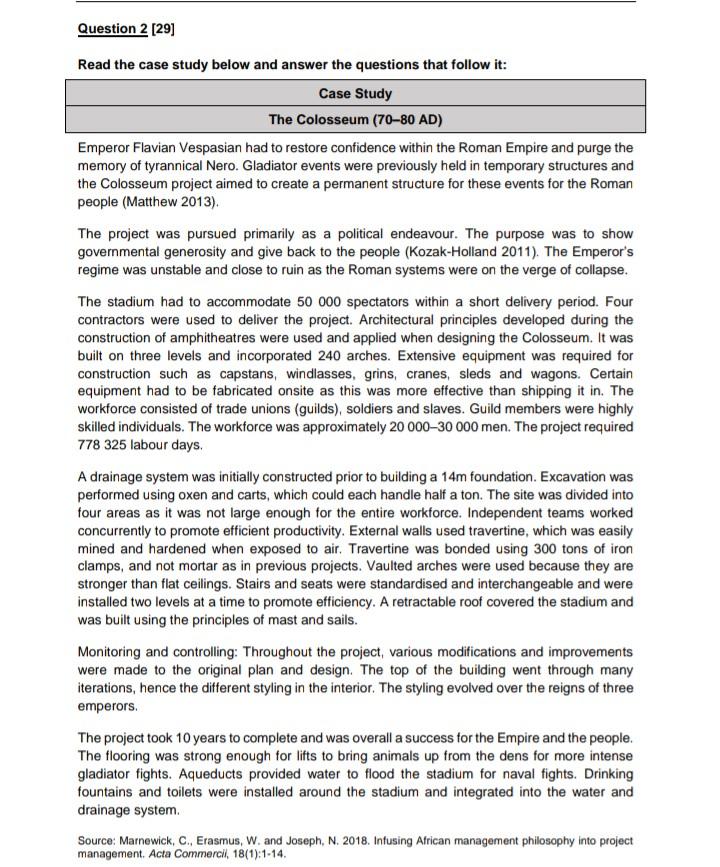
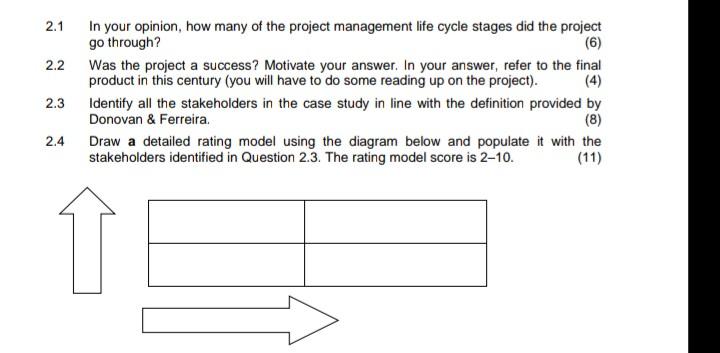
Question 2 (29) Read the case study below and answer the questions that follow it: Case Study The Colosseum (70-80 AD) Emperor Flavian Vespasian had to restore confidence within the Roman Empire and purge the memory of tyrannical Nero. Gladiator events were previously held in temporary structures and the Colosseum project aimed to create a permanent structure for these events for the Roman people (Matthew 2013). The project was pursued primarily as a political endeavour. The purpose was to show governmental generosity and give back to the people (Kozak-Holland 2011). The Emperor's regime was unstable and close to ruin as the Roman systems were on the verge of collapse. The stadium had to accommodate 50 000 spectators within a short delivery period. Four contractors were used to deliver the project. Architectural principles developed during the construction of amphitheatres were used and applied when designing the Colosseum. It was built on three levels and incorporated 240 arches. Extensive equipment was required for construction such as capstans, windlasses, grins, cranes, sleds and wagons. Certain equipment had to be fabricated onsite as this was more effective than shipping it in. The workforce consisted of trade unions (guilds), soldiers and slaves. Guild members were highly skilled individuals. The workforce was approximately 20 000-30 000 men. The project required 778 325 labour days. A drainage system was initially constructed prior to building a 14m foundation. Excavation was performed using oxen and carts, which could each handle half a ton. The site was divided into four areas as it was not large enough for the entire workforce. Independent teams worked concurrently to promote efficient productivity. External walls used travertine, which was easily mined and hardened when exposed to air. Travertine was bonded using 300 tons of iron clamps, and not mortar as in previous projects. Vaulted arches were used because they are stronger than flat ceilings. Stairs and seats were standardised and interchangeable and were installed two levels at a time to promote efficiency. A retractable roof covered the stadium and was built using the principles of mast and sails. Monitoring and controlling: Throughout the project, various modifications and improvements were made to the original plan and design. The top of the building went through many iterations, hence the different styling in the interior. The styling evolved over the reigns of three emperors. The project took 10 years to complete and was overall a success for the Empire and the people. The flooring was strong enough for lifts to bring animals up from the dens for more intense gladiator fights. Aqueducts provided water to flood the stadium for naval fights. Drinking fountains and toilets were installed around the stadium and integrated into the water and drainage system Source: Marnewick, C., Erasmus, W. and Joseph, N. 2018. Intusing African management philosophy into project management. Acta Commercil, 18(1):1-14. 2.1 2.2 In your opinion, how many of the project management life cycle stages did the project go through? Was the project a success? Motivate your answer. In your answer, refer to the final product in this century (you will have to do some reading up on the project). (4) Identify all the stakeholders in the case study in line with the definition provided by Donovan & Ferreira Draw a detailed rating model using the diagram below and populate it with the stakeholders identified in Question 2.3. The rating model score is 2-10. (11) 2.3 (8) 2.4
Step by Step Solution
There are 3 Steps involved in it
1 Expert Approved Answer
Step: 1 Unlock

Question Has Been Solved by an Expert!
Get step-by-step solutions from verified subject matter experts
Step: 2 Unlock
Step: 3 Unlock
 Study Help