







Question: Question 2 (40 marks) It is noticed that the above estimated sample regression model (1b) is not so satisfactory, thus the following revised population model
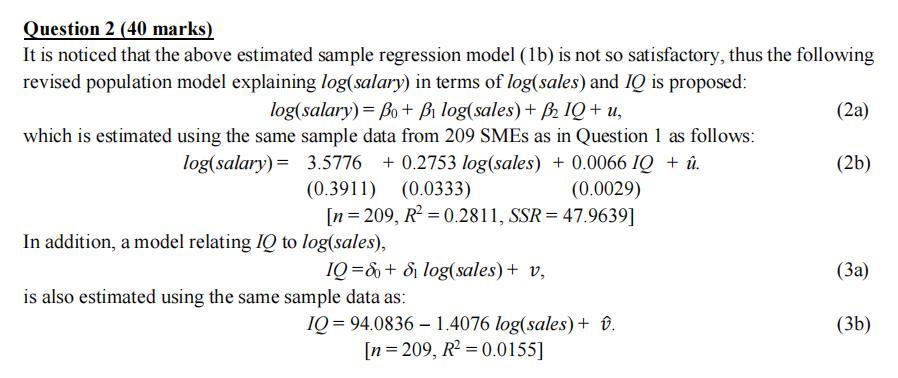
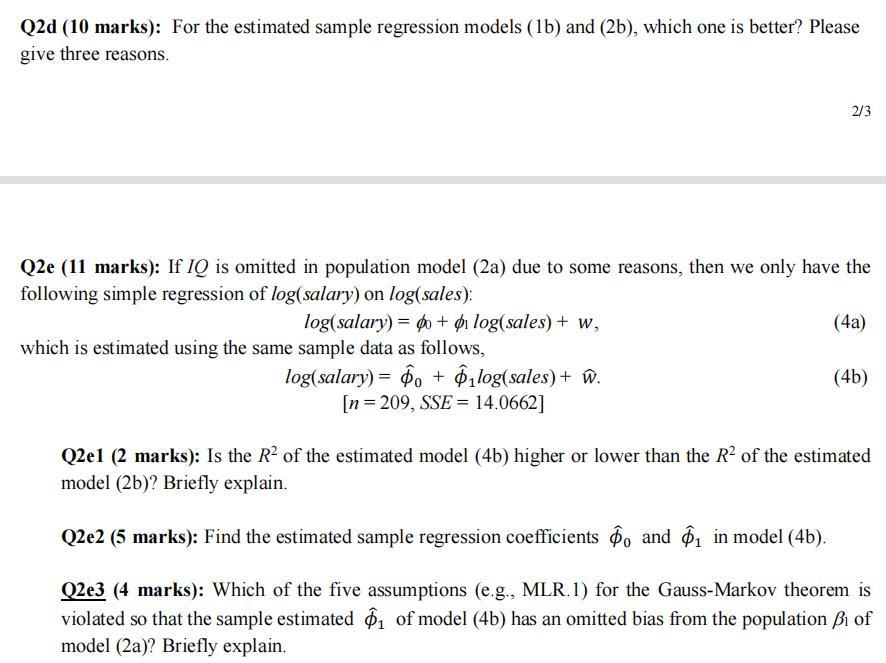
Question 2 (40 marks) It is noticed that the above estimated sample regression model (1b) is not so satisfactory, thus the following revised population model explaining log( salary) in terms of log( sales ) and IQ is proposed: log(salary)=0+1log(sales)+2IQ+u, which is estimated using the same sample data from 209 SMEs as in Question 1 as follows: log(salary)=3.5776+0.2753log(sales)+[n=209,R2=0.2811,SSR=47.9639]0.0066IQ+u^(0.3911)(0.0333) In addition, a model relating IQ to log( sales), IQ=0+1log(sales)+v is also estimated using the same sample data as: IQ=94.08361.4076log(sales)+v^[n=209,R2=0.0155] Q2d (10 marks): For the estimated sample regression models ( 1b) and (2b), which one is better? Please give three reasons. Q2e (11 marks): If IQ is omitted in population model (2a) due to some reasons, then we only have the following simple regression of log (salary) on log (sales): log(salary)=0+1log(sales)+w, which is estimated using the same sample data as follows, log(salary)=^0+^1log(sales)+w.[n=209,SSE=14.0662] Q2e1 (2 marks): Is the R2 of the estimated model (4b) higher or lower than the R2 of the estimated model (2b)? Briefly explain. Q2e2 (5 marks): Find the estimated sample regression coefficients ^0 and ^1 in model (4b). Q2e3 (4 marks): Which of the five assumptions (e.g., MLR.1) for the Gauss-Markov theorem is violated so that the sample estimated ^1 of model (4b) has an omitted bias from the population 1 of model (2a)? Briefly explain. Question 2 (40 marks) It is noticed that the above estimated sample regression model (1b) is not so satisfactory, thus the following revised population model explaining log( salary) in terms of log( sales ) and IQ is proposed: log(salary)=0+1log(sales)+2IQ+u, which is estimated using the same sample data from 209 SMEs as in Question 1 as follows: log(salary)=3.5776+0.2753log(sales)+[n=209,R2=0.2811,SSR=47.9639]0.0066IQ+u^(0.3911)(0.0333) In addition, a model relating IQ to log( sales), IQ=0+1log(sales)+v is also estimated using the same sample data as: IQ=94.08361.4076log(sales)+v^[n=209,R2=0.0155] Q2d (10 marks): For the estimated sample regression models ( 1b) and (2b), which one is better? Please give three reasons. Q2e (11 marks): If IQ is omitted in population model (2a) due to some reasons, then we only have the following simple regression of log (salary) on log (sales): log(salary)=0+1log(sales)+w, which is estimated using the same sample data as follows, log(salary)=^0+^1log(sales)+w.[n=209,SSE=14.0662] Q2e1 (2 marks): Is the R2 of the estimated model (4b) higher or lower than the R2 of the estimated model (2b)? Briefly explain. Q2e2 (5 marks): Find the estimated sample regression coefficients ^0 and ^1 in model (4b). Q2e3 (4 marks): Which of the five assumptions (e.g., MLR.1) for the Gauss-Markov theorem is violated so that the sample estimated ^1 of model (4b) has an omitted bias from the population 1 of model (2a)? Briefly explain
Step by Step Solution
There are 3 Steps involved in it

Get step-by-step solutions from verified subject matter experts
 Study Help