



Question: Question 2 - 45 points For an unbounded domain in 3D, the Green's function G(r,r) for L=2 can only depend on the scalar separation r,r.
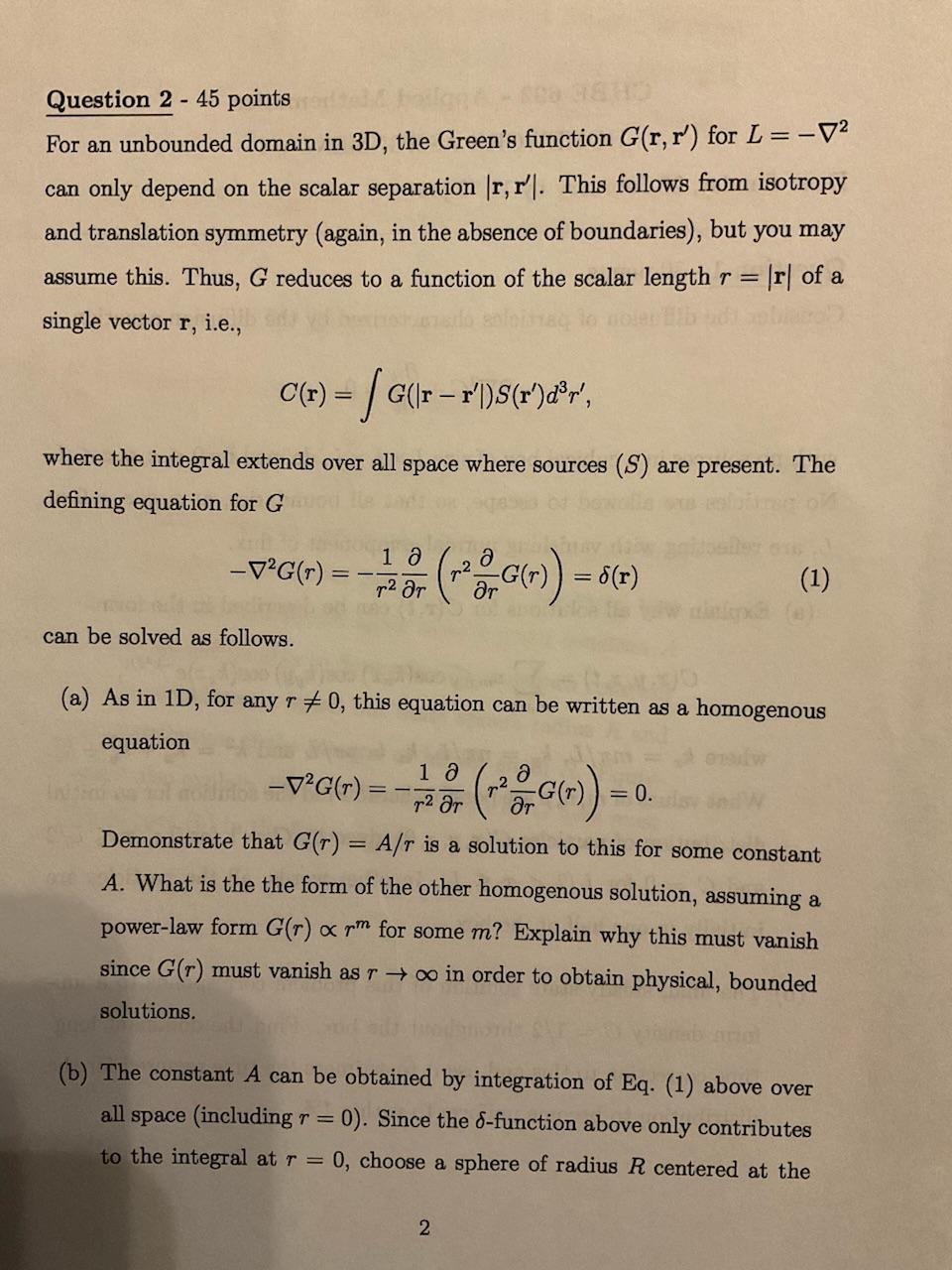
Question 2 - 45 points For an unbounded domain in 3D, the Green's function G(r,r) for L=2 can only depend on the scalar separation r,r. This follows from isotropy and translation symmetry (again, in the absence of boundaries), but you may assume this. Thus, G reduces to a function of the scalar length r=r of a single vector r, i.e., C(r)=G(rr)S(r)d3r where the integral extends over all space where sources (S) are present. The defining equation for G 2G(r)=r21r(r2rG(r))=(r) can be solved as follows. (a) As in 1D, for any r=0, this equation can be written as a homogenous equation 2G(r)=r21r(r2rG(r))=0. Demonstrate that G(r)=A/r is a solution to this for some constant A. What is the the form of the other homogenous solution, assuming a power-law form G(r)rm for some m ? Explain why this must vanish since G(r) must vanish as r in order to obtain physical, bounded solutions. (b) The constant A can be obtained by integration of Eq. (1) above over all space (including r=0 ). Since the -function above only contributes to the integral at r=0, choose a sphere of radius R centered at the
Step by Step Solution
There are 3 Steps involved in it

Get step-by-step solutions from verified subject matter experts