







Question: Question 2 (50%). Given R (A, B, C, D, E) and a set of FDs on R, F = {AD E, C A, DEB,
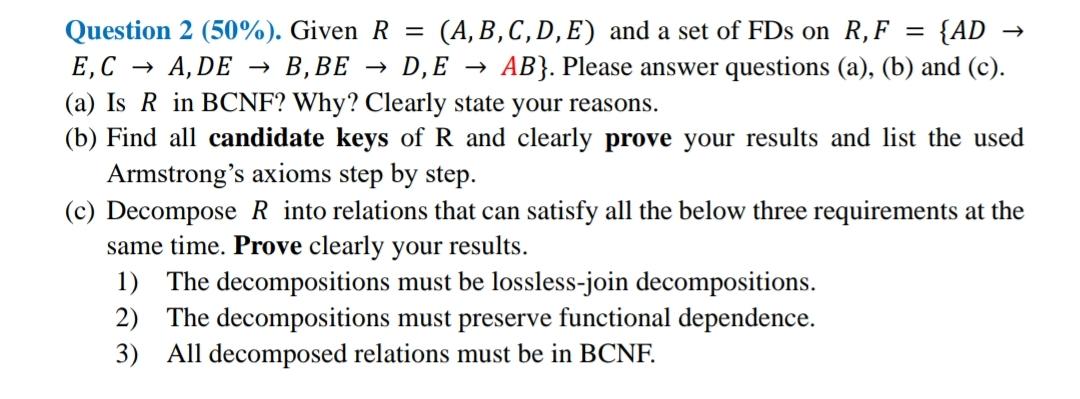
Question 2 (50%). Given R (A, B, C, D, E) and a set of FDs on R, F = {AD E, C A, DEB, BE D,E AB}. Please answer questions (a), (b) and (c). (a) Is R in BCNF? Why? Clearly state your reasons. (b) Find all candidate keys of R and clearly prove your results and list the used Armstrong's axioms step by step. (c) Decompose R into relations that can satisfy all the below three requirements at the same time. Prove clearly your results. 1) The decompositions must be lossless-join decompositions. = 2) The decompositions must preserve functional dependence. 3) All decomposed relations must be in BCNF.
Step by Step Solution
There are 3 Steps involved in it

Get step-by-step solutions from verified subject matter experts
 Study Help