







Question: Question 2 (50 Marks) How information technology can help boosting communication among virtual teams. Critically discuss how problems that emerge might be tackled. Reflect on
Question 2 (50 Marks)
How information technology can help boosting communication among virtual teams. Critically discuss how problems that emerge might be tackled. Reflect on the case and discuss how information technology in general is beneficial and how it has helped Volvo in particular to improve communication between its virtual teams. Discuss your experience with information technology in the era of covid-19. Did it have negative or positive effects in improving communication being it at work level or educational level?
Hint:
- To answer the query of this question, you need to refer to relevant course material and external resources.
- You need to discuss the importance of technology mediation and how it helps virtual teams, the problems faced with technology mediation and the role of translucence in this regard.
- You need to refer to the case and identify the role of technology medication, problems faced if any and how it was dealt with.
- You need to refer as well to a discussion of your personal experience with technology mediation and how it helped you or not to face problems of communication at the level of work and studies and what was the role of translucence in this regard.
- Your discussion needs to be supported with relevant references from B325 course material, case article and addition external resources you have referred to.
that is all the information
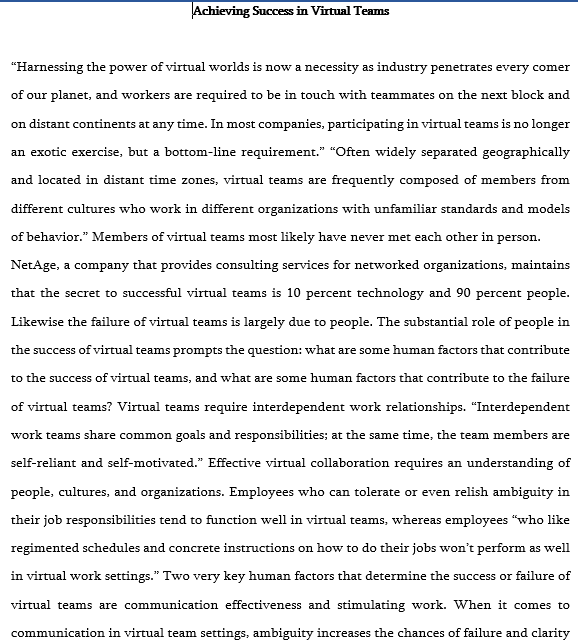
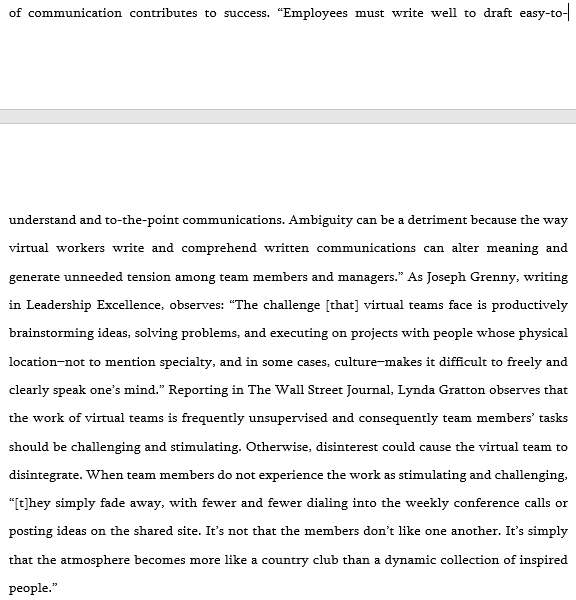
Achieving Success in Virtual Teams "Harnessing the power of virtual worlds is now a necessity as industry penetrates every comer of our planet, and workers are required to be in touch with teammates on the next block and on distant continents at any time. In most companies, participating in virtual teams is no longer an exotic exercise, but a bottom-line requirement. Often widely separated geographically and located in distant time zones, virtual teams are frequently composed of members from different cultures who work in different organizations with unfamiliar standards and models of behavior." Members of virtual teams most likely have never met each other in person. NetAge, a company that provides consulting services for networked organizations, maintains that the secret to successful virtual teams is 10 percent technology and 90 percent people. Likewise the failure of virtual teams is largely due to people. The substantial role of people in the success of virtual teams prompts the question: what are some human factors that contribute to the success of virtual teams, and what are some human factors that contribute to the failure of virtual teams? Virtual teams require interdependent work relationships. Interdependent work teams share common goals and responsibilities; at the same time, the team members are self-reliant and self-motivated. Effective virtual collaboration requires an understanding of people, cultures, and organizations. Employees who can tolerate or even relish ambiguity in their job responsibilities tend to function well in virtual teams, whereas employees "who like regimented schedules and concrete instructions on how to do their jobs won't perform as well in virtual work settings." Two very key human factors that determine the success or failure of virtual teams are communication effectiveness and stimulating work. When it comes to communication in virtual team settings, ambiguity increases the chances of failure and clarity of communication contributes to success. Employees must write well to draft easy-to- understand and to-the-point communications. Ambiguity can be a detriment because the way virtual workers write and comprehend written communications can alter meaning and generate unneeded tension among team members and managers. As Joseph Grenny, writing in Leadership Excellence, observes: The challenge [that] virtual teams face is productively brainstorming ideas, solving problems, and executing on projects with people whose physical location-not to mention specialty, and in some cases, culture-makes it difficult to freely and clearly speak one's mind. Reporting in The Wall Street Journal, Lynda Gratton observes that the work of virtual teams is frequently unsupervised and consequently team members' tasks should be challenging and stimulating. Otherwise, disinterest could cause the virtual team to disintegrate. When team members do not experience the work as stimulating and challenging, "[t]hey simply fade away, with fewer and fewer dialing into the weekly conference calls or posting ideas on the shared site. It's not that the members don't like one another. It's simply that the atmosphere becomes more like a country club than a dynamic collection of inspired peopleStep by Step Solution
There are 3 Steps involved in it
1 Expert Approved Answer
Step: 1 Unlock

Question Has Been Solved by an Expert!
Get step-by-step solutions from verified subject matter experts
Step: 2 Unlock
Step: 3 Unlock
 Study Help