







Question: Question 2. a) A total order message delivery service is to be built for a system of at least 4 distributed processes. The following five
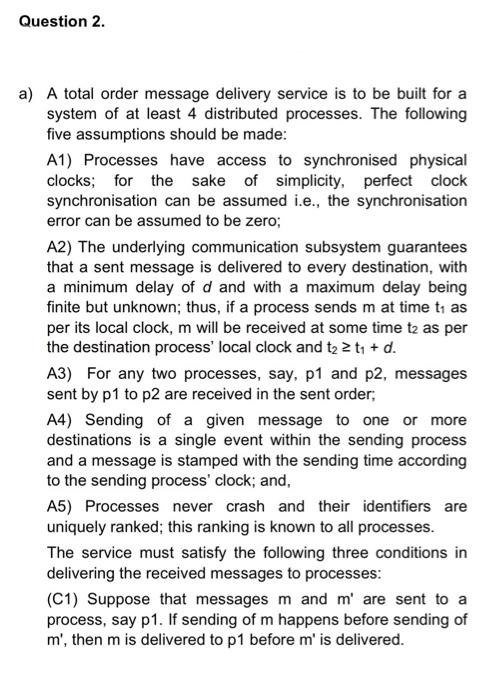
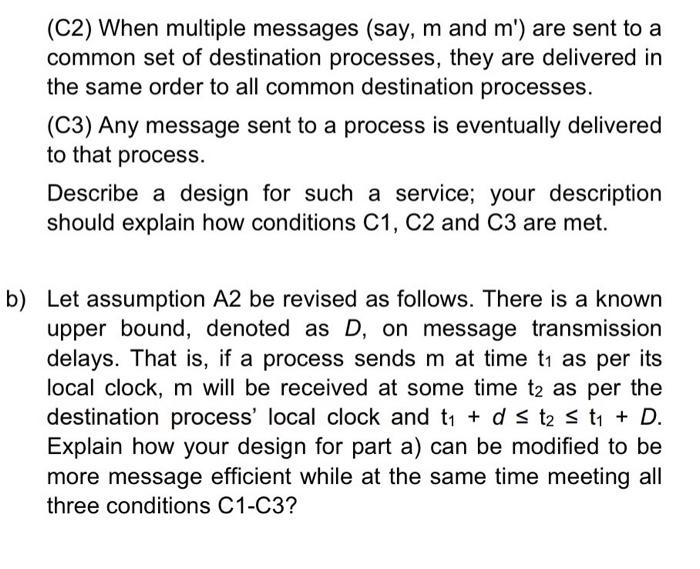
Question 2. a) A total order message delivery service is to be built for a system of at least 4 distributed processes. The following five assumptions should be made: A1) Processes have access to synchronised physical clocks; for the sake of simplicity, perfect clock synchronisation can be assumed i.e., the synchronisation error can be assumed to be zero; A2) The underlying communication subsystem guarantees that a sent message is delivered to every destination, with a minimum delay of d and with a maximum delay being finite but unknown; thus, if a process sends m at time ty as per its local clock, m will be received at some time tz as per the destination process' local clock and tz 2 t. + d. A3) For any two processes, say, p1 and p2, messages sent by p1 to p2 are received in the sent order, A4) Sending of a given message to one or more destinations is a single event within the sending process and a message is stamped with the sending time according to the sending process' clock; and, A5) Processes never crash and their identifiers are uniquely ranked; this ranking is known to all processes. The service must satisfy the following three conditions in delivering the received messages to processes: (C1) Suppose that messages m and m' are sent to a process, say p1. If sending of m happens before sending of m', then m is delivered to p1 before m' is delivered. (C2) When multiple messages (say, m and m') are sent to a common set of destination processes, they are delivered in the same order to all common destination processes. (C3) Any message sent to a process is eventually delivered to that process. Describe a design for such a service; your description should explain how conditions C1, C2 and C3 are met. b) Let assumption A2 be revised as follows. There is a known upper bound, denoted as D, on message transmission delays. That is, if a process sends m at time ti as per its local clock, m will be received at some time tz as per the destination process' local clock and 11 + d s tz s t1 + D. Explain how your design for part a) can be modified to be more message efficient while at the same time meeting all three conditions C1-C3? Question 2. a) A total order message delivery service is to be built for a system of at least 4 distributed processes. The following five assumptions should be made: A1) Processes have access to synchronised physical clocks; for the sake of simplicity, perfect clock synchronisation can be assumed i.e., the synchronisation error can be assumed to be zero; A2) The underlying communication subsystem guarantees that a sent message is delivered to every destination, with a minimum delay of d and with a maximum delay being finite but unknown; thus, if a process sends m at time ty as per its local clock, m will be received at some time tz as per the destination process' local clock and tz 2 t. + d. A3) For any two processes, say, p1 and p2, messages sent by p1 to p2 are received in the sent order, A4) Sending of a given message to one or more destinations is a single event within the sending process and a message is stamped with the sending time according to the sending process' clock; and, A5) Processes never crash and their identifiers are uniquely ranked; this ranking is known to all processes. The service must satisfy the following three conditions in delivering the received messages to processes: (C1) Suppose that messages m and m' are sent to a process, say p1. If sending of m happens before sending of m', then m is delivered to p1 before m' is delivered. (C2) When multiple messages (say, m and m') are sent to a common set of destination processes, they are delivered in the same order to all common destination processes. (C3) Any message sent to a process is eventually delivered to that process. Describe a design for such a service; your description should explain how conditions C1, C2 and C3 are met. b) Let assumption A2 be revised as follows. There is a known upper bound, denoted as D, on message transmission delays. That is, if a process sends m at time ti as per its local clock, m will be received at some time tz as per the destination process' local clock and 11 + d s tz s t1 + D. Explain how your design for part a) can be modified to be more message efficient while at the same time meeting all three conditions C1-C3
Step by Step Solution
There are 3 Steps involved in it

Get step-by-step solutions from verified subject matter experts
 Study Help