





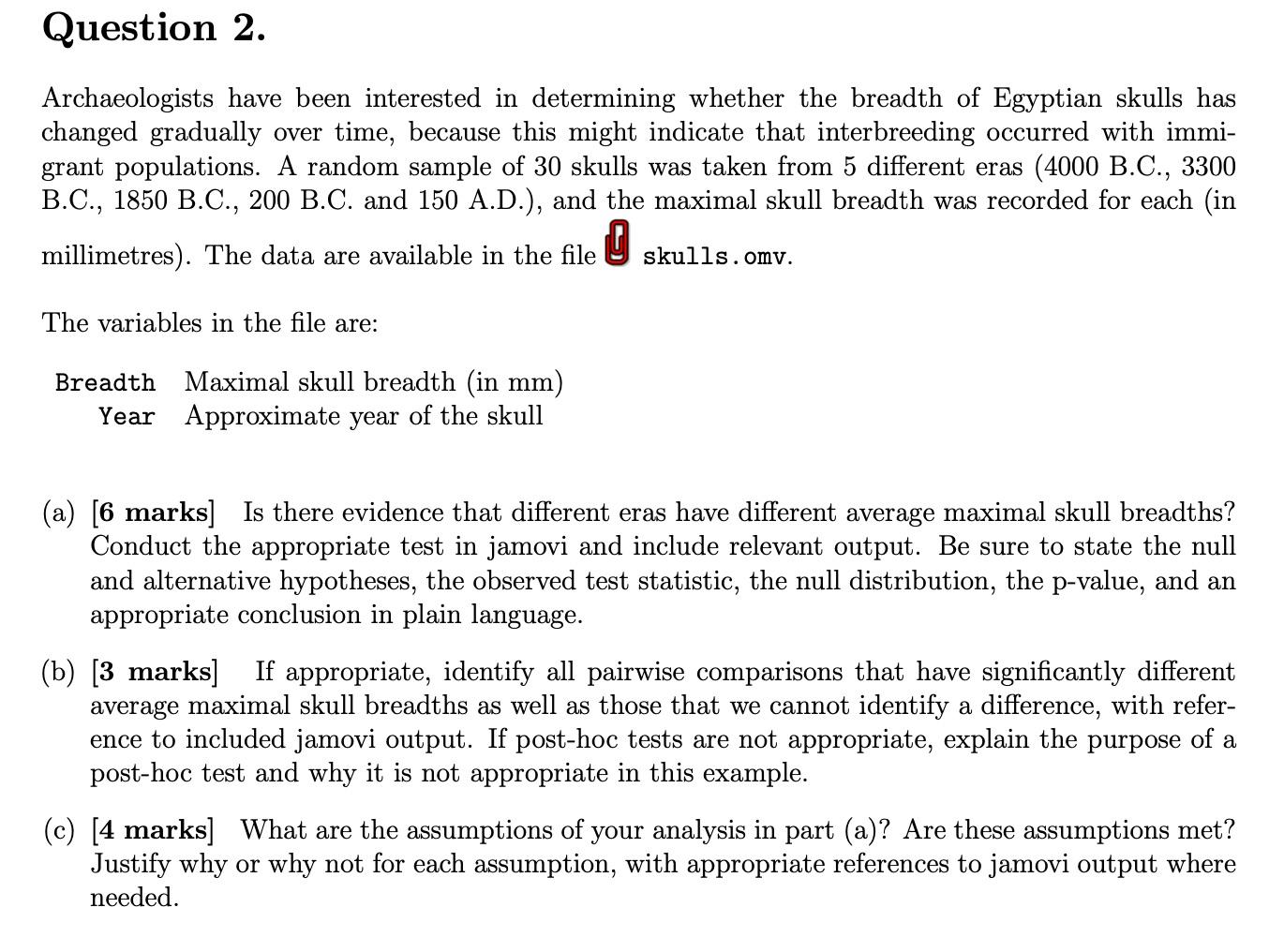
Question: Question 2. Archaeologists have been interested in determining whether the breadth of Egyptian skulls has changed gradually over time, because this might indicate that interbreeding
Question 2. Archaeologists have been interestedQuestion 2. Archaeologists have been interested

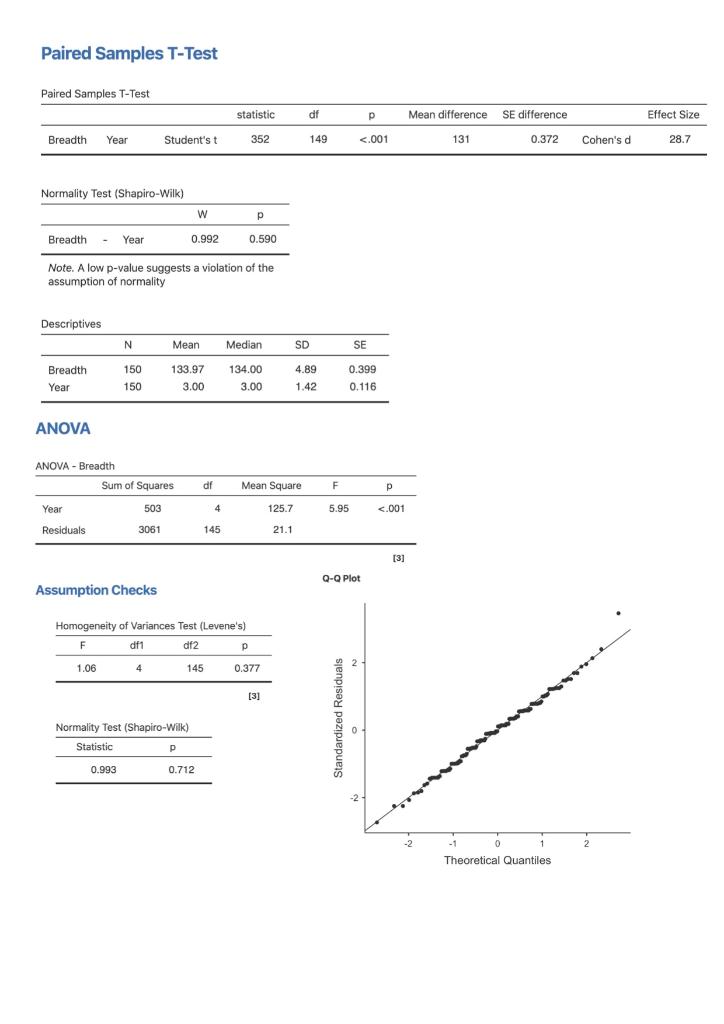
Question 2. Archaeologists have been interested in determining whether the breadth of Egyptian skulls has changed gradually over time, because this might indicate that interbreeding occurred with immi- grant populations. A random sample of 30 skulls was taken from 5 different eras (4000 B.C., 3300 B.C., 1850 B.C., 200 B.C. and 150 A.D.), and the maximal skull breadth was recorded for each (in millimetres). The data are available in the file 0 skulls.omy. The variables in the file are: Breadth Maximal skull breadth (in mm) Year Approximate year of the skull (a) [6 marks] Is there evidence that different eras have different average maximal skull breadths? Conduct the appropriate test in jamovi and include relevant output. Be sure to state the null and alternative hypotheses, the observed test statistic, the null distribution, the p-value, and an appropriate conclusion in plain language. (b) [3 marks] If appropriate, identify all pairwise comparisons that have significantly different average maximal skull breadths as well as those that we cannot identify a difference, with refer- ence to included jamovi output. If post-hoc tests are not appropriate, explain the purpose of a post-hoc test and why it is not appropriate in this example. (c) [4 marks] What are the assumptions of your analysis in part (a)? Are these assumptions met? Justify why or why not for each assumption, with appropriate references to jamovi output where needed. Paired Samples T-Test Paired Samples T-Test statistic df p Mean difference SE difference Effect Size Breadth Year Student'st 352 149 <.001 cohen d normality test w p breadth year note. a low p-value suggests violation of the assumption descriptives n mean median sd se anova sum squares df square f residuals q-plot checks homogeneity variances df1 df2 standardized statistic theoretical quantiles question archaeologists have been interested in determining whether egyptian skulls has changed gradually over time because this might indicate that interbreeding occurred with immi- grant populations. random sample was taken from different eras b.c. and a.d. maximal skull recorded for each millimetres data are available file skulls.omy. variables are: mm approximate marks is there evidence average breadths conduct appropriate jamovi include relevant output. be sure to state null alternative hypotheses observed distribution an conclusion plain language. if identify all pairwise comparisons significantly as well those we cannot difference refer- ence included post-hoc tests not explain purpose why it example. what assumptions your analysis part these met justify or references output where needed. paired samples t-test effect size student>

Step by Step Solution

There are 3 Steps involved in it

1 Expert Approved Answer
Step: 1 Unlock blur-text-image

Question Has Been Solved by an Expert!

Get step-by-step solutions from verified subject matter experts

Step: 2 Unlock
Step: 3 Unlock

Students Have Also Explored These Related General Management Questions!