







Question: Question 2: Assume we have a CPU with 16-bit instruction (0-3 for Op-code, 4-15 for address). It is able to process signed integers (oth bit
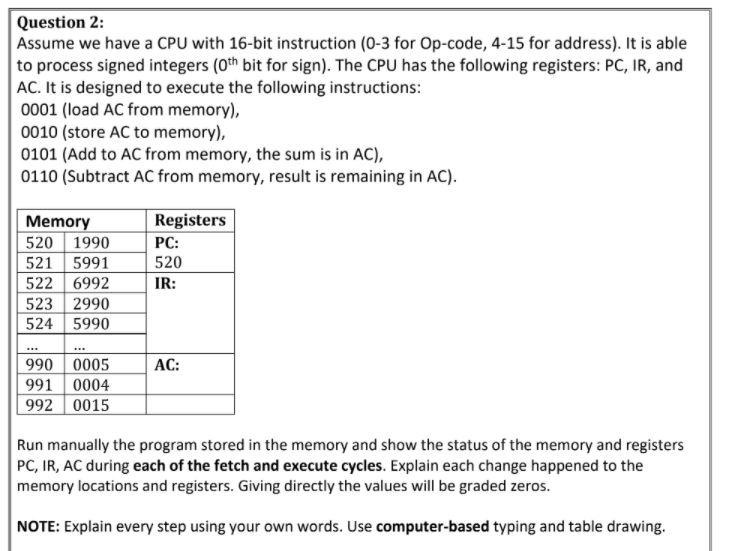
Question 2: Assume we have a CPU with 16-bit instruction (0-3 for Op-code, 4-15 for address). It is able to process signed integers (oth bit for sign). The CPU has the following registers: PC, IR, and AC. It is designed to execute the following instructions: 0001 (load AC from memory), 0010 (store AC to memory), 0101 (Add to AC from memory, the sum is in AC), 0110 (Subtract AC from memory, result is remaining in AC). Memory 520 1990 521 5991 522 6992 523 2990 524 5990 Registers PC: 520 IR: AC: 990 0005 991 0004 992 0015 Run manually the program stored in the memory and show the status of the memory and registers PC, IR, AC during each of the fetch and execute cycles. Explain each change happened to the memory locations and registers. Giving directly the values will be graded zeros. NOTE: Explain every step using your own words. Use computer-based typing and table drawing
Step by Step Solution
There are 3 Steps involved in it

Get step-by-step solutions from verified subject matter experts
 Study Help