







Question: Question 2: (Cheap talk game) A professor is asked by a potential employer to evaluate his student who is applying for a job with this
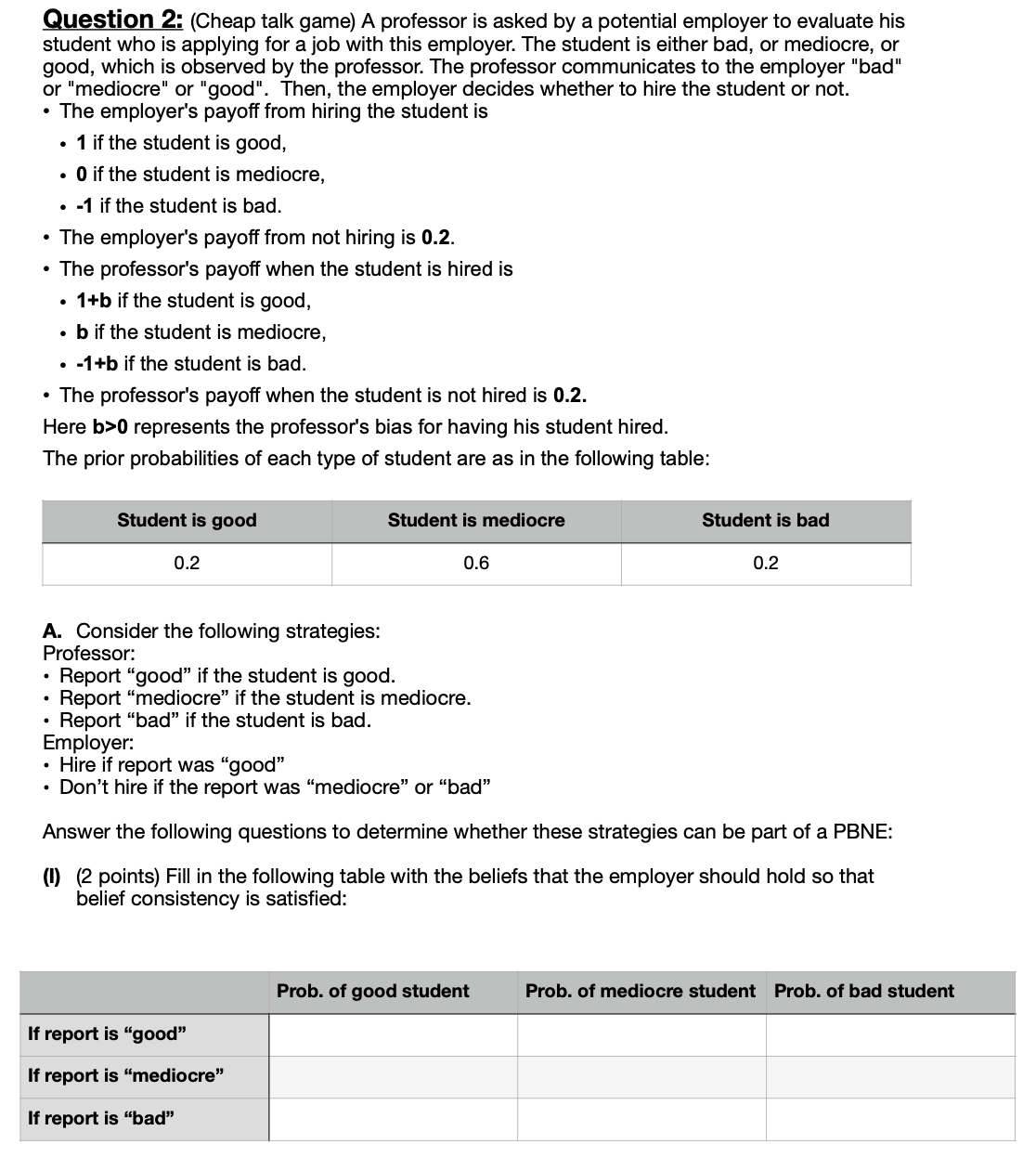
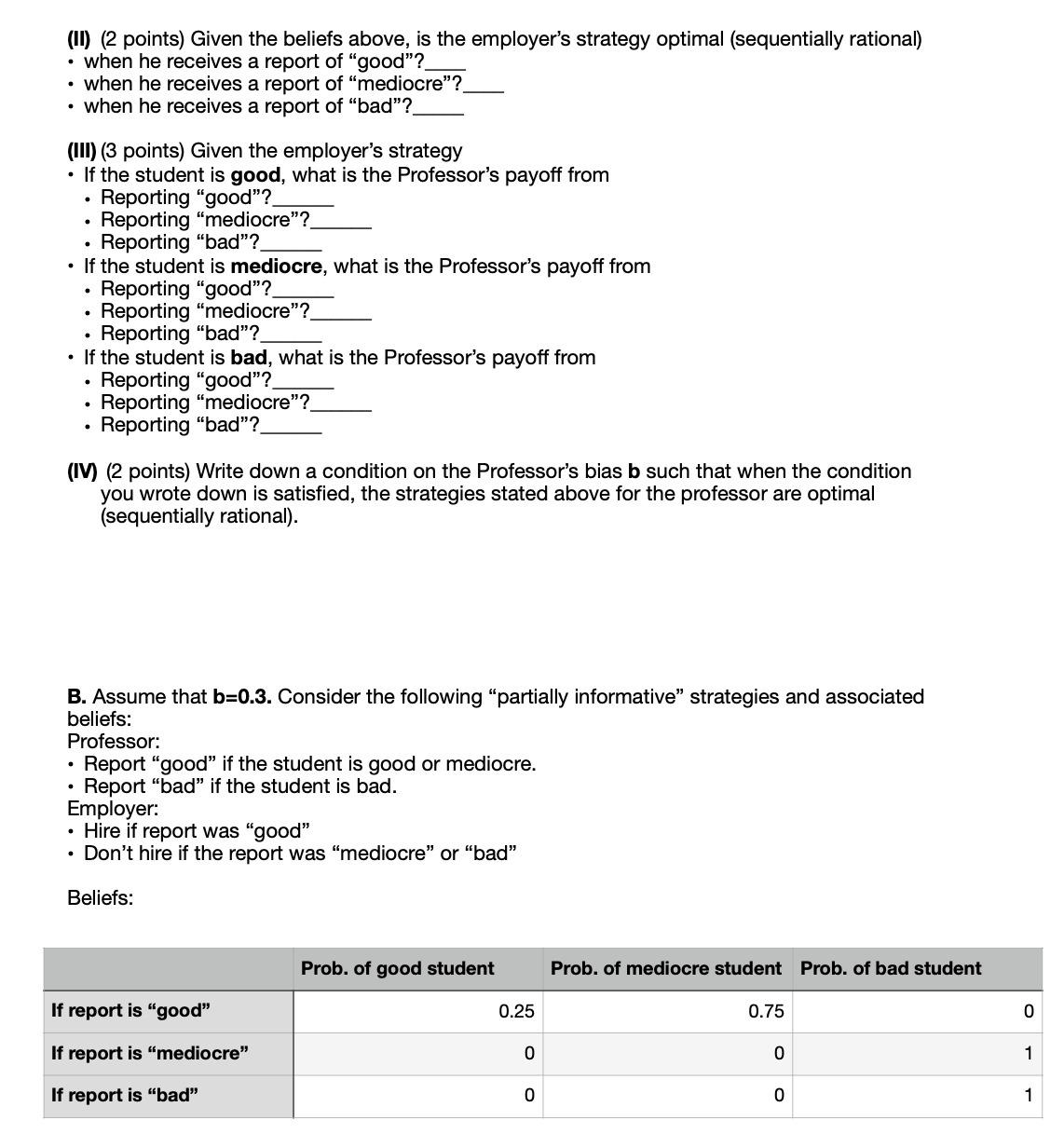
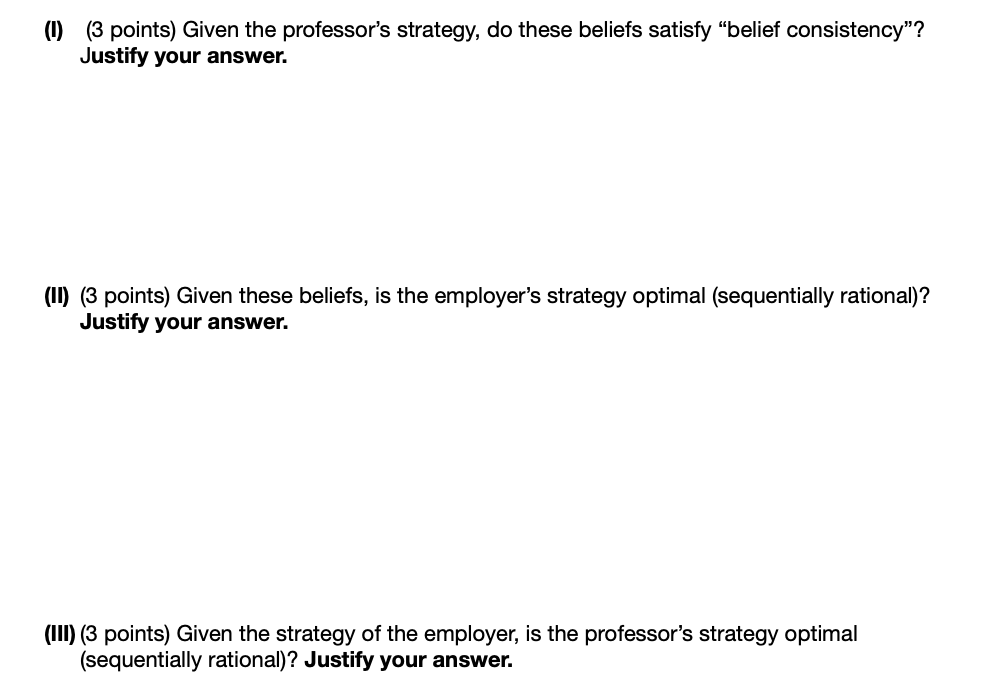
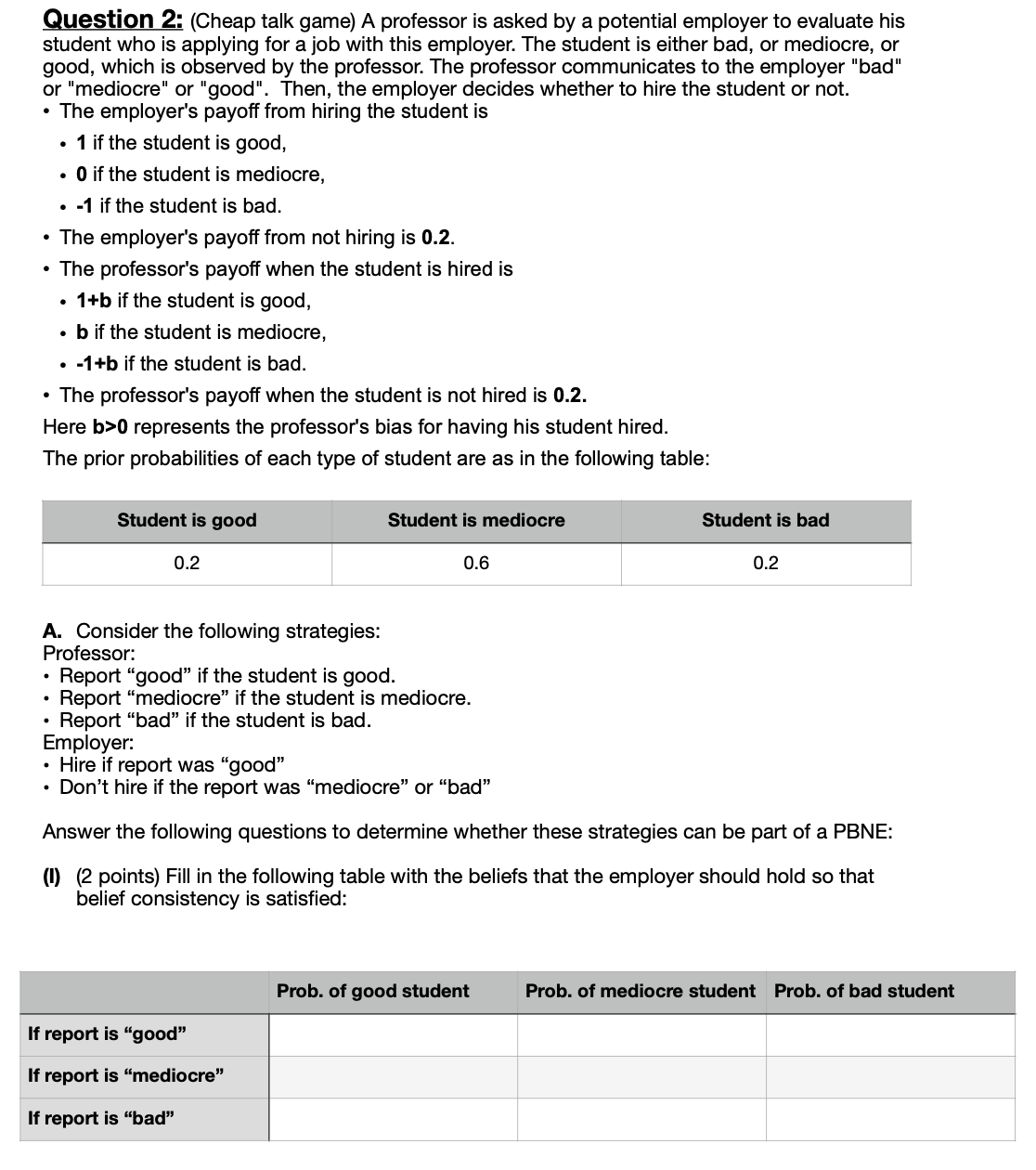
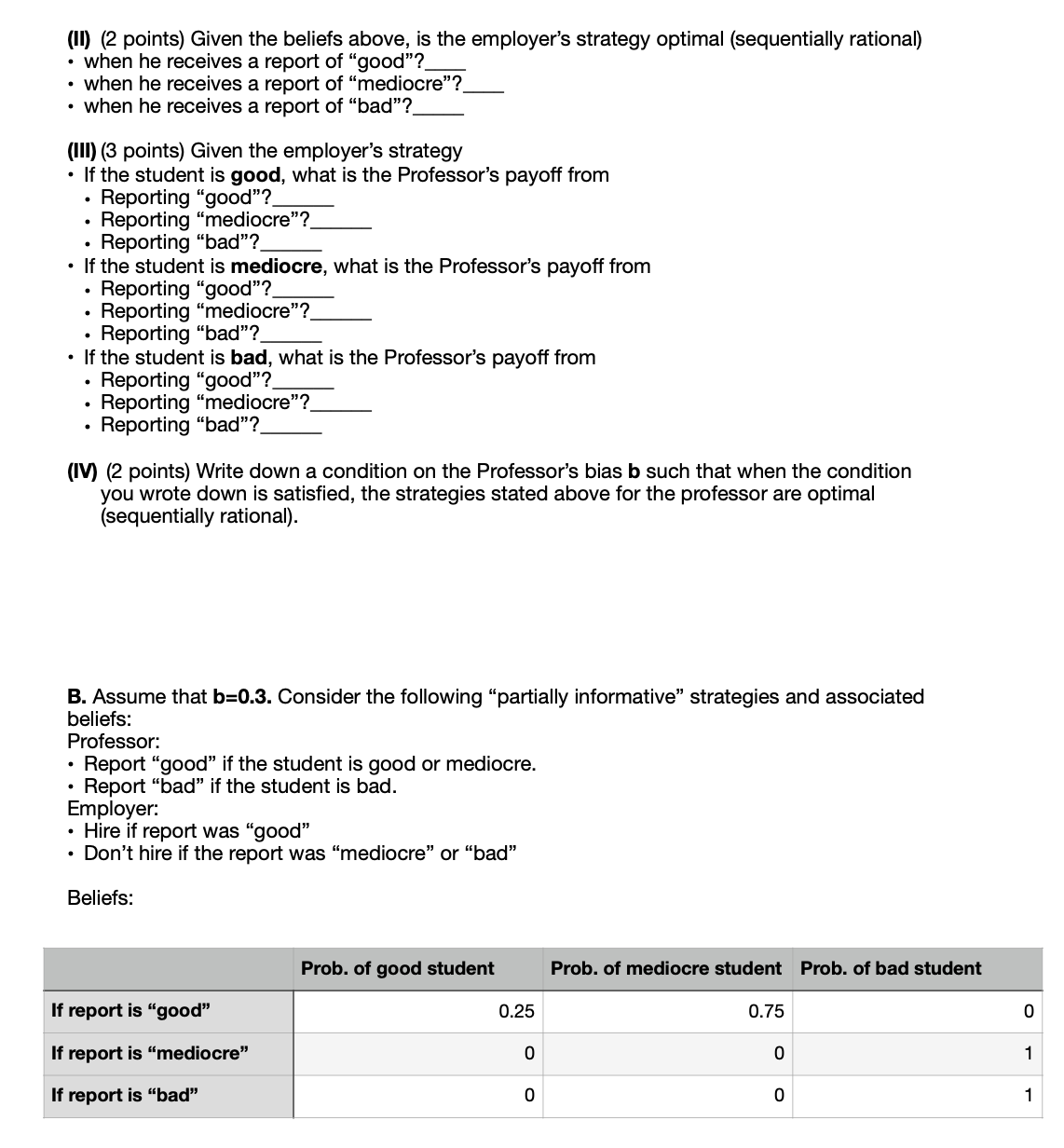
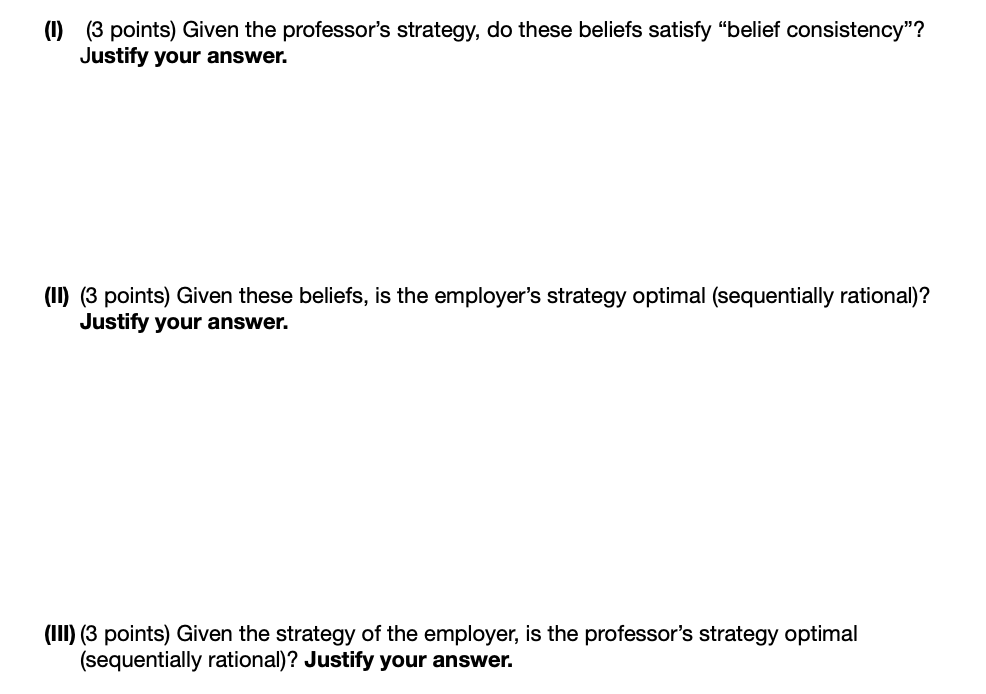
Question 2: (Cheap talk game) A professor is asked by a potential employer to evaluate his student who is applying for a job with this employer. The student is either bad, or mediocre, or good, which is observed by the professor. The professor communicates to the employer "bad" or "mediocre" or "good". Then, the employer decides whether to hire the student or not. * The employer's payoff from hiring the student is 1if the student is good, 0 if the student is mediocre, -1 if the student is bad. + The employer's payoff from not hiring is 0.2. The professor's payoff when the student is hired is 1+b if the student is good, b if the student is mediocre, =1+b if the student is bad. The professor's payoff when the student is not hired is 0.2. Here b>0 represents the professor's bias for having his student hired. The prior probabilities of each type of student are as in the following table: Student is good Student is mediocre Student is bad 0.2 0.6 0.2 A. Consider the following strategies: Professor: + Report \"good\" if the student is good. Report \"mediocre\" if the student is mediocre. + Report \"bad\" if the student is bad. Employer: Hire if report was \"good\" Don't hire if the report was \"mediocre\" or \"bad\" Answer the following questions to determine whether these strategies can be part of a PBNE: () (2 points) Fill in the following table with the beliefs that the employer should hold so that belief consistency is satisfied: Prob. of good student Prob. of mediocre student Prob. of bad student If report is \"good\" If report is \"mediocre\" If report is \"bad\" (1) (2 points) Given the beliefs above, is the employer's strategy optimal (sequentially rational) when he receives a report of \"good\"?____ when he receives a report of \"mediocre?___ when he receives a report of \"bad\"? (1) (3 points) Given the employer's strategy + If the student is good, what is the Professor's payoff from + Reporting \"good\"? - Reporting \"mediocre\"? Reporting \"bad\"? + If the student is mediocre, what is the Professor's payoff from - Reporting \"good\"? Reporting \"mediocre\"? - Reporting \"bad\"? + If the student is bad, what is the Professor's payoff from Reporting \"good\"? - Reporting \"mediocre\"? Reporting \"bad\"? (IV) (2 points) Write down a condition on the Professor's bias b such that when the condition you wrote down is satisfied, the strategies stated above for the professor are optimal (sequentially rational). B. Assume that b=0.3. Consider the following \"partially informative\" strategies and associated beliefs: Professor: + Report \"good\" if the student is good or mediocre. + Report \"bad\" if the student is bad. Employer: + Hire if report was \"good\" Don''t hire if the report was \"mediocre\" or \"bad\" Beliefs: Prob. of good student Prob. of mediocre student Prob. of bad student If report is \"good\" 0.25 0.75 0 If report is \"mediocre\" 0 0 1 If report is \"bad\" 0 0 1 (I) (3 points) Given the professor's strategy, do these beliefs satisfy \"belief consistency\"? Justify your answer. (I) (3 points) Given these beliefs, is the employer's strategy optimal (sequentially rational)? Justify your answer. (Im) (3 points) Given the strategy of the employer, is the professor's strategy optimal (sequentially rational)? Justify your
Step by Step Solution
There are 3 Steps involved in it

Get step-by-step solutions from verified subject matter experts
 Study Help