Question: question #2 - classifications are based on both cost and value of service. from the carriers standpoint, how has cost of service changed? Holala 244
question #2 - classifications are based on both cost and value of service. from the carriers standpoint, how has cost of service changed?
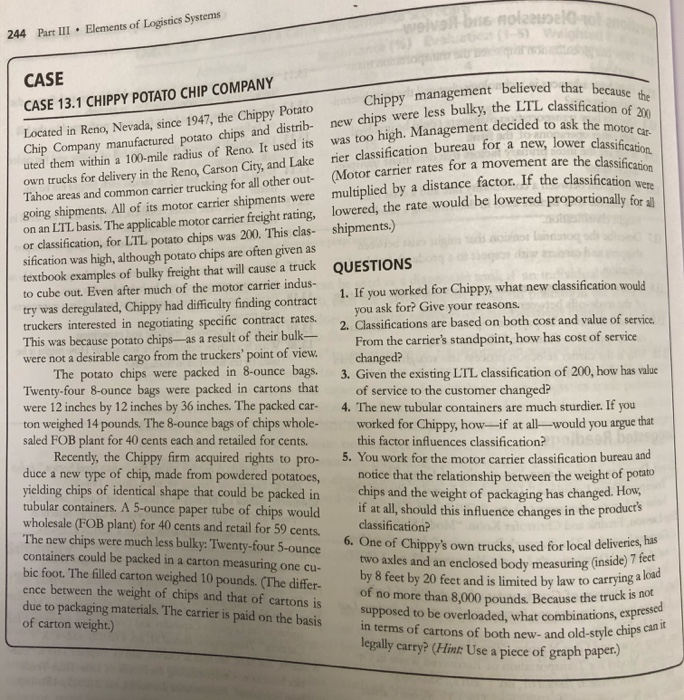
Holala 244 Part III. Elements of Logistics Systems CASE 13.1 CHIPPY POTATO CHIP COMPANY Located in Reno, Nevada, since 1947, the Chippy Potato Chip Company manufactured potato chips and distrib- uted them within a 100-mile radius of Reno. It used its LTL classification of 210 to ask the motor car- new, lower classification are the classification he classification were CASE v management believed that because new chips were less bulky, the LTL classid was too high. Management decided to ask the own trucks for delivery in the Reno, Carson City, and Lakerier classification bureau for a new, lower clas (Motor carrier rates for a movement are the clase Tahoe areas and common carrier trucking for all other out- multiplied by a distance factor. If the classificatie going shipments. All of its motor carrier shipments were lowered, the rate would be lowered proportionally for on an LTL basis. The applicable motor carrier freight rating, shipments.) or classification, for LTL potato chips was 200. This clas- sification was high, although potato chips are often given as textbook examples of bulky freight that will cause a truck QUESTIONS to cube out. Even after much of the motor carrier indus- 1. If you worked for Chippy, what new classification would try was deregulated, Chippy had difficulty finding contract you ask for? Give your reasons. truckers interested in negotiating specific contract rates. 2. Classifications are based on both cost and value of service. This was because potato chips-as a result of their bulk From the carrier's standpoint, how has cost of service were not a desirable cargo from the truckers' point of view. changed? The potato chips were packed in 8-ounce bags. 3. Given the existing LTL classification of 200, how has value Twenty-four 8-ounce bags were packed in cartons that of service to the customer changed? were 12 inches by 12 inches by 36 inches. The packed car. 4. The new tubular containers are much sturdier. If you ton weighed 14 pounds. The 8-ounce bags of chips whole worked for Chippy, how--if at all would you argue that saled FOB plant for 40 cents each and retailed for cents. this factor influences classification? Recently, the Chippy firm acquired rights to pro 5. You work for the motor carrier classification bureau and duce a new type of chip, made from powdered potatoes, notice that the relationship between the weight of potato yielding chips of identical shape that could be packed in tubular containers. A 5-ounce paper tube of chips would chips and the weight of packaging has changed. How, wholesale (FOB plant) for 40 cents and retail for 59 cents. if at all, should this influence changes in the products classification? 6. One of Chippy's own trucks, used for local deliveries, has two axles and an enclosed body measuring inside) by 8 feet by 20 feet and is limited by law to carrying a of no more than 8,000 pounds. Because the truck is of carton weight.) supposed to be overloaded, what combinations, expres in terms of cartons of both new and old-style chips legally carry? (Hint: Use a piece of graph paper.) The new chips were much less bulky: Twenty-four 5-ounce containers could be packed in a carton measuring one cu- bic foot. The filled carton weighed 10 pounds. (The differ- ence between the weight of chips and that of cartons is due to packaging materials. The carrier is paid on the basis style chips can it









 Study Help