







Question: Question 2 Consider the entry deterrence game in the context of two aluminum producers, Alcoa and UC RUSAL. The US aluminum market has inverse demand
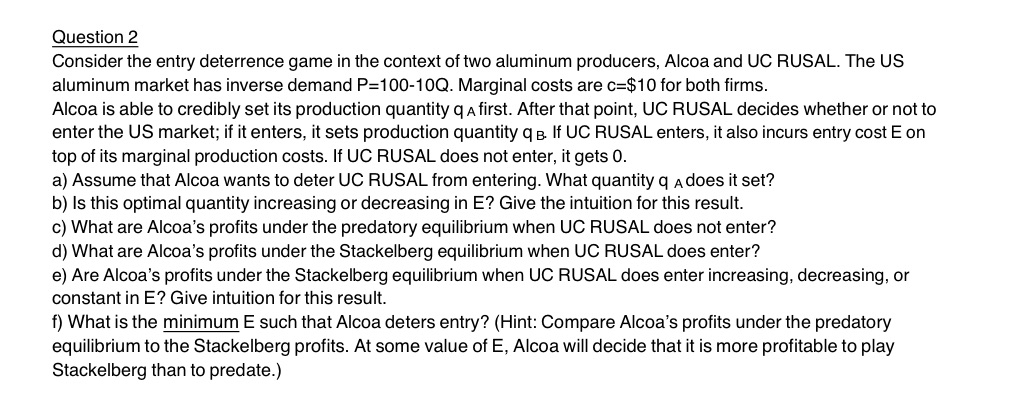
Question 2 Consider the entry deterrence game in the context of two aluminum producers, Alcoa and UC RUSAL. The US aluminum market has inverse demand P=100-10Q. Marginal costs are c=$10 for both firms. Alcoa is able to credibly set its production quantity q A first. After that point, UC RUSAL decides whether or not to enter the US market; if it enters, it sets production quantity q s. If UC RUSAL enters, it also incurs entry cost E on top of its marginal production costs. If UC RUSAL does not enter, it gets 0. a) Assume that Alcoa wants to deter UC RUSAL from entering. What quantity q A does it set? b) Is this optimal quantity increasing or decreasing in E? Give the intuition for this result. c) What are Alcoa's profits under the predatory equilibrium when UC RUSAL does not enter? d) What are Alcoa's profits under the Stackelberg equilibrium when UC RUSAL does enter? e) Are Alcoa's profits under the Stackelberg equilibrium when UC RUSAL does enter increasing, decreasing, or constant in E? Give intuition for this result. f) What is the minimum E such that Alcoa deters entry? (Hint: Compare Alcoa's profits under the predatory equilibrium to the Stackelberg profits. At some value of E, Alcoa will decide that it is more profitable to play Stackelberg than to predate.)
Step by Step Solution
There are 3 Steps involved in it

Get step-by-step solutions from verified subject matter experts
 Study Help