





Question: question #2 Consider the following four-step assembly operation with quality problems. All resources are staffed by one employee. The first resource has a processing time
question #2 Consider the following four-stepquestion #2 Consider the following four-step

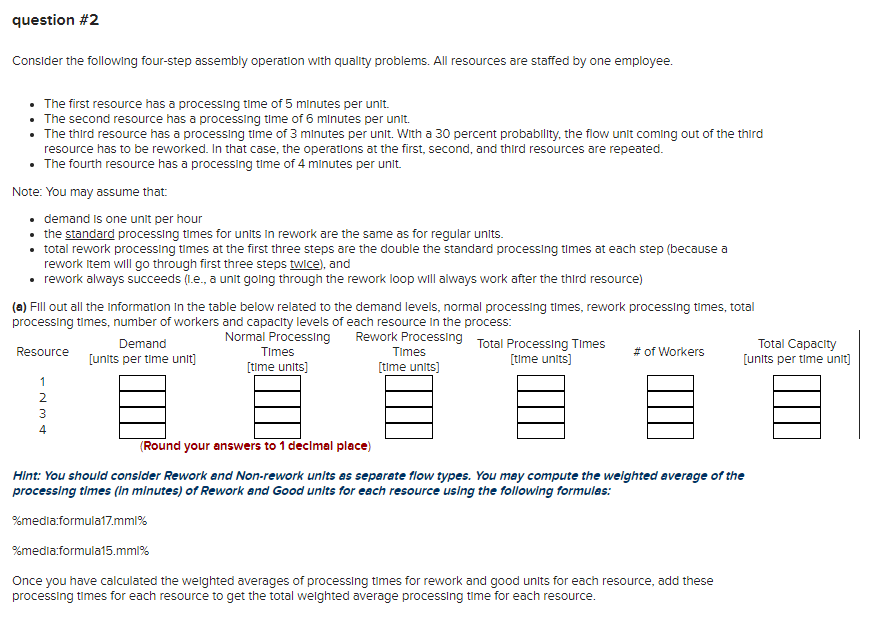
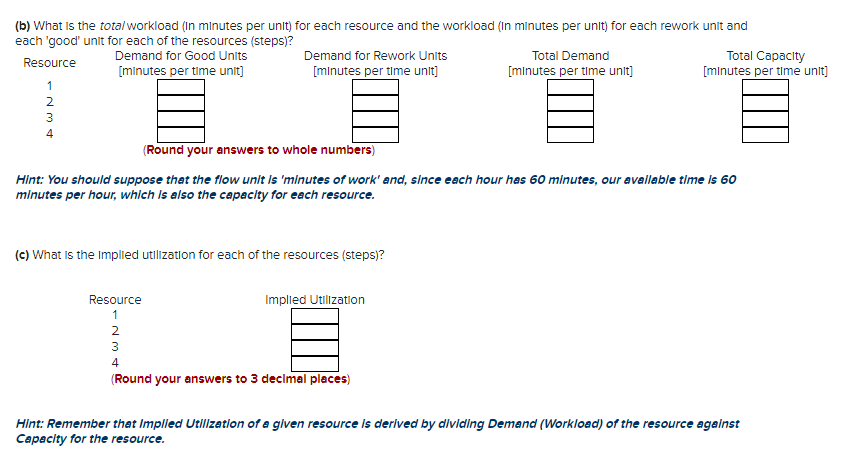
question #2 Consider the following four-step assembly operation with quality problems. All resources are staffed by one employee. The first resource has a processing time of 5 minutes per unit. The second resource has a processing time of 6 minutes per unit. . The third resource has a processing time of 3 minutes per unit. With a 30 percent probability, the flow unit coming out of the third resource has to be reworked. In that case, the operations at the first second, and third resources are repeated. The fourth resource has a processing time of 4 minutes per unit Note: You may assume that: demand is one unit per hour the standard processing times for units in rework are the same as for regular units. total rework processing times at the first three steps are the double the standard processing times at each step (because a rework item will go through first three steps twice), and rework always succeeds (l.e., a unit going through the rework loop will always work after the third resource) (a) Fill out all the information in the table below related to the demand levels, normal processing times, rework processing times, total processing times, number of workers and capacity levels of each resource in the process: Normal Processing Rework Processing Total Processing Times Demand Resource Total Capacity Times Times [units per time unit) # of Workers [time units] [units per time unit) [time units] [time units] 1 2 3 4 (Round your answers to 1 decimal place) Hint: You should consider Rework and Non-rework units as separate flow types. You may compute the weighted average of the processing times (in minutes) of Rework and Good units for each resource using the following formules: %media:formula17.mml% %media:formula15.mml% Once you have calculated the weighted averages of processing times for rework and good units for each resource, add these processing times for each resource to get the total weighted average processing time for each resource. (b) What is the total workload (in minutes per unit) for each resource and the workload (in minutes per unit) for each rework unit and each 'good' unit for each of the resources (steps)? Resource Demand for Good Units Demand for Rework Units Total Demand Total Capacity [minutes per time unit) [minutes per time unit] [minutes per time unit] [minutes per time unit] 1 NM 4 (Round your answers to whole numbers) Hint: You should suppose that the flow unit is 'minutes of work' and, since each hour has 60 minutes, our avallable time is 60 minutes per hour, which is also the capacity for each resource. (c) What is the Implied utilization for each of the resources (steps)? Resource Implied Utilization 1 2. 3 4 (Round your answers to 3 decimal places) Hint: Remember that Implied Utilization of a given resource is derived by dividing Demand (Workload) of the resource against Capacity for the resource

Step by Step Solution

There are 3 Steps involved in it

1 Expert Approved Answer
Step: 1 Unlock blur-text-image

Question Has Been Solved by an Expert!

Get step-by-step solutions from verified subject matter experts

Step: 2 Unlock
Step: 3 Unlock

Students Have Also Explored These Related General Management Questions!