







Question: Question #2: Floating Point Operations (30 points) You and your brother are working on control insects by embedding microprocessors in these insects. You are working
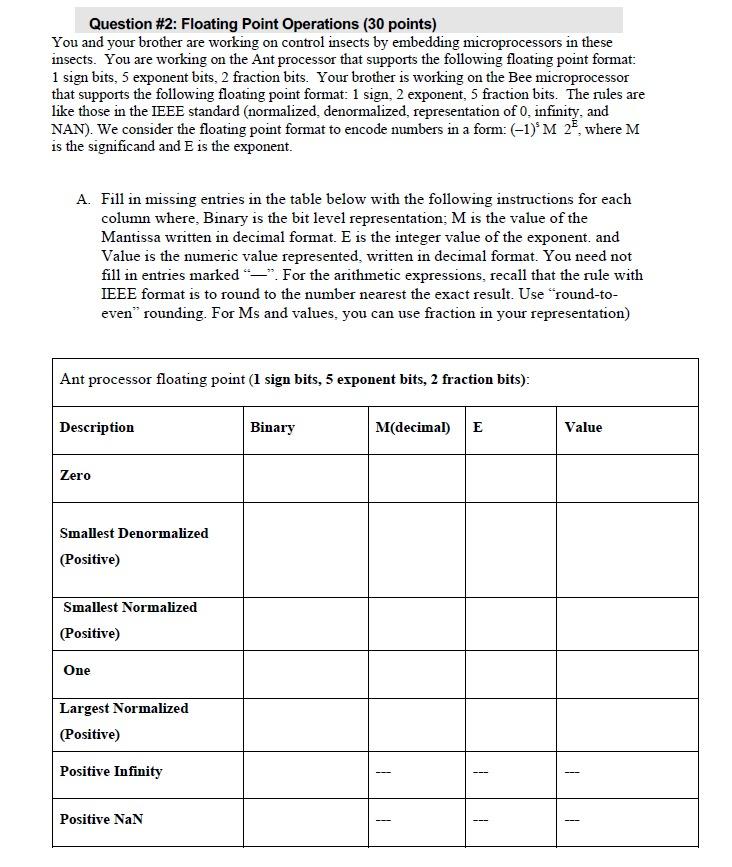
Question #2: Floating Point Operations (30 points) You and your brother are working on control insects by embedding microprocessors in these insects. You are working on the Ant processor that supports the following floating point format: 1 sign bits, 5 exponent bits, 2 fraction bits. Your brother is working on the Bee microprocessor that supports the following floating point format: 1 sign, 2 exponent, 5 fraction bits. The rules are like those in the IEEE standard (normalized, denormalized, representation of 0. infinity, and NAN). We consider the floating point format to encode numbers in a form: (-1) M 25, where M is the significand and E is the exponent. A. Fill in missing entries in the table below with the following instructions for each column where, Binary is the bit level representation; M is the value of the Mantissa written in decimal format. E is the integer value of the exponent. and Value is the numeric value represented, written in decimal format. You need not fill in entries marked" " For the arithmetic expressions, recall that the rule with IEEE format is to round to the number nearest the exact result. Use "round-to- even rounding. For Ms and values, you can use fraction in your representation) Ant processor floating point (1 sign bits, 5 esponent bits, 2 fraction bits): Description Binary M(decimal) E Value Zero Smallest Denormalized (Positive) Smallest Normalized (Positive) One Largest Normalized (Positive) Positive Infinity --- EE Positive NaN Question #2: Floating Point Operations (30 points) You and your brother are working on control insects by embedding microprocessors in these insects. You are working on the Ant processor that supports the following floating point format: 1 sign bits, 5 exponent bits, 2 fraction bits. Your brother is working on the Bee microprocessor that supports the following floating point format: 1 sign, 2 exponent, 5 fraction bits. The rules are like those in the IEEE standard (normalized, denormalized, representation of 0. infinity, and NAN). We consider the floating point format to encode numbers in a form: (-1) M 25, where M is the significand and E is the exponent. A. Fill in missing entries in the table below with the following instructions for each column where, Binary is the bit level representation; M is the value of the Mantissa written in decimal format. E is the integer value of the exponent. and Value is the numeric value represented, written in decimal format. You need not fill in entries marked" " For the arithmetic expressions, recall that the rule with IEEE format is to round to the number nearest the exact result. Use "round-to- even rounding. For Ms and values, you can use fraction in your representation) Ant processor floating point (1 sign bits, 5 esponent bits, 2 fraction bits): Description Binary M(decimal) E Value Zero Smallest Denormalized (Positive) Smallest Normalized (Positive) One Largest Normalized (Positive) Positive Infinity --- EE Positive NaN
Step by Step Solution
There are 3 Steps involved in it

Get step-by-step solutions from verified subject matter experts
 Study Help