







Question: Question 2 ( Flow sheeting ) Cellulosic Ethanol Production Cellulosic ethanol is a type of biofuel produced from lignocellulose, a material that comprises much of
Question Flow sheeting
Cellulosic Ethanol Production
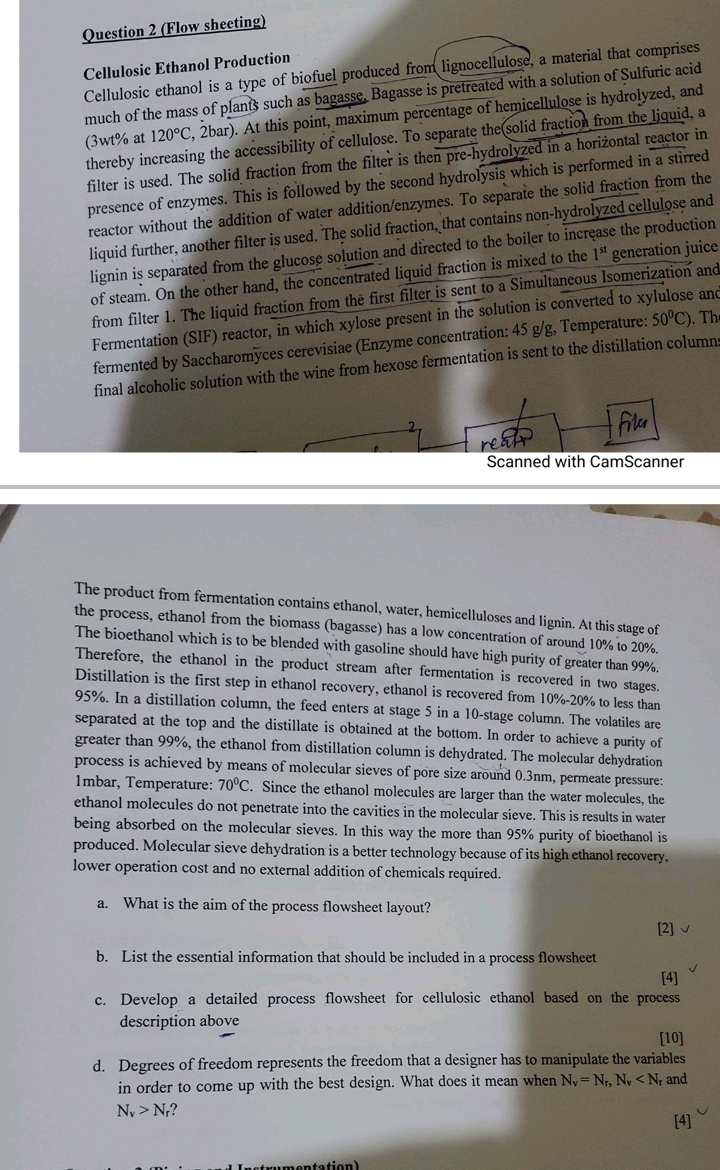
Cellulosic ethanol is a type of biofuel produced from lignocellulose, a material that comprises much of the mass of plants such as bagasse. Bagasse is pretreated with a solution of Sulfuric acid at : At this point, maximum percentage of hemicellulose is hydrolyzed, and thereby increasing the accessibility of cellulose. To separate the solid fraction from the liquid, a filter is used. The solid fraction from the filter is then prehydrolyzed in a horizontal reactor in presence of enzymes. This is followed by the second hydrolysis which is performed in a stirred reactor without the addition of water additionenzymes To separate the solid fraction from the liquid further, another filter is used. The solid fraction, that contains nonhydrolyzed cellulose and lignin is separated from the glucose solution and directed to the boiler to increase the production of steam. On the other hand, the concentrated liquid fraction is mixed to the generation juice from filter The liquid fraction from the first filter is sent to a Simultaneous Isomerization and Fermentation SIF reactor, in which xylose present in the solution is converted to xylulose anc fermented by Saccharomyces cerevisiae Enzyme concentration: Temperature: Th final alcoholic solution with the wine from hexose fermentation is sent to the distillation column
The product from fermentation contains ethanol, water, hemicelluloses and lignin. At this stage of the process, ethanol from the biomass bagasse has a low concentration of around to The bioethanol which is to be blended with gasoline should have high purity of greater than Therefore, the ethanol in the product stream after fermentation is recovered in two stages. Distillation is the first step in ethanol recovery, ethanol is recovered from to less than In a distillation column, the feed enters at stage in a stage column. The volatiles are separated at the top and the distillate is obtained at the bottom. In order to achieve a purity of greater than the ethanol from distillation column is dehydrated. The molecular dehydration process is achieved by means of molecular sieves of pore size around permeate pressure: Temperature: Since the ethanol molecules are larger than the water molecules, the ethanol molecules do not penetrate into the cavities in the molecular sieve. This is results in water being absorbed on the molecular sieves. In this way the more than purity of bioethanol is produced. Molecular sieve dehydration is a better technology because of its high ethanol recovery, lower operation cost and no external addition of chemicals required.
a What is the aim of the process flowsheet layout?
b List the essential information that should be included in a process flowsheet
b List the essential information that should be included in a process flowsheet
c Develop a detailed process flowsheet for cellulosic ethanol based on the process description above
d Degrees of freedom represents the freedom that a designer has to manipulate the variables in order to come up with the best design. What does it mean when and
Step by Step Solution
There are 3 Steps involved in it
1 Expert Approved Answer
Step: 1 Unlock

Question Has Been Solved by an Expert!
Get step-by-step solutions from verified subject matter experts
Step: 2 Unlock
Step: 3 Unlock
 Study Help