







Question: Question 2 For a radial cam-follower (flat-faced) mechanism shown below, the cam rotates at a constant angular velocity of 180 rpm (CW) and is
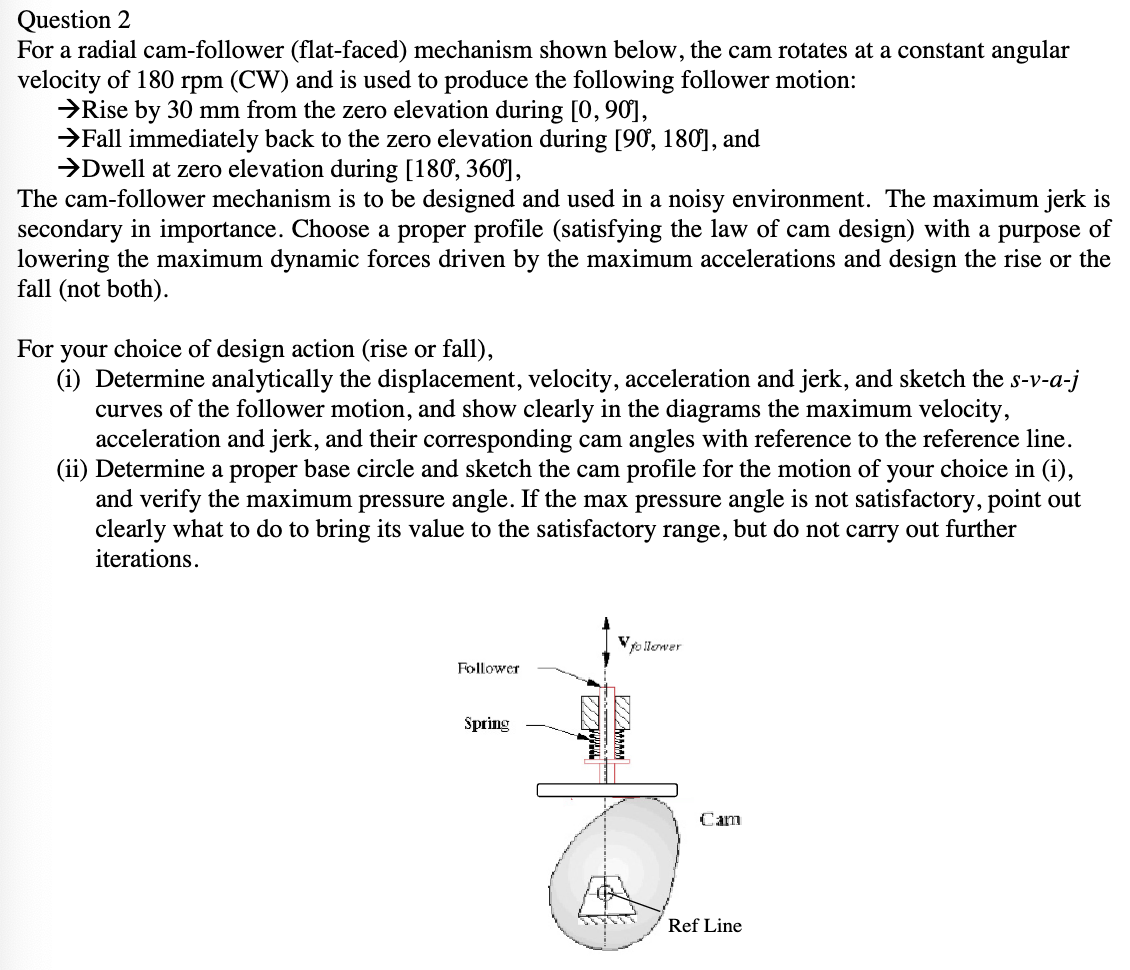
Question 2 For a radial cam-follower (flat-faced) mechanism shown below, the cam rotates at a constant angular velocity of 180 rpm (CW) and is used to produce the following follower motion: Rise by 30 mm from the zero elevation during [0, 90], Fall immediately back to the zero elevation during [90, 180], and Dwell at zero elevation during [180, 360], The cam-follower mechanism is to be designed and used in a noisy environment. The maximum jerk is secondary in importance. Choose a proper profile (satisfying the law of cam design) with a purpose of lowering the maximum dynamic forces driven by the maximum accelerations and design the rise or the fall (not both). For your choice of design action (rise or fall), (i) Determine analytically the displacement, velocity, acceleration and jerk, and sketch the s-v-a-j curves of the follower motion, and show clearly in the diagrams the maximum velocity, acceleration and jerk, and their corresponding cam angles with reference to the reference line. (ii) Determine a proper base circle and sketch the cam profile for the motion of your choice in (i), and verify the maximum pressure angle. If the max pressure angle is not satisfactory, point out clearly what to do to bring its value to the satisfactory range, but do not carry out further iterations. Wfollower Follower Spring Cam Ref Line
Step by Step Solution
There are 3 Steps involved in it
Solutions Step 1 We must examine the displacement velocity acceleration and jerk profiles in order to construct a radial camfollower system with a fla... View full answer

Get step-by-step solutions from verified subject matter experts
 Study Help