



Question: QUESTION 2 Formaldehyde is produced commercially by the catalytic oxidation of methanol. In a sido reaction, the methanol is oxidized to form CO2 CH3OH+02 CH20
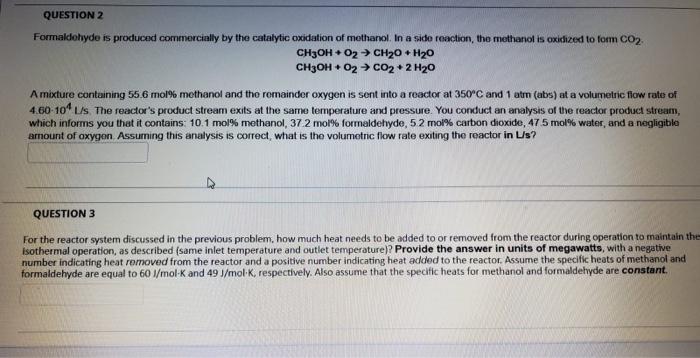
QUESTION 2 Formaldehyde is produced commercially by the catalytic oxidation of methanol. In a sido reaction, the methanol is oxidized to form CO2 CH3OH+02 CH20 + H20 CH3OH + O2 CO2 + 2H20 A mixture containing 55.6 mol% methanol and the remainder oxygen is sent into a reactor at 350C and 1 atm (abs) at a volumetric fiow rate of 4.60 10 us The reactor's product stream exits at the same temperature and pressure. You conduct an analysis of the reactor product stream, which informs you that it contains: 10.1 mol% methanol, 37 2 mol% formaldehyde, 52 mol% carbon dioxide, 47 5 mol% water, and a negligible amount of oxygen Assuming this analysis is correct, what is the volumetric flow rate exiting the reactor in Lis? QUESTION 3 For the reactor system discussed in the previous problem, how much heat needs to be added to or removed from the reactor during operation to maintain the isothermal operation, as described (same inlet temperature and outlet temperature)? Provide the answer in units of megawatts, with a negative number indicating heat removed from the reactor and a positive number indicating heat added to the reactor. Assume the specific heats of methanol and formaldehyde are equal to 60 1/mol-K and 49 1/mol, respectively. Also assume that the specific heats for methanol and formaldehyde are constant
Step by Step Solution
There are 3 Steps involved in it

Get step-by-step solutions from verified subject matter experts