







Question: Question 2 In this question, we'll consider a model with a risk-averse multi-tasking agent where the tasks have correlated noise. There is a principal and
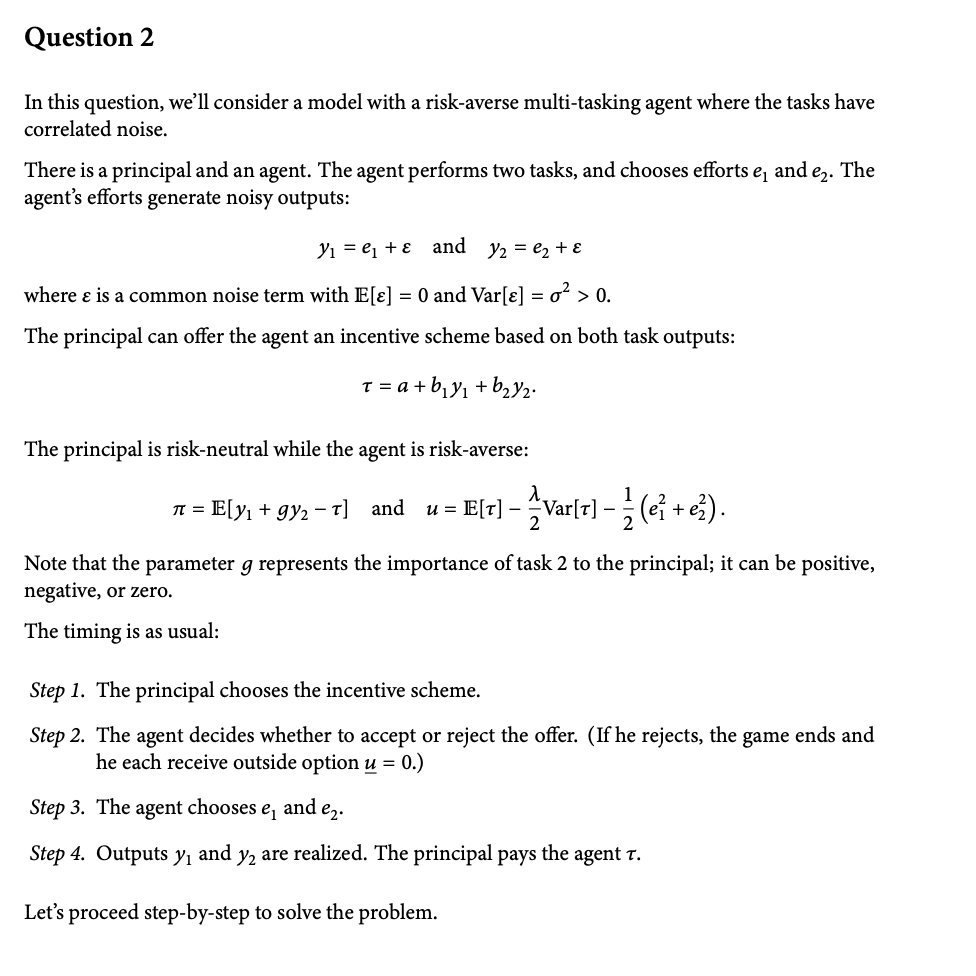
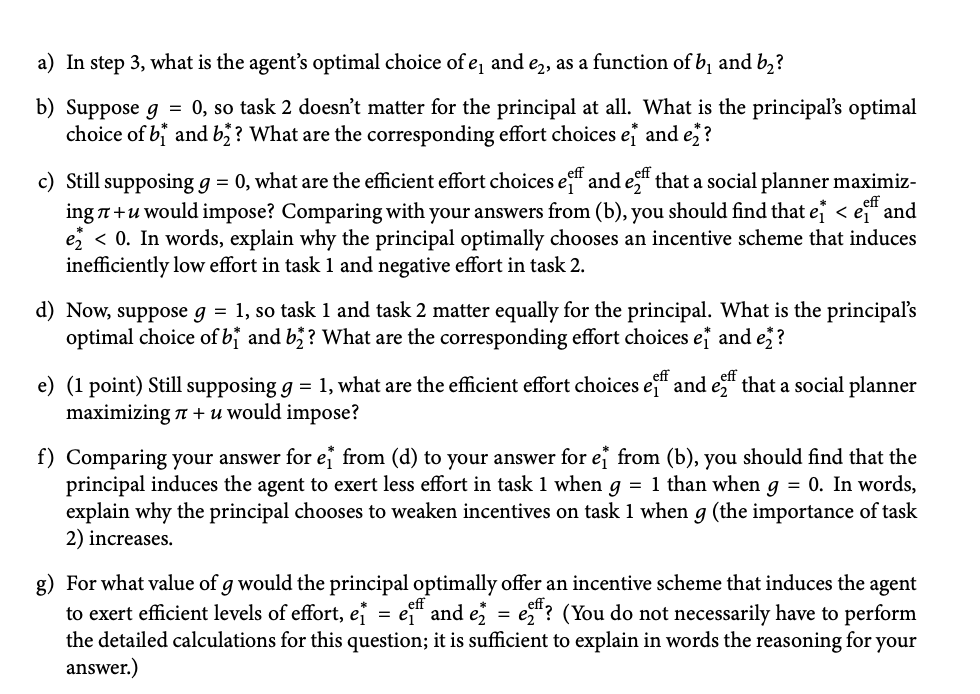
Question 2 In this question, we'll consider a model with a risk-averse multi-tasking agent where the tasks have correlated noise. There is a principal and an agent. The agent performs two tasks, and chooses efforts el and 82. The agent's efforts generate noisy outputs: y1=e1+ and y2=e2+e where e is a common noise term with ]E[e] = 0 and Var[e] = 02 > 0. The principal can offer the agent an incentive scheme based on both task outputs: 1' =a+b1yl +52\". The principal is risk-neutral while the agent is risk-averse: ll 1 2 2 I: = ]E[y1+ 9y; 1'] and u = ]E[1'] EVarh] 5(81+8 ). Note that the parameter 9 represents the importance of task 2 to the principal; it can be positive, negative, or zero. The timing is as usual: Step 1. The principal chooses the incentive scheme. Step 2. The agent decides whether to accept or reject the offer. (If he rejects, the game ends and he each receive outside option g = 0.) Step 3. The agent chooses "31 and 82. Step 4. Outputs yl and y; are realized. The principal pays the agent 1'. Let's proceed step-by-step to solve the problem. a) b) C) d) In step 3, what is the agent's optimal choice of 81 and 82, as a function of 51 and b2? Suppose g = 0, so task 2 doesn't matter for the principal at all. What is the principal's optimal choice of bf and b; ? What are the corresponding effort choices 61' and e; ? Still supposing g = 0, what are the efficient effort choices ei and eff that a social planner maximiz- ing 3'! +1.: would impose? Comparing with your answers from (b), you should nd that e: c of and e;
Step by Step Solution
There are 3 Steps involved in it

Get step-by-step solutions from verified subject matter experts
 Study Help