







Question: Question 2 . Interpolation of Temperature Data In this question ( Question 2 ) we will use interpolation and root finding algorithms to analyze heat
Question Interpolation of Temperature Data
In this question Question we will use interpolation and root finding algorithms to analyze heat transfer in an
environmental application. Lakes in temperate climates can become thermally stratified during the summer: a layer
of warm buoyant water near the surface, called the epilimnion, overlies a layer of colder denser water near the bottom,
called the hypolimnion. The thermocline is a thin horizontal layer that separates the epilimnion and hypolimnion.
Quantifying thermal stratification by approximating the depth of the thermocline can be important when estimating
the impacts of pollution on a lake.
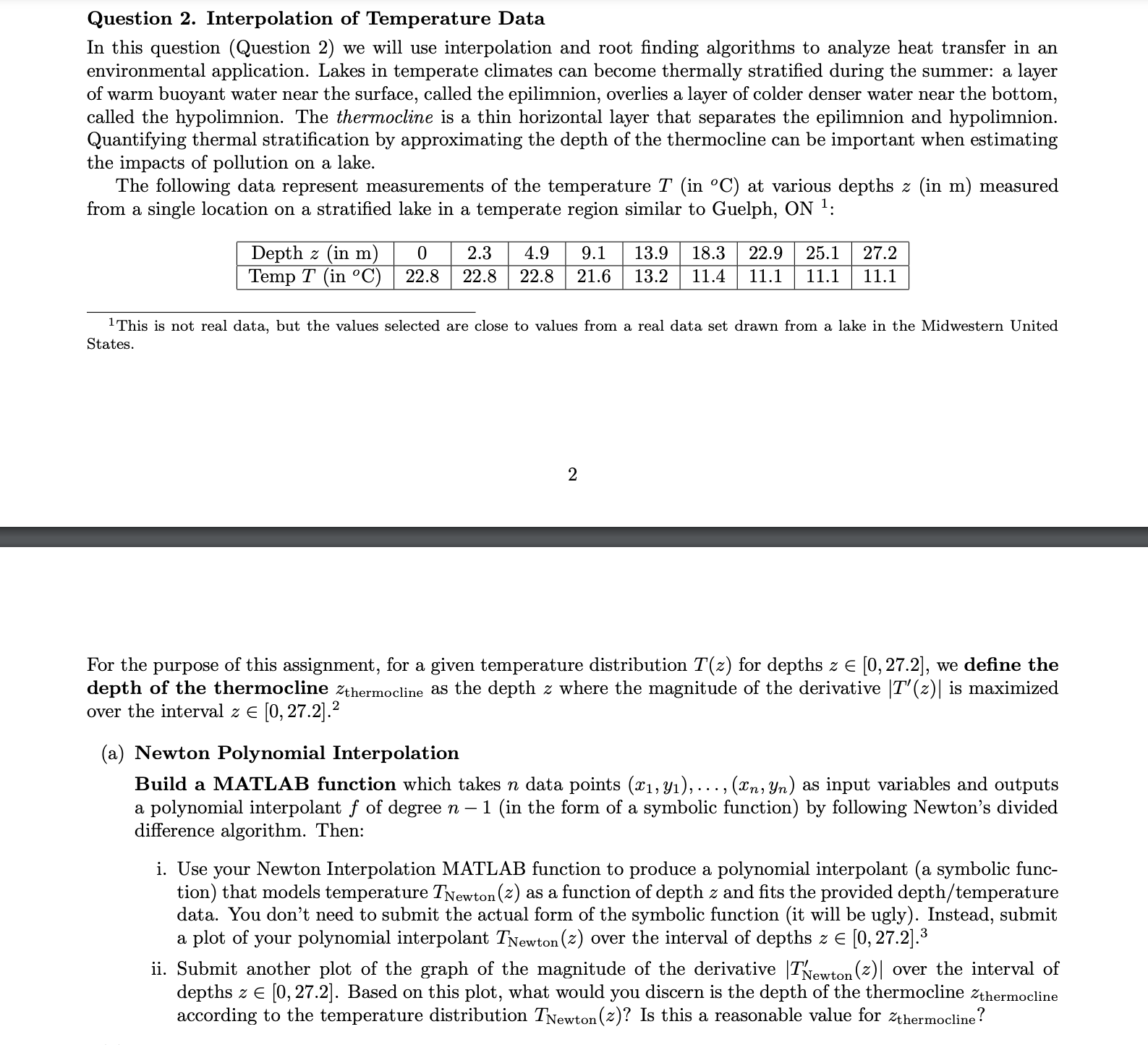
The following data represent measurements of the temperature in at various depths in measured
from a single location on a stratified lake in a temperate region similar to Guelph, :
This is not real data, but the values selected are close to values from a real data set drawn from a lake in the Midwestern United
States.
For the purpose of this assignment, for a given temperature distribution for depths zin we define the
depth of the thermocline as the depth where the magnitude of the derivative is maximized
over the interval zin
a Newton Polynomial Interpolation
Build a MATLAB function which takes data points dots, as input variables and outputs
a polynomial interpolant of degree in the form of a symbolic function by following Newton's divided
difference algorithm. Then:
i Use your Newton Interpolation MATLAB function to produce a polynomial interpolant a symbolic func
tion that models temperature as a function of depth and fits the provided depthtemperature
data. You don't need to submit the actual form of the symbolic function it will be ugly Instead, submit
a plot of your polynomial interpolant over the interval of depths zin
ii Submit another plot of the graph of the magnitude of the derivative over the interval of
depths zin Based on this plot, what would you discern is the depth of the thermocline
according to the temperature distribution Is this a reasonable value for
Step by Step Solution
There are 3 Steps involved in it
1 Expert Approved Answer
Step: 1 Unlock

Question Has Been Solved by an Expert!
Get step-by-step solutions from verified subject matter experts
Step: 2 Unlock
Step: 3 Unlock
 Study Help