







Question: visual basic Question 2: Interpolation Interpolation is a technique which you may have covered in stage 1, and you will certainly cover in stage 2
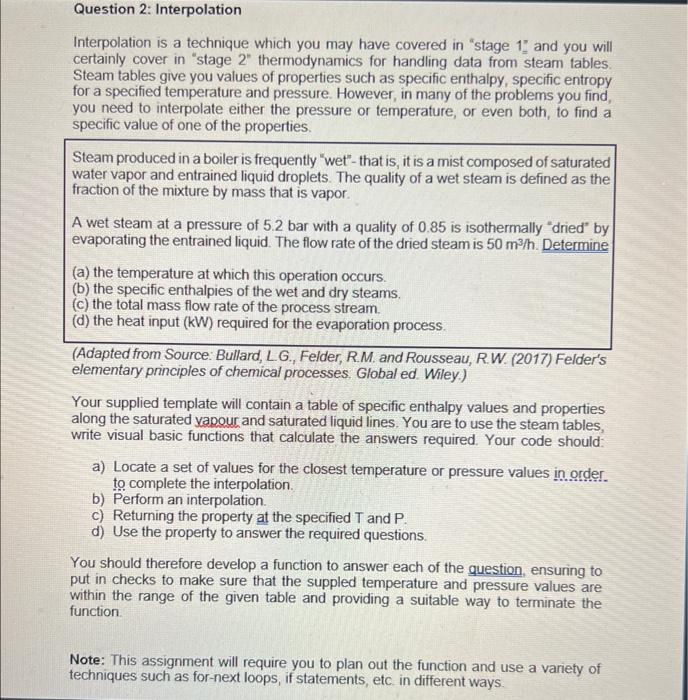
Question 2: Interpolation Interpolation is a technique which you may have covered in "stage 1", and you will certainly cover in "stage 2 " thermodynamics for handling data from steam tables. Steam tables give you values of properties such as specific enthalpy, specific entropy for a specified temperature and pressure. However, in many of the problems you find, you need to interpolate either the pressure or temperature, or even both, to find a specific value of one of the properties. Steam produced in a boiler is frequently "wet"- that is, it is a mist composed of saturated water vapor and entrained liquid droplets. The quality of a wet steam is defined as the fraction of the mixture by mass that is vapor. A wet steam at a pressure of 5.2 bar with a quality of 0.85 is isothermally "dried" by evaporating the entrained liquid. The flow rate of the dried steam is 50m3/h. Determine (a) the temperature at which this operation occurs. (b) the specific enthalpies of the wet and dry steams. (c) the total mass flow rate of the process stream. (d) the heat input (kW ) required for the evaporation process. (Adapted from Source: Bullard, L. G., Felder, R.M. and Rousseau, R.W. (2017) Felder's elementary principles of chemical processes, Global ed. Wiley.) Your supplied template will contain a table of specific enthalpy values and properties along the saturated yapour and saturated liquid lines. You are to use the steam tables, write visual basic functions that calculate the answers required. Your code should: a) Locate a set of values for the closest temperature or pressure values in order. to complete the interpolation. b) Perform an interpolation. c) Returning the property at the specified T and P. d) Use the property to answer the required questions. You should therefore develop a function to answer each of the question, ensuring to put in checks to make sure that the suppled temperature and pressure values are within the range of the given table and providing a suitable way to terminate the function. Note: This assignment will require you to plan out the function and use a variety of techniques such as for-next loops, if statements, etc in different ways. Question 2: Interpolation Interpolation is a technique which you may have covered in "stage 1", and you will certainly cover in "stage 2 " thermodynamics for handling data from steam tables. Steam tables give you values of properties such as specific enthalpy, specific entropy for a specified temperature and pressure. However, in many of the problems you find, you need to interpolate either the pressure or temperature, or even both, to find a specific value of one of the properties. Steam produced in a boiler is frequently "wet"- that is, it is a mist composed of saturated water vapor and entrained liquid droplets. The quality of a wet steam is defined as the fraction of the mixture by mass that is vapor. A wet steam at a pressure of 5.2 bar with a quality of 0.85 is isothermally "dried" by evaporating the entrained liquid. The flow rate of the dried steam is 50m3/h. Determine (a) the temperature at which this operation occurs. (b) the specific enthalpies of the wet and dry steams. (c) the total mass flow rate of the process stream. (d) the heat input (kW ) required for the evaporation process. (Adapted from Source: Bullard, L. G., Felder, R.M. and Rousseau, R.W. (2017) Felder's elementary principles of chemical processes, Global ed. Wiley.) Your supplied template will contain a table of specific enthalpy values and properties along the saturated yapour and saturated liquid lines. You are to use the steam tables, write visual basic functions that calculate the answers required. Your code should: a) Locate a set of values for the closest temperature or pressure values in order. to complete the interpolation. b) Perform an interpolation. c) Returning the property at the specified T and P. d) Use the property to answer the required questions. You should therefore develop a function to answer each of the question, ensuring to put in checks to make sure that the suppled temperature and pressure values are within the range of the given table and providing a suitable way to terminate the function. Note: This assignment will require you to plan out the function and use a variety of techniques such as for-next loops, if statements, etc in different ways
Step by Step Solution
There are 3 Steps involved in it

Get step-by-step solutions from verified subject matter experts
 Study Help