







Question: Question #2: Let's delve into the financial analysis. This is what I would call back-of-the-envelope analysis, so it's not complex. Based on the information provided
Question #2: Let's delve into the financial analysis. This is what I would call back-of-the-envelope analysis, so it's not complex.
- Based on the information provided in the case what is the overall size of the diaper market in Venezuela. By this I mean how many diapers (cases/5 per) could be sold in a year?
- Based on the pricing sensitivity analysis that Gomez performed what percentage of the market could maxiaNET capture at various prices? Pick a high price and a low price.
- How much money would maxiaNET make at each price you determined?
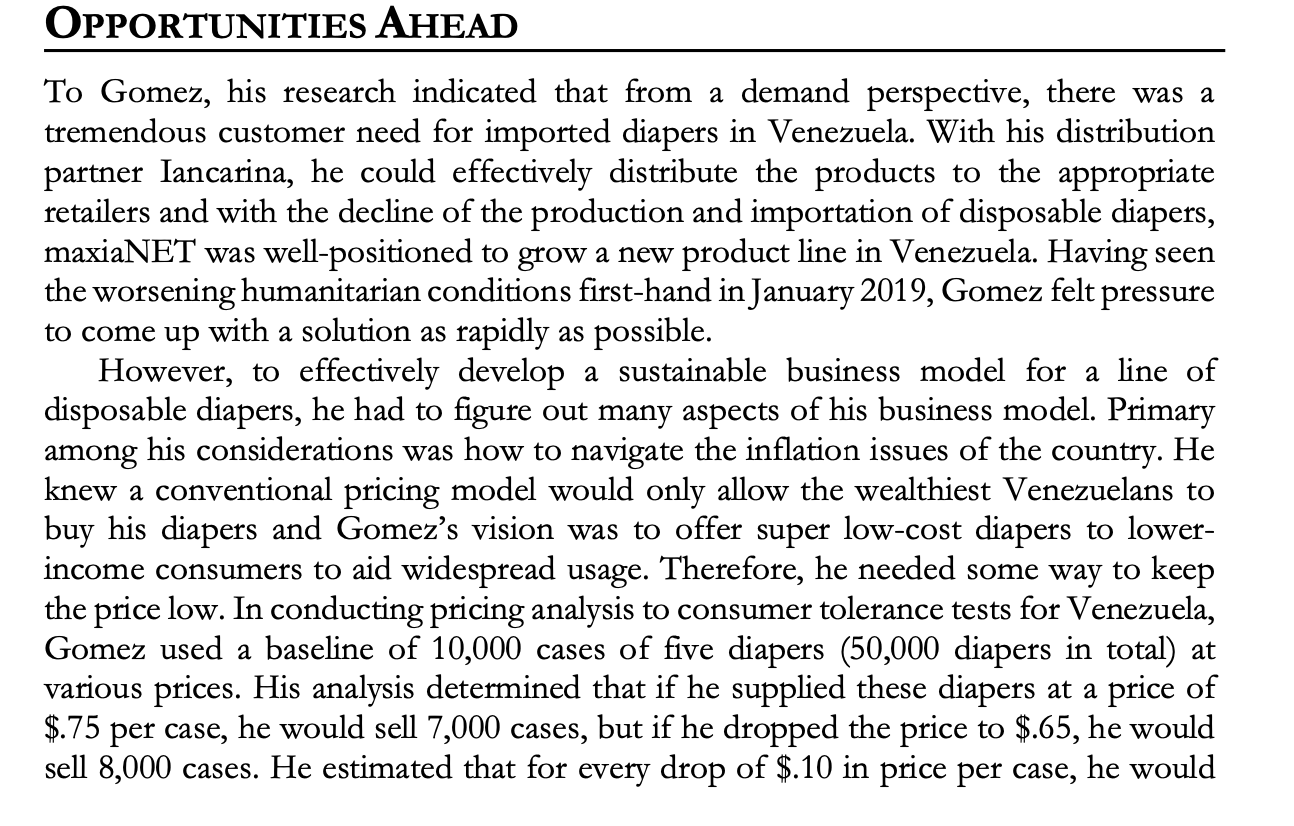
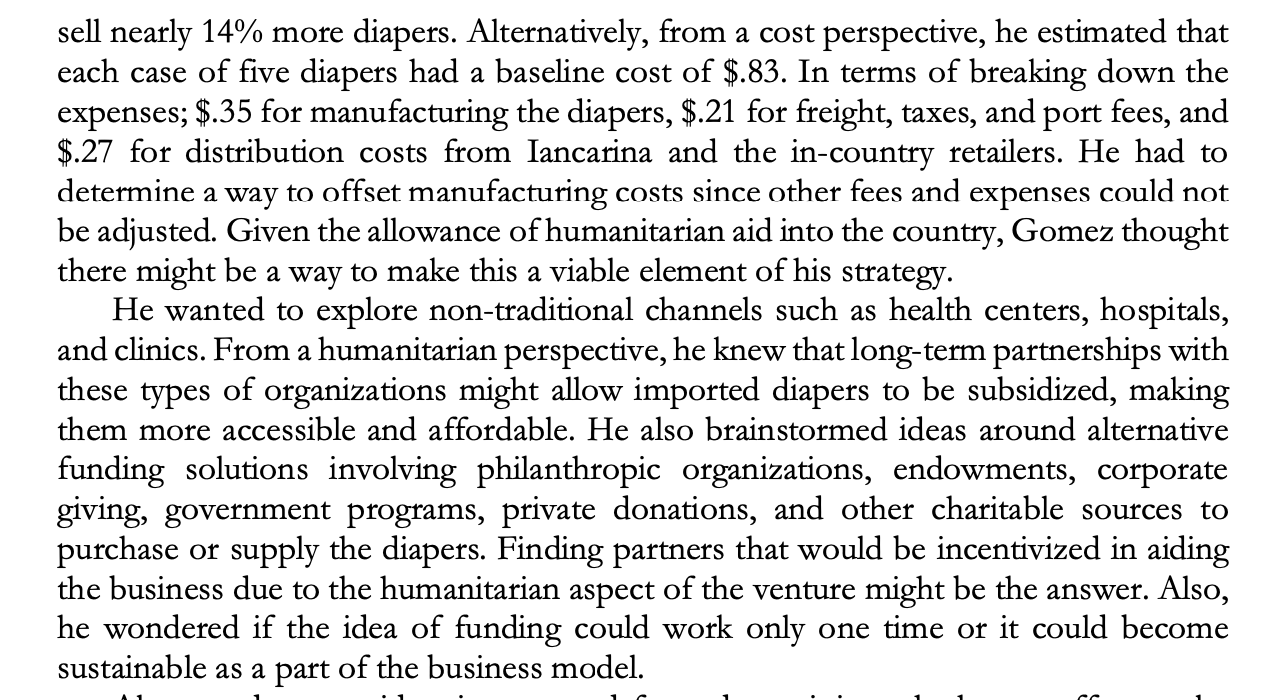
OPPORTUNITIES AHEAD To Gomez, his research indicated that from a demand perspective, there was a tremendous customer need for imported diapers in Venezuela. With his distribution partner Iancarina, he could effectively distribute the products to the appropriate retailers and with the decline of the production and importation of disposable diapers, maxiaNET was well-positioned to grow a new product line in Venezuela. Having seen the worsening humanitarian conditions first-hand in January 2019, Gomez felt pressure to come up with a solution as rapidly as possible. However, to effectively develop a sustainable business model for a line of disposable diapers, he had to figure out many aspects of his business model. Primary among his considerations was how to navigate the inflation issues of the country. He knew a conventional pricing model would only allow the wealthiest Venezuelans to buy his diapers and Gomez's vision was to offer super low-cost diapers to lower- income consumers to aid widespread usage. Therefore, he needed some way to keep the price low. In conducting pricing analysis to consumer tolerance tests for Venezuela, Gomez used a baseline of 10,000 cases of five diapers (50,000 diapers in total) at various prices. His analysis determined that if he supplied these diapers at a price of $.75 per case, he would sell 7,000 cases, but if he dropped the price to $.65, he would sell 8,000 cases. He estimated that for every drop of $.10 in price per case, he would a a sell nearly 14% more diapers. Alternatively, from a cost perspective, he estimated that each case of five diapers had a baseline cost of $.83. In terms of breaking down the expenses; $.35 for manufacturing the diapers, $.21 for freight, taxes, and port fees, and $.27 for distribution costs from Iancarina and the in-country retailers. He had to determine a way to offset manufacturing costs since other fees and expenses could not be adjusted. Given the allowance of humanitarian aid into the country, Gomez thought there might be a way to make this a viable element of his strategy. He wanted to explore non-traditional channels such as health centers, hospitals, and clinics. From a humanitarian perspective, he knew that long-term partnerships with these types of organizations might allow imported diapers to be subsidized, making them more accessible and affordable. He also brainstormed ideas around alternative funding solutions involving philanthropic organizations, endowments, corporate giving, government programs, private donations, and other charitable sources to purchase or supply the diapers. Finding partners that would be incentivized in aiding the business due to the humanitarian aspect of the venture might be the answer. Also, he wondered if the idea of funding could work only one time or it could become sustainable as a part of the business model. OPPORTUNITIES AHEAD To Gomez, his research indicated that from a demand perspective, there was a tremendous customer need for imported diapers in Venezuela. With his distribution partner Iancarina, he could effectively distribute the products to the appropriate retailers and with the decline of the production and importation of disposable diapers, maxiaNET was well-positioned to grow a new product line in Venezuela. Having seen the worsening humanitarian conditions first-hand in January 2019, Gomez felt pressure to come up with a solution as rapidly as possible. However, to effectively develop a sustainable business model for a line of disposable diapers, he had to figure out many aspects of his business model. Primary among his considerations was how to navigate the inflation issues of the country. He knew a conventional pricing model would only allow the wealthiest Venezuelans to buy his diapers and Gomez's vision was to offer super low-cost diapers to lower- income consumers to aid widespread usage. Therefore, he needed some way to keep the price low. In conducting pricing analysis to consumer tolerance tests for Venezuela, Gomez used a baseline of 10,000 cases of five diapers (50,000 diapers in total) at various prices. His analysis determined that if he supplied these diapers at a price of $.75 per case, he would sell 7,000 cases, but if he dropped the price to $.65, he would sell 8,000 cases. He estimated that for every drop of $.10 in price per case, he would a a sell nearly 14% more diapers. Alternatively, from a cost perspective, he estimated that each case of five diapers had a baseline cost of $.83. In terms of breaking down the expenses; $.35 for manufacturing the diapers, $.21 for freight, taxes, and port fees, and $.27 for distribution costs from Iancarina and the in-country retailers. He had to determine a way to offset manufacturing costs since other fees and expenses could not be adjusted. Given the allowance of humanitarian aid into the country, Gomez thought there might be a way to make this a viable element of his strategy. He wanted to explore non-traditional channels such as health centers, hospitals, and clinics. From a humanitarian perspective, he knew that long-term partnerships with these types of organizations might allow imported diapers to be subsidized, making them more accessible and affordable. He also brainstormed ideas around alternative funding solutions involving philanthropic organizations, endowments, corporate giving, government programs, private donations, and other charitable sources to purchase or supply the diapers. Finding partners that would be incentivized in aiding the business due to the humanitarian aspect of the venture might be the answer. Also, he wondered if the idea of funding could work only one time or it could become sustainable as a part of the business model
Step by Step Solution
There are 3 Steps involved in it

Get step-by-step solutions from verified subject matter experts
 Study Help