







Question: Question 2 (Marks: 50) Read the following case study on knowledge management in the banking industry and then answer the questions that follow: Extracts from
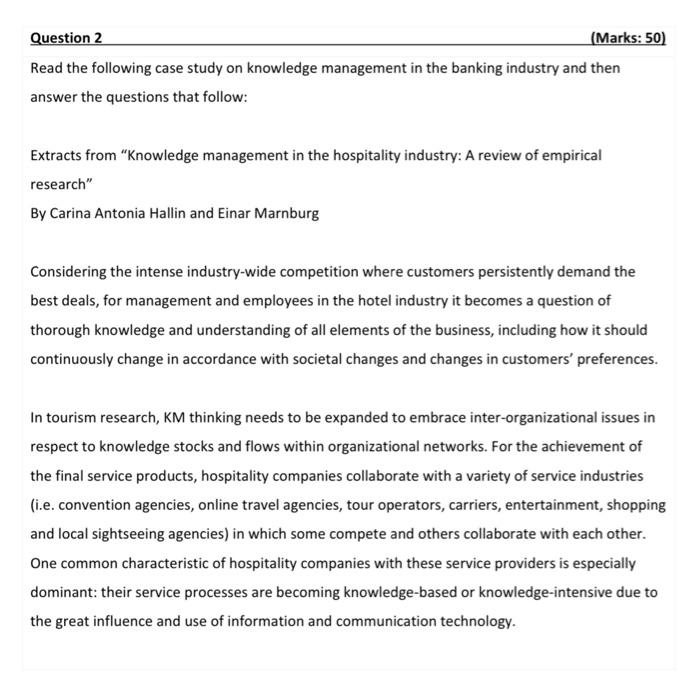
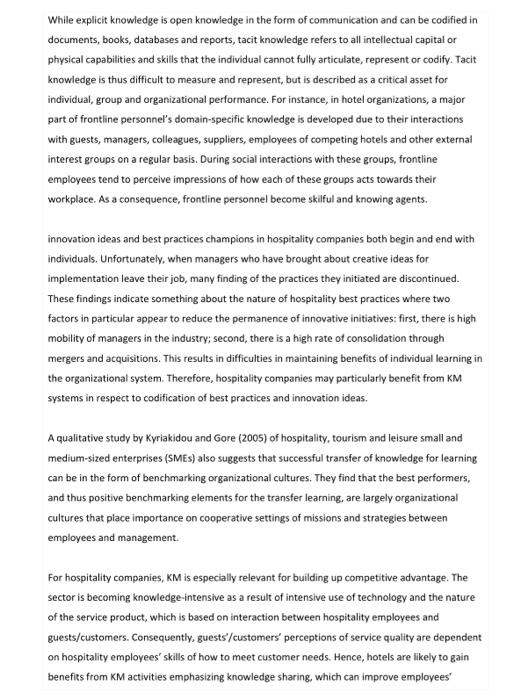
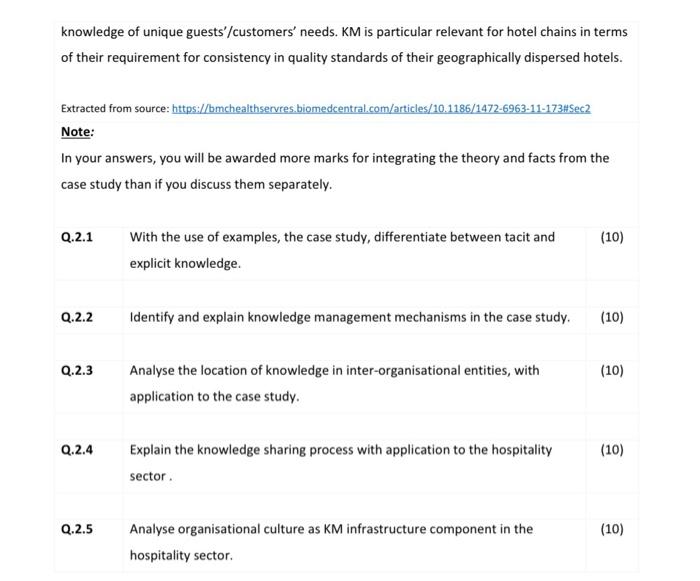
Question 2 (Marks: 50) Read the following case study on knowledge management in the banking industry and then answer the questions that follow: Extracts from "Knowledge management in the hospitality industry: A review of empirical research" By Carina Antonia Hallin and Einar Marnburg Considering the intense industry-wide competition where customers persistently demand the best deals, for management and employees in the hotel industry it becomes a question of thorough knowledge and understanding of all elements of the business, including how it should continuously change in accordance with societal changes and changes in customers' preferences. In tourism research, KM thinking needs to be expanded to embrace inter-organizational issues in respect to knowledge stocks and flows within organizational networks. For the achievement of the final service products, hospitality companies collaborate with a variety of service industries (i.e. convention agencies, online travel agencies, tour operators, carriers, entertainment, shopping and local sightseeing agencies) in which some compete and others collaborate with each other. One common characteristic of hospitality companies with these service providers is especially dominant: their service processes are becoming knowledge-based or knowledge-intensive due to the great influence and use of information and communication technology. While explicit knowledge is open knowledge in the form of communication and can be codified in documents, books, databases and reports, tacit knowledge refers to all intellectual capital or physical capabilities and skills that the individual cannot fully articulate, represent or codify. Tacit knowledge is thus difficult to measure and represent, but is described as a critical asset for individual, group and organizational performance. For instance, in hotel organizations, a major part of frontline personnel's domain-specific knowledge is developed due to their interactions with guests, managers, colleagues, suppliers, employees of competing hotels and other external interest groups on a regular basis. During social interactions with these groups, frontline employees tend to perceive impressions of how each of these groups acts towards their workplace. As a consequence, frontline personnel become skilful and knowing agents. innovation ideas and best practices champions in hospitality companies both begin and end with individuals. Unfortunately, when managers who have brought about creative ideas for implementation leave their job, many finding of the practices they initiated are discontinued. These findings indicate something about the nature of hospitality best practices where two factors in particular appear to reduce the permanence of innovative initiatives: first, there is high mobility of managers in the industry; second, there is a high rate of consolidation through mergers and acquisitions. This results in difficulties in maintaining benefits of individual learning in the organizational system. Therefore, hospitality companies may particularly benefit from KM systems in respect to codification of best practices and innovation ideas. A qualitative study by Kyriakidou and Gore (2005) of hospitality, tourism and leisure small and medium-sized enterprises (SMEs) also suggests that successful transfer of knowledge for learning can be in the form of benchmarking organizational cultures. They find that the best performers, and thus positive benchmarking elements for the transfer learning, are largely organizational cultures that place importance on cooperative settings of missions and strategies between employees and management. For hospitality companies, KM is especially relevant for building up competitive advantage. The sector is becoming knowledge-intensive as a result of intensive use of technology and the nature of the service product, which is based on interaction between hospitality employees and guests/customers. Consequently, guests/customers' perceptions of service quality are dependent on hospitality employees' skills of how to meet customer needs. Hence, hotels are likely to gain benefits from KM activities emphasizing knowledge sharing, which can improve employees' knowledge of unique guests'/customers' needs. KM is particular relevant for hotel chains in terms of their requirement for consistency in quality standards of their geographically dispersed hotels. Extracted from source: https://bmchealthservres.biomedcentral.com/articles/10.1186/1472-6963-11-173HSec2 Note: In your answers, you will be awarded more marks for integrating the theory and facts from the case study than if you discuss them separately. Q.2.1 With the use of examples, the case study, differentiate between tacit and (10) explicit knowledge. Q.2.2 Identify and explain knowledge management mechanisms in the case study. Q.2.3 Analyse the location of knowledge in inter-organisational entities, with application to the case study. Q.2.4 Explain the knowledge sharing process with application to the hospitality (10) sector. Q.2.5 Analyse organisational culture as KM infrastructure component in the (10) hospitality sector
Step by Step Solution
There are 3 Steps involved in it

Get step-by-step solutions from verified subject matter experts
 Study Help