







Question: Question 2. One method of solving a linear system with iterations is called the successive over- relaxation method. It can be summed up as below,
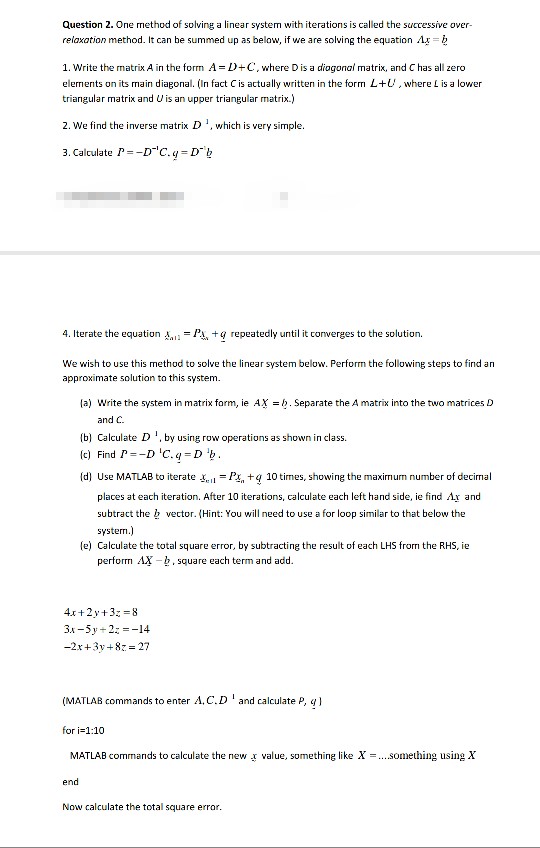
Question 2. One method of solving a linear system with iterations is called the successive over- relaxation method. It can be summed up as below, if we are solving the equation ?? b 1. write the matrix A in the form A = L)+C, where D is a diagonal atrix, and C has all zero elements on its main diagonal. (n fact C is actually written in the form L+U, where L is a lower triangular matrix and U is an upper triangular matrix.) 2. We find the inverse matrix D ', which is very simple. 3. Calculate P-DC. Db 4. Iterate the equation P repeatedly until it converges to the solution. We wish to use this method to solve the linear system below. Perform the following steps to find an approximate solution to this system. Write the system in matrix form, ie AX = b . Separate the A matrix into the two matrices D and C [a) (b) Calculate D by using row operations as shown in class. (c) Find P--D C.D (d) Use MATLAB to iterate g 10 times, showing the maximum number of decinal places at each iteration. After 10 iterations, calculate each left hand side, ie find Ar and subtract the vector. (Hint: You will need to use a for loop similar to that below the systerr e) Calculate the total square error, by subtracting the result of each LHS from the RHS, ie perform AX -. square each term and add. 4x+2y+3 8 3x-5y+2:14 -2x + 3y +8z = 27 (MATLAB commands to enter A,C.D and calculate P, l for :10 MATLAB commands to calculate the new x value, something like X = g using X end Now calculate the total square error. Question 2. One method of solving a linear system with iterations is called the successive over- relaxation method. It can be summed up as below, if we are solving the equation ?? b 1. write the matrix A in the form A = L)+C, where D is a diagonal atrix, and C has all zero elements on its main diagonal. (n fact C is actually written in the form L+U, where L is a lower triangular matrix and U is an upper triangular matrix.) 2. We find the inverse matrix D ', which is very simple. 3. Calculate P-DC. Db 4. Iterate the equation P repeatedly until it converges to the solution. We wish to use this method to solve the linear system below. Perform the following steps to find an approximate solution to this system. Write the system in matrix form, ie AX = b . Separate the A matrix into the two matrices D and C [a) (b) Calculate D by using row operations as shown in class. (c) Find P--D C.D (d) Use MATLAB to iterate g 10 times, showing the maximum number of decinal places at each iteration. After 10 iterations, calculate each left hand side, ie find Ar and subtract the vector. (Hint: You will need to use a for loop similar to that below the systerr e) Calculate the total square error, by subtracting the result of each LHS from the RHS, ie perform AX -. square each term and add. 4x+2y+3 8 3x-5y+2:14 -2x + 3y +8z = 27 (MATLAB commands to enter A,C.D and calculate P, l for :10 MATLAB commands to calculate the new x value, something like X = g using X end Now calculate the total square error
Step by Step Solution
There are 3 Steps involved in it

Get step-by-step solutions from verified subject matter experts
 Study Help