







Question: question 2 please 1. Consider the first version of multiplication hardware in Figure 1. We use 4-bit numbers for simplicity. The Multiplicand register, ALU, and
 question 2 please
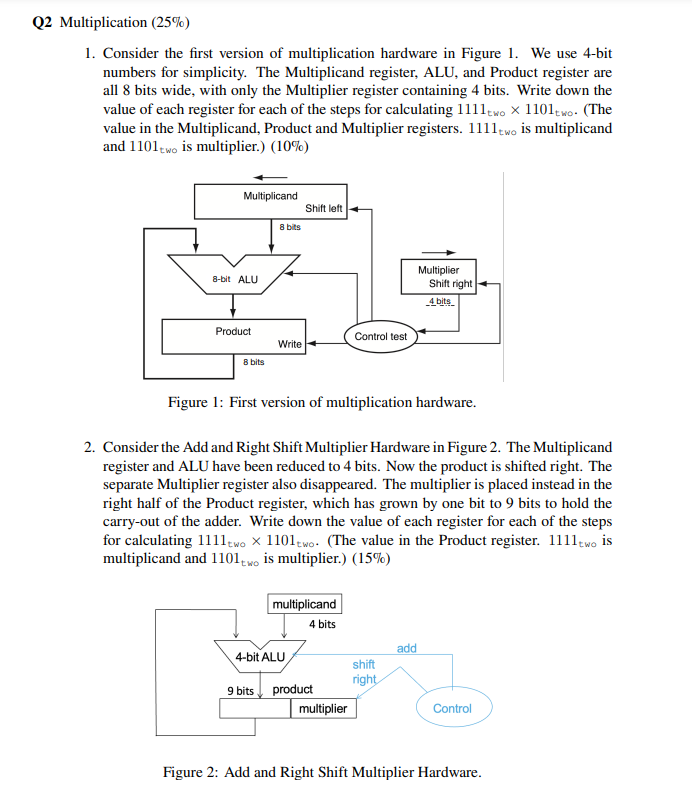
1. Consider the first version of multiplication hardware in Figure 1. We use 4-bit numbers for simplicity. The Multiplicand register, ALU, and Product register are all 8 bits wide, with only the Multiplier register containing 4 bits. Write down the value of each register for each of the steps for calculating 1111two1101two. (The value in the Multiplicand, Product and Multiplier registers. 1111two is multiplicand and 1101two is multiplier.) (10%) Figure 1: First version of multiplication hardware. 2. Consider the Add and Right Shift Multiplier Hardware in Figure 2. The Multiplicand register and ALU have been reduced to 4 bits. Now the product is shifted right. The separate Multiplier register also disappeared. The multiplier is placed instead in the right half of the Product register, which has grown by one bit to 9 bits to hold the carry-out of the adder. Write down the value of each register for each of the steps for calculating 1111two1101two. (The value in the Product register. 1111two is multiplicand and 1101two is multiplier.) (15%) Figure 2: Add and Right Shift Multiplier Hardware
Step by Step Solution
There are 3 Steps involved in it

Get step-by-step solutions from verified subject matter experts
 Study Help