







Question: Question 2: Reverse Engineering the Cache (15 points) Your company has just purchased a new processor and you have been asked to determine the structure
Question 2: Reverse Engineering the Cache (15 points) Your company has just purchased a new processor and you have been asked to determine the structure of the cache. In order to gather some data on the cache,
you have written a program that accesses different memory locations in the byte- addressable data cache. You use the response time to determine if each access
was a hit or a miss. Below are the results from your testing of the cache. Assume the block size and number of sets are both powers of two. Partial credit will be rare, and perhaps non-existent, on this problem.
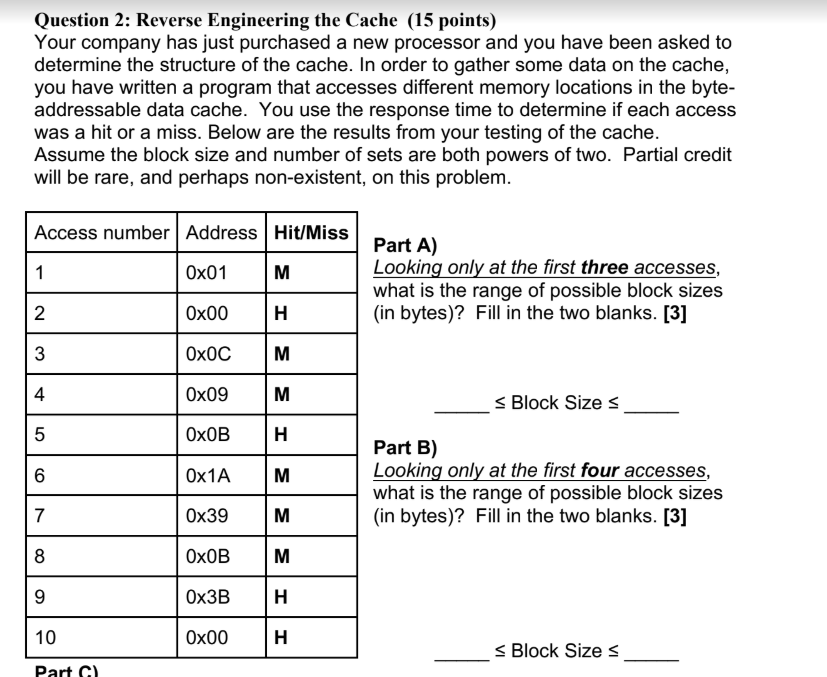
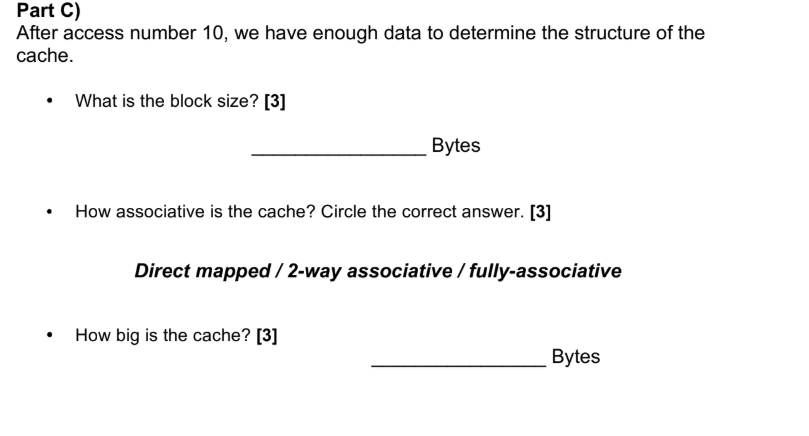
Question 2: Reverse Engineering the Cache (15 points) Your company has just purchased a new processor and you have been asked to determine the structure of the cache. In order to gather some data on the cache, you have written a program that accesses different memory locations in the byte- addressable data cache. You use the response time to determine if each access was a hit or a miss. Below are the results from your testing of the cache Assume the block size and number of sets are both powers of two. Partial credit will be rare, and perhaps non-existent, on this problem Access number Address Hit/Miss Looking only at the first three accesses, what is the range of possible block sizes (in bytes)? Fill in the two blanks. [3] 0x01 0x00 H 2 3 4 0x09 S Block Size s Part B) Looking only at the first four accesses, what is the range of possible block sizes (in bytes)? Fill in the two blanks. [3] 0x1AM 0x39 M 0xOB M 0x3BH 0x00 S Block Size s Part C Question 2: Reverse Engineering the Cache (15 points) Your company has just purchased a new processor and you have been asked to determine the structure of the cache. In order to gather some data on the cache, you have written a program that accesses different memory locations in the byte- addressable data cache. You use the response time to determine if each access was a hit or a miss. Below are the results from your testing of the cache Assume the block size and number of sets are both powers of two. Partial credit will be rare, and perhaps non-existent, on this problem Access number Address Hit/Miss Looking only at the first three accesses, what is the range of possible block sizes (in bytes)? Fill in the two blanks. [3] 0x01 0x00 H 2 3 4 0x09 S Block Size s Part B) Looking only at the first four accesses, what is the range of possible block sizes (in bytes)? Fill in the two blanks. [3] 0x1AM 0x39 M 0xOB M 0x3BH 0x00 S Block Size s Part C
Step by Step Solution
There are 3 Steps involved in it

Get step-by-step solutions from verified subject matter experts
 Study Help