







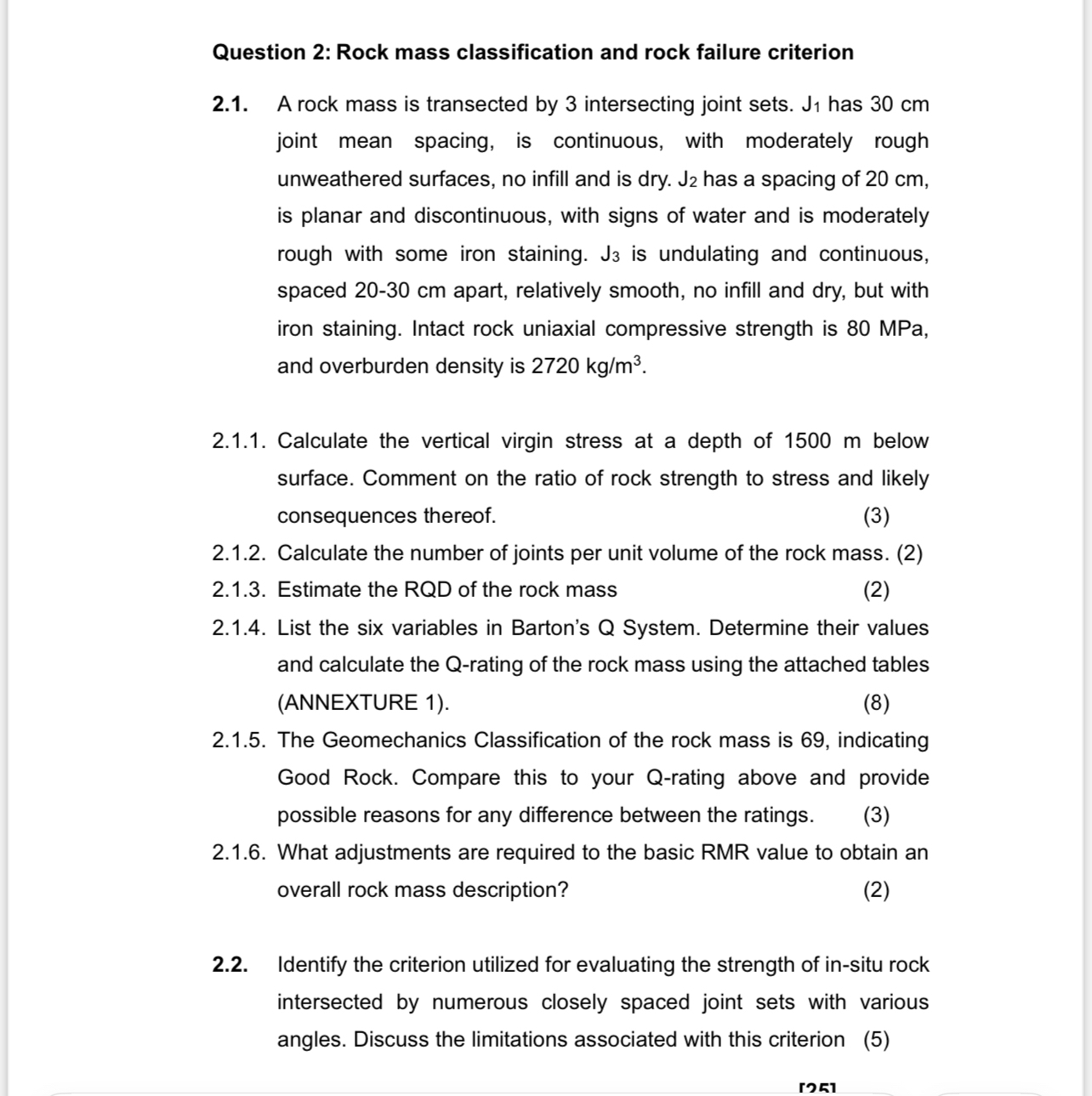
Question: Question 2 : Rock mass classification and rock failure criterion 2 . 1 . A rock mass is transected by 3 intersecting joint sets. J
Question : Rock mass classification and rock failure criterion
A rock mass is transected by intersecting joint sets. has joint mean spacing, is continuous, with moderately rough unweathered surfaces, no infill and is dry. has a spacing of is planar and discontinuous, with signs of water and is moderately rough with some iron staining. is undulating and continuous, spaced cm apart, relatively smooth, no infill and dry, but with iron staining. Intact rock uniaxial compressive strength is MPa, and overburden density is
Calculate the vertical virgin stress at a depth of below surface. Comment on the ratio of rock strength to stress and likely consequences thereof.
Calculate the number of joints per unit volume of the rock mass.
Estimate the of the rock mass
List the six variables in Barton's Q System. Determine their values and calculate the Qrating of the rock mass using the attached tables ANNEXTURE
The Geomechanics Classification of the rock mass is indicating Good Rock. Compare this to your Qrating above and provide possible reasons for any difference between the ratings.
What adjustments are required to the basic RMR value to obtain an overall rock mass description?
Identify the criterion utilized for evaluating the strength of insitu rock intersected by numerous closely spaced joint sets with various angles. Discuss the limitations associated with this criterion
Step by Step Solution
There are 3 Steps involved in it
1 Expert Approved Answer
Step: 1 Unlock

Question Has Been Solved by an Expert!
Get step-by-step solutions from verified subject matter experts
Step: 2 Unlock
Step: 3 Unlock
 Study Help