







Question: Question 2 We will work through the housing policy problem a bit differently in this question because we incorporate a demand function. Consider a
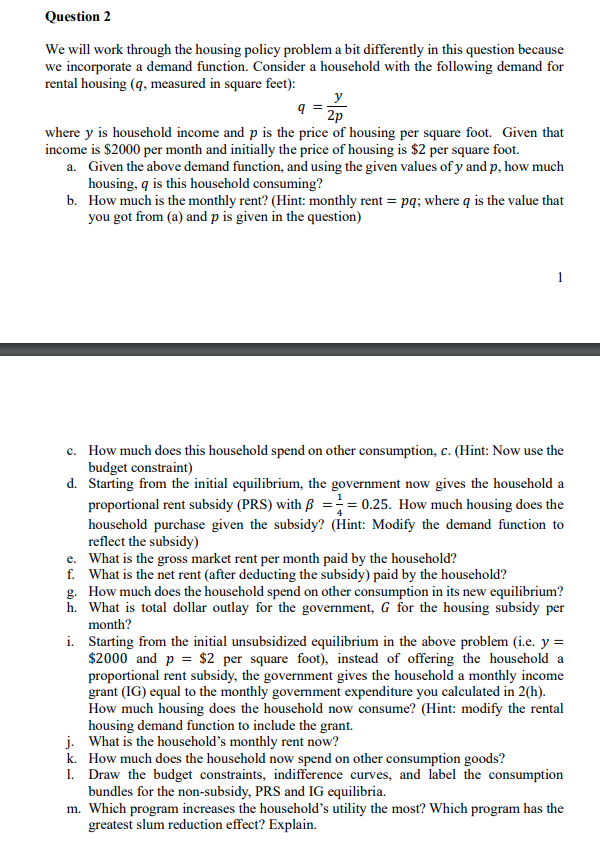
Question 2 We will work through the housing policy problem a bit differently in this question because we incorporate a demand function. Consider a household with the following demand for rental housing (q, measured in square feet): y 9 2p where y is household income and p is the price of housing per square foot. Given that income is $2000 per month and initially the price of housing is $2 per square foot. a. Given the above demand function, and using the given values of y and p, how much housing, q is this household consuming? b. How much is the monthly rent? (Hint: monthly rent = pq; where q is the value that you got from (a) and p is given in the question) c. How much does this household spend on other consumption, c. (Hint: Now use the budget constraint) d. Starting from the initial equilibrium, the government now gives the household a proportional rent subsidy (PRS) with == 0.25. How much housing does the household purchase given the subsidy? (Hint: Modify the demand function to reflect the subsidy) e. What is the gross market rent per month paid by the household? f. What is the net rent (after deducting the subsidy) paid by the household? g. How much does the household spend on other consumption in its new equilibrium? h. What is total dollar outlay for the government, G for the housing subsidy per month? i. Starting from the initial unsubsidized equilibrium in the above problem (i.e. y = $2000 and p = $2 per square foot), instead of offering the household a proportional rent subsidy, the government gives the household a monthly income grant (IG) equal to the monthly government expenditure you calculated in 2(h). How much housing does the household now consume? (Hint: modify the rental housing demand function to include the grant. j. What is the household's monthly rent now? k. How much does the household now spend on other consumption goods? 1. Draw the budget constraints, indifference curves, and label the consumption bundles for the non-subsidy, PRS and IG equilibria. m. Which program increases the household's utility the most? Which program has the greatest slum reduction effect? Explain.
Step by Step Solution
There are 3 Steps involved in it
a Given the demand function q 2p and the values of y 2000 and p 2 we can calculate the housing consumption q as follows q 2p 2 2 4 square feet b The m... View full answer

Get step-by-step solutions from verified subject matter experts
 Study Help