







Question: Question 2 (Web Cache). Consider the following scenario where two schools of one university are installing web caches for users. (You only need to
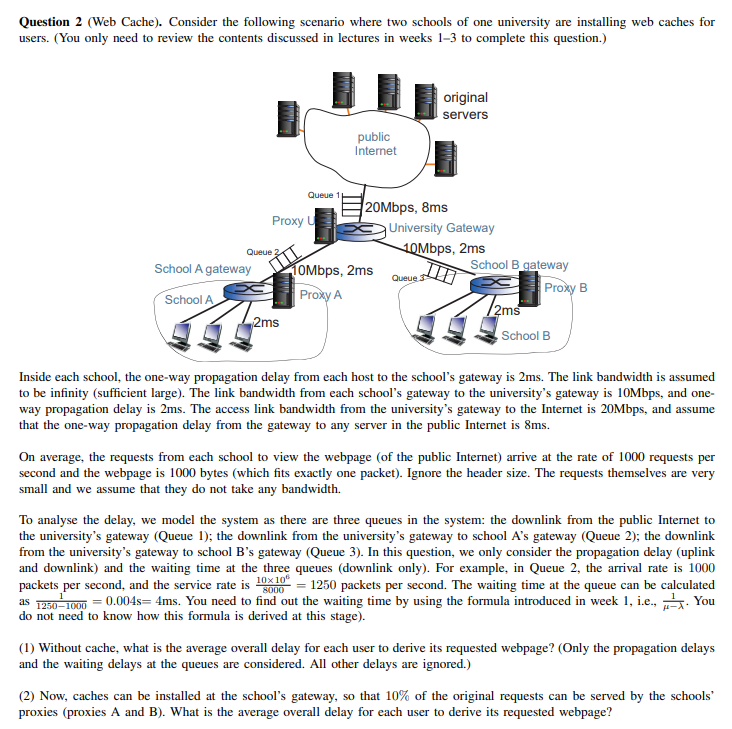
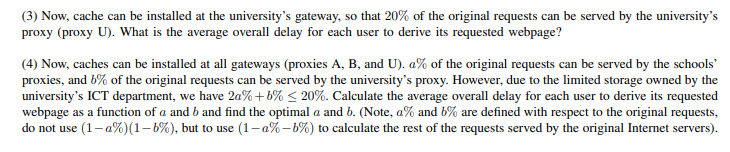
Question 2 (Web Cache). Consider the following scenario where two schools of one university are installing web caches for users. (You only need to review the contents discussed in lectures in weeks 1-3 to complete this question.) Queue 2 School A gateway School A Proxy U Queue 1 2ms public Internet 20Mbps, 8ms 10Mbps, 2ms Proxy A original servers University Gateway 10Mbps, 2ms Queue 3 School B gateway /2ms wwwwww Proxy B School B Inside each school, the one-way propagation delay from each host to the school's gateway is 2ms. The link bandwidth is assumed to be infinity (sufficient large). The link bandwidth from each school's gateway to the university's gateway is 10Mbps, and one- way propagation delay is 2ms. The access link bandwidth from the university's gateway to the Internet is 20Mbps, and assume that the one-way propagation delay from the gateway to any server in the public Internet is 8ms. On average, the requests from each school to view the webpage (of the public Internet) arrive at the rate of 1000 requests per second and the webpage is 1000 bytes (which fits exactly one packet). Ignore the header size. The requests themselves are very small and we assume that they do not take any bandwidth. To analyse the delay, we model the system as there are three queues in the system: the downlink from the public Internet to the university's gateway (Queue 1); the downlink from the university's gateway to school A's gateway (Queue 2); the downlink from the university's gateway to school B's gateway (Queue 3). In this question, we only consider the propagation delay (uplink and downlink) and the waiting time at the three queues (downlink only). For example, in Queue 2, the arrival rate is 1000 10x10 packets per second, and the service rate is 10000 =1250 packets per second. The waiting time at the queue can be calculated as 1250-1000 = 0.004s= 4ms. You need to find out the waiting time by using the formula introduced in week 1, i.e., X. You do not need to know how this formula is derived at this stage). (1) Without cache, what is the average overall delay for each user to derive its requested webpage? (Only the propagation delays and the waiting delays at the queues are considered. All other delays are ignored.) (2) Now, caches can be installed at the school's gateway, so that 10% of the original requests can be served by the schools' proxies (proxies A and B). What is the average overall delay for each user to derive its requested webpage? (3) Now, cache can be installed at the university's gateway, so that 20% of the original requests can be served by the university's proxy (proxy U). What is the average overall delay for each user to derive its requested webpage? (4) Now, caches can be installed at all gateways (proxies A, B, and U). a% of the original requests can be served by the schools' proxies, and 6% of the original requests can be served by the university's proxy. However, due to the limited storage owned by the university's ICT department, we have 2a%+b% 20%. Calculate the average overall delay for each user to derive its requested webpage as a function of a and b and find the optimal a and b. (Note, a% and 6% are defined with respect to the original requests, do not use (1-a%) (1-b%), but to use (1-a%-b%) to calculate the rest of the requests served by the original Internet servers).
Step by Step Solution
There are 3 Steps involved in it

Get step-by-step solutions from verified subject matter experts
 Study Help