







Question: Question 3 (Delay and Loss). As shown in the figure below, a file of size F = 1000+ S bytes is transmitted on an
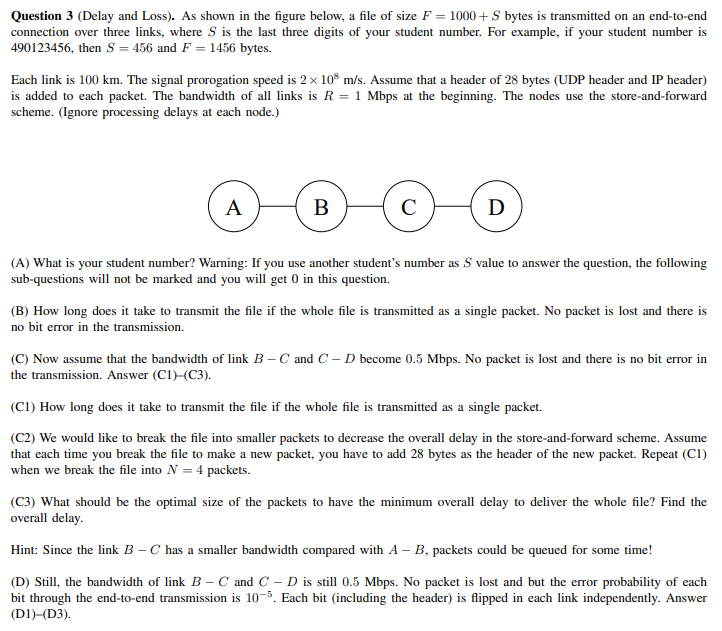
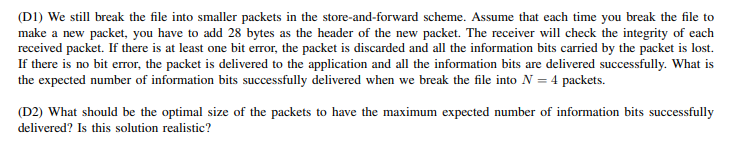
Question 3 (Delay and Loss). As shown in the figure below, a file of size F = 1000+ S bytes is transmitted on an end-to-end connection over three links, where S is the last three digits of your student number. For example, if your student number is 490123456, then S = 456 and F = 1456 bytes. Each link is 100 km. The signal prorogation speed is 2 108 m/s. Assume that a header of 28 bytes (UDP header and IP header) is added to each packet. The bandwidth of all links is R = 1 Mbps at the beginning. The nodes use the store-and-forward scheme. (Ignore processing delays at each node.) A B C D (A) What is your student number? Warning: If you use another student's number as S value to answer the question, the following sub-questions will not be marked and you will get 0 in this question. (B) How long does it take to transmit the file if the whole file is transmitted as a single packet. No packet is lost and there is no bit error in the transmission. (C) Now assume that the bandwidth of link B-C and C - D become 0.5 Mbps. No packet is lost and there is no bit error in the transmission. Answer (C1)-(C3). (C1) How long does it take to transmit the file if the whole file is transmitted as a single packet. (C2) We would like to break the file into smaller packets to decrease the overall delay in the store-and-forward scheme. Assume that each time you break the file to make a new packet, you have to add 28 bytes as the header of the new packet. Repeat (C1) when we break the file into N = 4 packets. (C3) What should be the optimal size of the packets to have the minimum overall delay to deliver the whole file? Find the overall delay. Hint: Since the link B-C has a smaller bandwidth compared with A- B, packets could be queued for some time! (D) Still, the bandwidth of link B - C and C - D is still 0.5 Mbps. No packet is lost and but the error probability of each bit through the end-to-end transmission is 10-5. Each bit (including the header) is flipped in each link independently. Answer (D1)-(D3). (D1) We still break the file into smaller packets in the store-and-forward scheme. Assume that each time you break the file to make a new packet, you have to add 28 bytes as the header of the new packet. The receiver will check the integrity of each received packet. If there is at least one bit error, the packet is discarded and all the information bits carried by the packet is lost. If there is no bit error, the packet is delivered to the application and all the information bits are delivered successfully. What is the expected number of information bits successfully delivered when we break the file into N = 4 packets. (D2) What should be the optimal size of the packets to have the maximum expected number of information bits successfully delivered? Is this solution realistic?
Step by Step Solution
There are 3 Steps involved in it

Get step-by-step solutions from verified subject matter experts
 Study Help