







Question: Question 2: Your organization is considering two projects. Its WACC is 10%, and the projects' after-tax cash flows (in millions of dollars) would be as
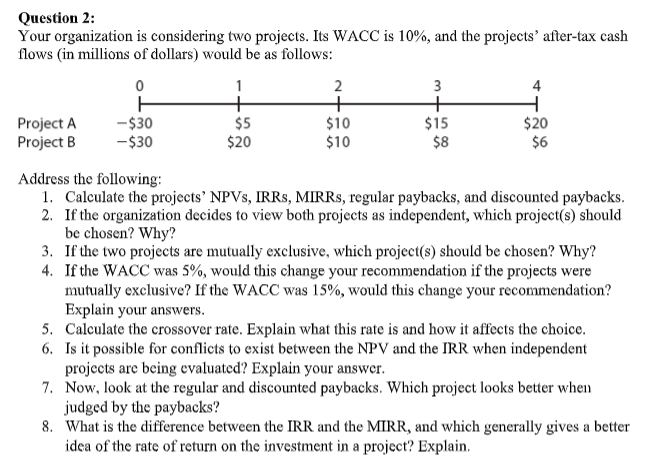
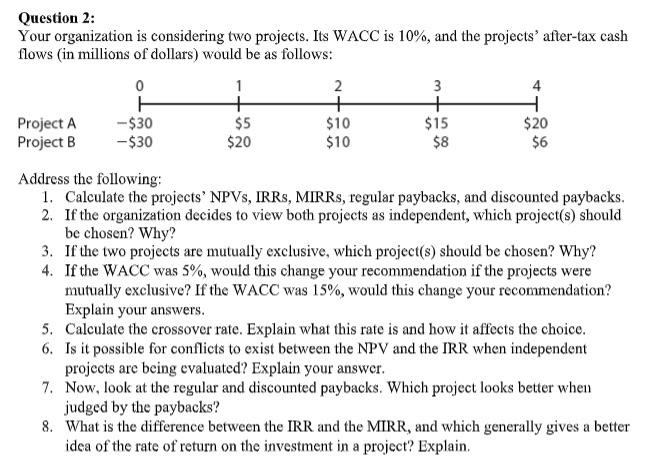
Question 2: Your organization is considering two projects. Its WACC is 10%, and the projects' after-tax cash flows (in millions of dollars) would be as follows: 0 1 2 3 4 + + Project A - $30 $10 $15 $20 Project B - $30 $20 $10 $8 $6 $5 Address the following: 1. Calculate the projects' NPVS, IRRS, MIRRs, regular paybacks, and discounted paybacks. 2. If the organization decides to view both projects as independent, which project(s) should be chosen? Why? 3. If the two projects are mutually exclusive, which project(s) should be chosen? Why? 4. If the WACC was 5%, would this change your recommendation if the projects were mutually exclusive? If the WACC was 15%, would this change your recommendation? Explain your answers. 5. Calculate the crossover rate. Explain what this rate is and how it affects the choice. 6. Is it possible for conflicts to exist between the NPV and the IRR when independent projects are being evaluated? Explain your answer. 7. Now, look at the regular and discounted paybacks. Which project looks better when judged by the paybacks? 8. What is the difference between the IRR and the MIRR, and which generally gives a better idea of the rate of return on the investment in a project? Explain. Question 2: Your organization is considering two projects. Its WACC is 10%, and the projects' after-tax cash flows (in millions of dollars) would be as follows: 0 1 2 3 4 H + + Project A -$30 $5 $10 $15 $20 Project B --$30 $20 $10 $8 $6 Address the following: 1. Calculate the projects' NPVS, IRRS, MIRRs, regular paybacks, and discounted paybacks. 2. If the organization decides to view both projects as independent, which project() should be chosen? Why? 3. If the two projects are mutually exclusive, which project(s) should be chosen? Why? 4. If the WACC was 5%, would this change your recommendation if the projects were mutually exclusive? If the WACC was 15%, would this change your recommendation? Explain your answers. 5. Calculate the crossover rate. Explain what this rate is and how it affects the choice. 6. Is it possible for conflicts to exist between the NPV and the IRR when independent projects are being evaluated? Explain your answer. 7. Now, look at the regular and discounted paybacks. Which project looks better when judged by the paybacks? 8. What is the difference between the IRR and the MIRR, and which generally gives a better idea of the rate of return on the investment in a project? Explain
Step by Step Solution
There are 3 Steps involved in it

Get step-by-step solutions from verified subject matter experts
 Study Help