Question: QUESTION 20 1 points Save Answer The Agreement on Trade-Related Aspects of International Property Rights (TRIPS Agreement) O A. Attempts to bring protection of Intellectual
QUESTION 20 1 points Save Answer The Agreement on
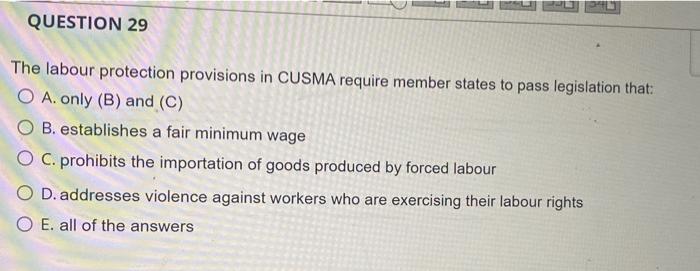
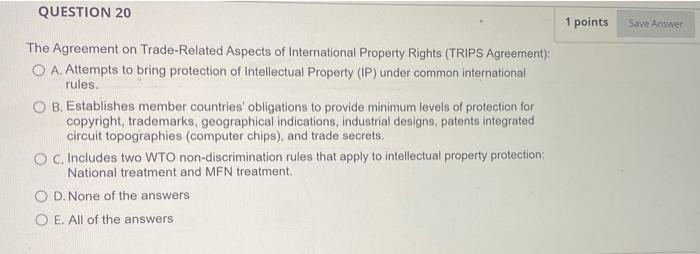
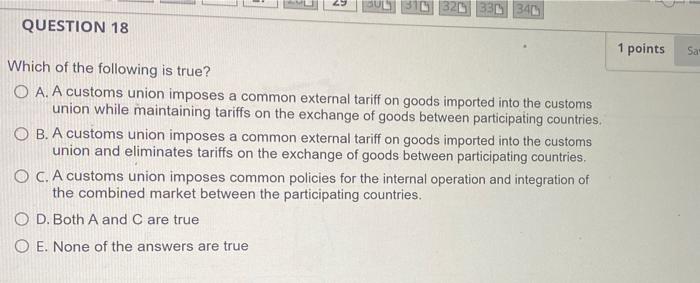
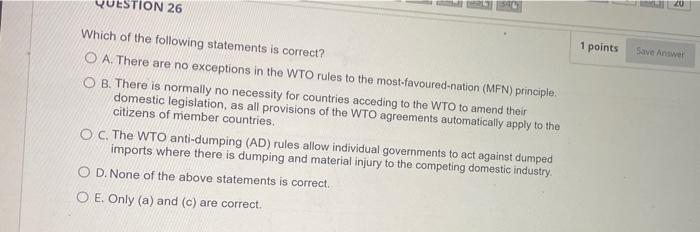
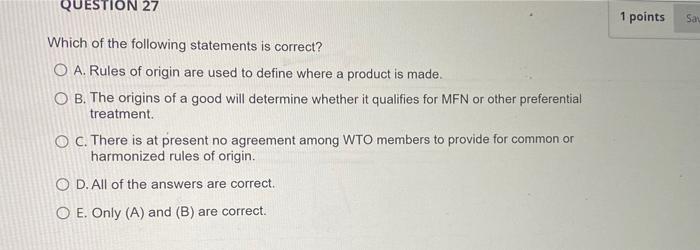
QUESTION 20 1 points Save Answer The Agreement on Trade-Related Aspects of International Property Rights (TRIPS Agreement) O A. Attempts to bring protection of Intellectual Property (IP) under common international rules. O B. Establishes member countries' obligations to provide minimum levels of protection for copyright, trademarks, geographical indications, industrial designs, patents integrated circuit topographies (computer chips), and trade secrets O c. Includes two WTO non-discrimination rules that apply to intellectual property protection: National treatment and MFN treatment O D. None of the answers O E. All of the answers 63 320 E 340 QUESTION 18 1 points Sa Which of the following is true? O A. A customs union imposes a common external tariff on goods imported into the customs union while maintaining tariffs on the exchange of goods between participating countries. O B. A customs union imposes a common external tariff on goods imported into the customs union and eliminates tariffs on the exchange of goods between participating countries, O C. A customs union imposes common policies for the internal operation and integration of the combined market between the participating countries. O D. Both A and C are true O E. None of the answers are true QUESTION 26 1 points Save Answer Which of the following statements is correct? O A. There are no exceptions in the WTO rules to the most-favoured-nation (MFN) principle. O B. There is normally no necessity for countries acceding to the WTO to amend their domestic legislation, as all provisions of the WTO agreements automatically apply to the citizens of member countries. O C. The WTO anti-dumping (AD) rules allow individual governments to act against dumped imports where there is dumping and material injury to the competing domestic industry. O D. None of the above statements is correct O E. Only (a) and (c) are correct. QUESTION 27 1 points Sas Which of the following statements is correct? O A. Rules of origin are used to define where a product is made O B. The origins of a good will determine whether it qualifies for MFN or other preferential treatment. O c. There is at present no agreement among WTO members to provide for common or harmonized rules of origin. O D. All of the answers are correct. O E. Only (A) and (B) are correct. QUESTION 29 The labour protection provisions in CUSMA require member states to pass legislation that: O A. only (B) and (C) O B. establishes a fair minimum wage O C. prohibits the importation of goods produced by forced labour O D.addresses violence against workers who are exercising their labour rights O E. all of the answers QUESTION 20 1 points Save Answer The Agreement on Trade-Related Aspects of International Property Rights (TRIPS Agreement) O A. Attempts to bring protection of Intellectual Property (IP) under common international rules. O B. Establishes member countries' obligations to provide minimum levels of protection for copyright, trademarks, geographical indications, industrial designs, patents integrated circuit topographies (computer chips), and trade secrets O c. Includes two WTO non-discrimination rules that apply to intellectual property protection: National treatment and MFN treatment O D. None of the answers O E. All of the answers 63 320 E 340 QUESTION 18 1 points Sa Which of the following is true? O A. A customs union imposes a common external tariff on goods imported into the customs union while maintaining tariffs on the exchange of goods between participating countries. O B. A customs union imposes a common external tariff on goods imported into the customs union and eliminates tariffs on the exchange of goods between participating countries, O C. A customs union imposes common policies for the internal operation and integration of the combined market between the participating countries. O D. Both A and C are true O E. None of the answers are true QUESTION 26 1 points Save Answer Which of the following statements is correct? O A. There are no exceptions in the WTO rules to the most-favoured-nation (MFN) principle. O B. There is normally no necessity for countries acceding to the WTO to amend their domestic legislation, as all provisions of the WTO agreements automatically apply to the citizens of member countries. O C. The WTO anti-dumping (AD) rules allow individual governments to act against dumped imports where there is dumping and material injury to the competing domestic industry. O D. None of the above statements is correct O E. Only (a) and (c) are correct. QUESTION 27 1 points Sas Which of the following statements is correct? O A. Rules of origin are used to define where a product is made O B. The origins of a good will determine whether it qualifies for MFN or other preferential treatment. O c. There is at present no agreement among WTO members to provide for common or harmonized rules of origin. O D. All of the answers are correct. O E. Only (A) and (B) are correct. QUESTION 29 The labour protection provisions in CUSMA require member states to pass legislation that: O A. only (B) and (C) O B. establishes a fair minimum wage O C. prohibits the importation of goods produced by forced labour O D.addresses violence against workers who are exercising their labour rights O E. all of the answers
Step by Step Solution

There are 3 Steps involved in it

1 Expert Approved Answer
Step: 1 Unlock blur-text-image

Question Has Been Solved by an Expert!

Get step-by-step solutions from verified subject matter experts

Step: 2 Unlock
Step: 3 Unlock

Students Have Also Explored These Related General Management Questions!