







Question: Question 22 10 points SAVE ANSWER Question 2: Databases, ERP, and the Revenue cycle (10 marks) a. Below are 12 pieces of data an organisation
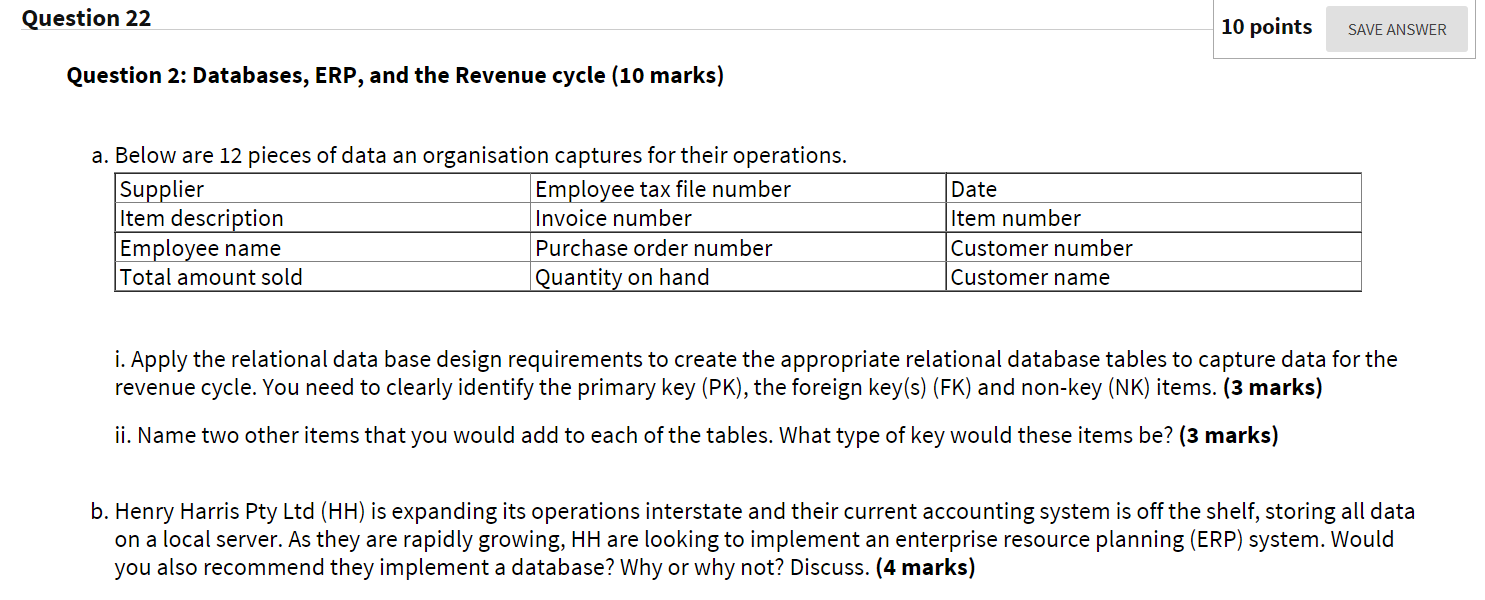
Question 22 10 points SAVE ANSWER Question 2: Databases, ERP, and the Revenue cycle (10 marks) a. Below are 12 pieces of data an organisation captures for their operations. Supplier Employee tax file number Item description Invoice number Employee name Purchase order number Total amount sold Quantity on hand Date Item number Customer number Customer name i. Apply the relational data base design requirements to create the appropriate relational database tables to capture data for the revenue cycle. You need to clearly identify the primary key (PK), the foreign key(s) (FK) and non-key (NK) items. (3 marks) ii. Name two other items that you would add to each of the tables. What type of key would these items be? (3 marks) b. Henry Harris Pty Ltd (HH) is expanding its operations interstate and their current accounting system is off the shelf, storing all data on a local server. As they are rapidly growing, HH are looking to implement an enterprise resource planning (ERP) system. Would you also recommend they implement a database? Why or why not? Discuss. (4 marks) Question 22 10 points SAVE ANSWER Question 2: Databases, ERP, and the Revenue cycle (10 marks) a. Below are 12 pieces of data an organisation captures for their operations. Supplier Employee tax file number Item description Invoice number Employee name Purchase order number Total amount sold Quantity on hand Date Item number Customer number Customer name i. Apply the relational data base design requirements to create the appropriate relational database tables to capture data for the revenue cycle. You need to clearly identify the primary key (PK), the foreign key(s) (FK) and non-key (NK) items. (3 marks) ii. Name two other items that you would add to each of the tables. What type of key would these items be? (3 marks) b. Henry Harris Pty Ltd (HH) is expanding its operations interstate and their current accounting system is off the shelf, storing all data on a local server. As they are rapidly growing, HH are looking to implement an enterprise resource planning (ERP) system. Would you also recommend they implement a database? Why or why not? Discuss. (4 marks)
Step by Step Solution
There are 3 Steps involved in it

Get step-by-step solutions from verified subject matter experts
 Study Help