Question: Question 22 (15 points) Mini case #2 Building a Multicultural Team - Is it Worth it? Kalia works in a large business, managing a diverse
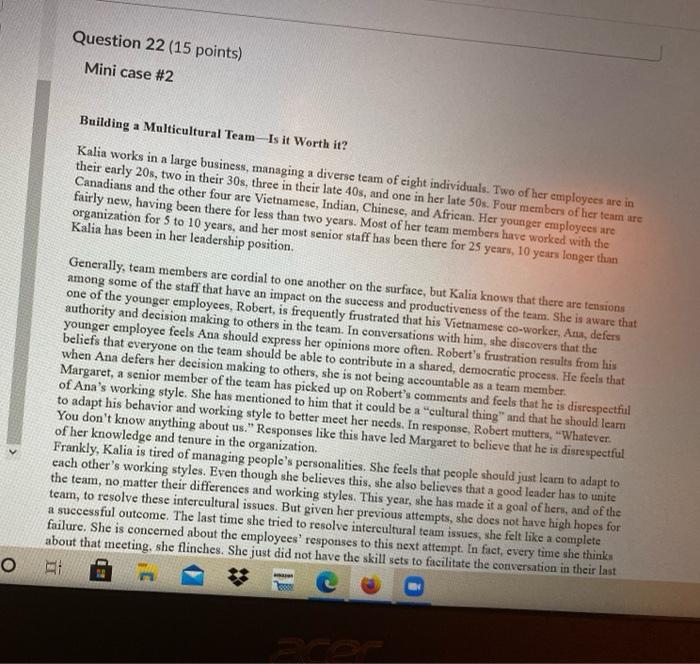
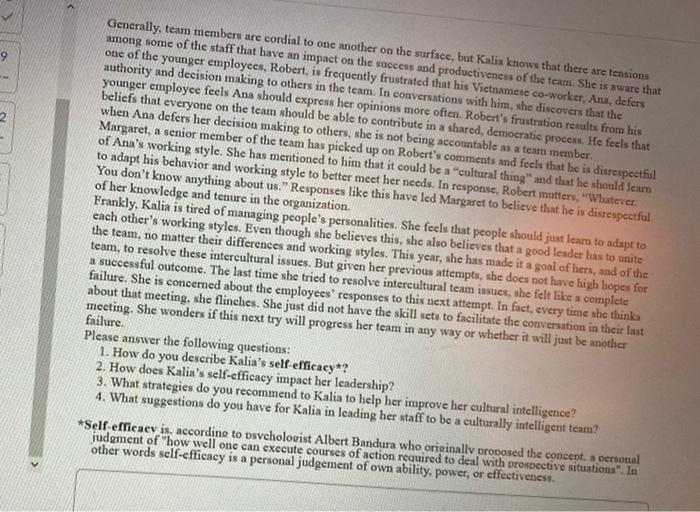
Question 22 (15 points) Mini case #2 Building a Multicultural Team - Is it Worth it? Kalia works in a large business, managing a diverse team of eight individuals. Two of her employees are in their early 20s, two in their 30s, three in their late 40s, and one in her late 50s. Four members of her team are Canadians and the other four are Vietnamese, Indian, Chinese, and African. Her younger employees are fairly new, having been there for less than two years. Most of her team members have worked with the organization for 5 to 10 years, and her most senior staff has been there for 25 years, 10 years longer than Kalia has been in her leadership position. Generally, team members are cordial to one another on the surface, but Kalia knows that there are tensions among some of the staff that have an impact on the success and productiveness of the team. She is aware that one of the younger employees, Robert, is frequently frustrated that his Vietnamese co-worker, Anus, defers authority and decision making to others in the team. In conversations with him, she discovers tut the younger employee feels Aun should express her opinions more often. Robert's frustration results from luis beliefs that everyone on the team should be able to contribute in a shared, democratic process. He feels that when Ana defers her decision making to others, she is not being accountable as a team member Margaret, a senior member of the team has picked up on Robert's comments and feels that he is disrespectful of Ana's working style. She has mentioned to him that it could be a "cultural thing" and that he should leam to adapt his behavior and working style to better meet her needs. In response, Robert mutters, "Whatever. You don't know anything about us." Responses like this have led Margaret to believe that he is disrespectful of her knowledge and tenure in the organization. Frankly, Kalia is tired of managing people's personalities. She feels that people should just learn to adapt to cach other's working styles. Even though she believes this, she also believes that a good leader has to unite the team, no matter their differences and working styles. This year, she has made it a goal of hers, and of the team, to resolve these intercultural issues. But given her previous attempts, she does not have high hopes for a successful outcome. The last time she tried to resolve intercultural team issues, she felt like a complete failure. She is concerned about the employees' responses to this next attempt. In fact, every time she thinks about that meeting, she flinches. She just did not have the skill sets to facilitate the conversation in their last O 9 2 Generally, team members are cordial to one another on the surface, but Kalia knows that there are tensions among some of the staff that have an impact on the success and productiveness of the team. She is aware that one of the younger employees, Robert, is frequently frustrated that his Vietnamese co-worker, Ana, defers authority and decision making to others in the team. In conversations with him, she discovers that the younger employee feels Ana should express her opinions more often. Robert's frustration results from his beliefs that everyone on the team should be able to contributo in a shared, democratic process. He feels that when Ana defers her decision making to others, she is not being accountable as a team member Margaret, a senior member of the team has picked up on Robert's comments and feels that he is disrespectful of Ana's working style. She has mentioned to him that it could be a "cultural thing" and that he should leam to adapt his behavior and working style to better meet her needs. In response, Robert mutters, "Whatever You don't know anything about us." Responses like this have led Margaret to believe that he is disrespectful of her knowledge and tenure in the organization, Frankly, Kalia is tired of managing people's personalities. She feels that people should just learn to adapt to each other's working styles. Even though she believes this, she also believes that a good leader has to unite the team, no matter their differences and working styles. This year, she has made it a goal of hers, and of the team, to resolve these intercultural issues. But given her previous attempts, she does not have high hopes for a successful outcome. The last time she tried to resolve intercultural team issues, she felt like a complete failure. She is concemed about the employees' responses to this next attempt. In fact, every time she thinks about that meeting, she flinches. She just did not have the skill sets to facilitate the conversation in their last meeting. She wonders if this next try will progress her team in any way or whether it will just be another failure. Please answer the following questions: 1. How do you describe Kalia's self-efficacy*? 2. How does Kalia's self-efficacy impact her leadership? 3. What strategies do you recommend to Kalin to help her improve her cultural intelligence? 4. What suggestions do you have for Kalia in leading her staff to be a culturally intelligent teamu? *Self efficacy is, according to usvchologist Albert Bandura who originally proposed the concept a personal judgment of "how well one can execute courses of action required to deal with prospective situations". In other words self-efficacy is a personal judgement of own ability, power, or effectiveness









 Study Help