







Question: Question 23 A $1,000 par value bond was issued five years ago at a 8 percent coupon rate. It currently has 25 years remaining to
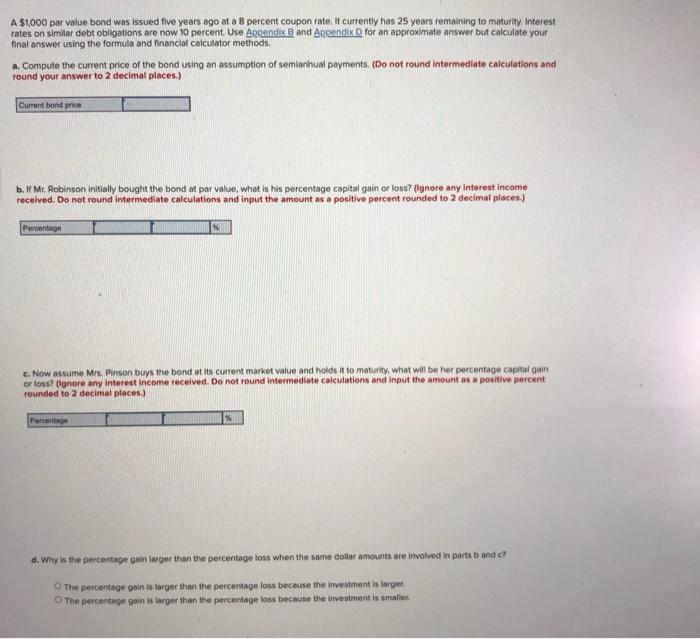
A $1,000 par value bond was issued five years ago at a 8 percent coupon rate. It currently has 25 years remaining to maturity. Interest rates on similar debt obligations are now 10 percent Use Appendix B and Argendix D for an approximate answer but calculate your final answer using the formula and financial calculator methods a. Compute the current price of the bond using an assumption of semiannual payments. (Do not round intermediate calculations and round your answer to 2 decimal places.) Current and price b. If Mt. Robinson initially bought the bond et par value, what is his percentage capital gain or loss? (ignore any interest income received. Do not round Intermediate calculations and input the amount as a positive percent rounded to 2 decimal places.) Percentage Now assume Mrs. Pinson buys the bond at its current market value and holds it to maturity, what will be her percentage capital gain or loss? ignore any interest Income received. Do not round Intermediate calculations and input the amount as a positive percent rounded to 2 decimal places) Percentage d. Why is the percentage gain larger than the percentage loss when the same dollar amounts are involved in parts and e? The percentage gain is larger than the percentage loss because the investment is larger The percentage gain is larger than the percentage loss because the investment is smaller A $1,000 par value bond was issued five years ago at a 8 percent coupon rate. It currently has 25 years remaining to maturity. Interest rates on similar debt obligations are now 10 percent Use Appendix B and Argendix D for an approximate answer but calculate your final answer using the formula and financial calculator methods a. Compute the current price of the bond using an assumption of semiannual payments. (Do not round intermediate calculations and round your answer to 2 decimal places.) Current and price b. If Mt. Robinson initially bought the bond et par value, what is his percentage capital gain or loss? (ignore any interest income received. Do not round Intermediate calculations and input the amount as a positive percent rounded to 2 decimal places.) Percentage Now assume Mrs. Pinson buys the bond at its current market value and holds it to maturity, what will be her percentage capital gain or loss? ignore any interest Income received. Do not round Intermediate calculations and input the amount as a positive percent rounded to 2 decimal places) Percentage d. Why is the percentage gain larger than the percentage loss when the same dollar amounts are involved in parts and e? The percentage gain is larger than the percentage loss because the investment is larger The percentage gain is larger than the percentage loss because the investment is smaller
Step by Step Solution
There are 3 Steps involved in it
To solve these problems lets go through each part step by step Part A Compute the Current Price of t... View full answer

Get step-by-step solutions from verified subject matter experts
 Study Help