



Question: Question 2/3 Question 2 (1 point) In 2008, there were 507 children in Arizona out of 32,601 who were diagnosed with Autism Spectrum Disorder (ASD)
Question 2/3
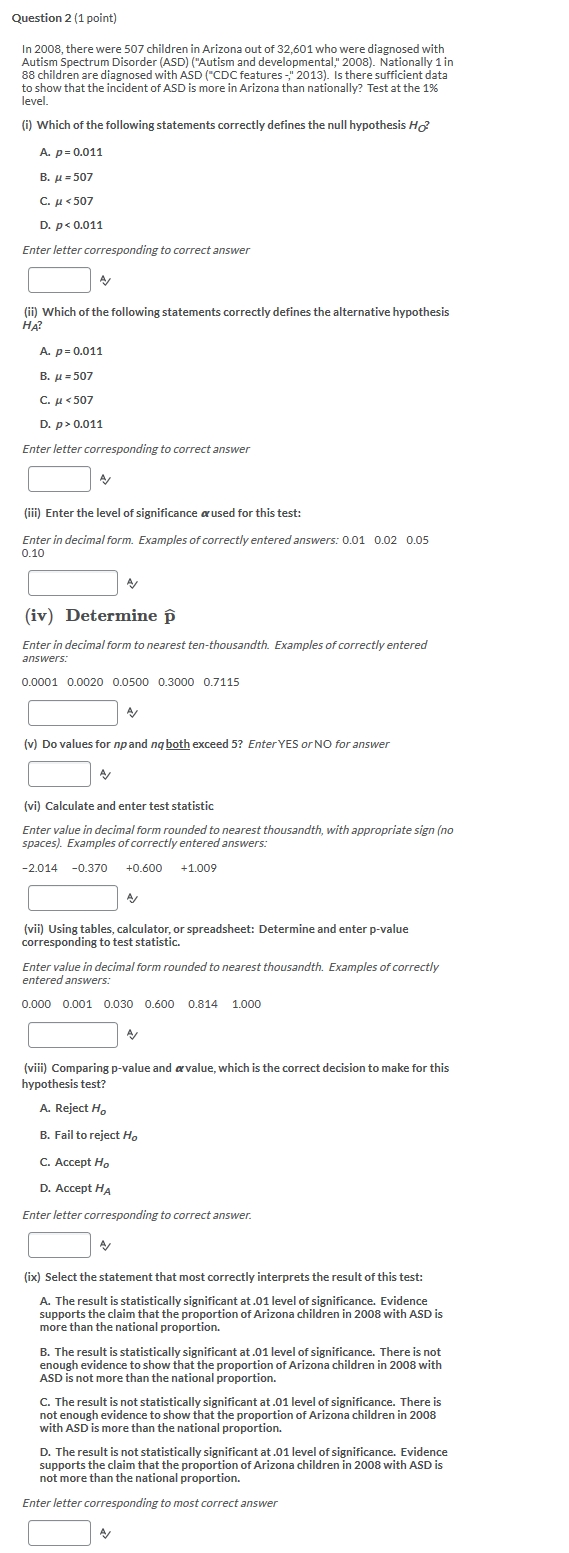
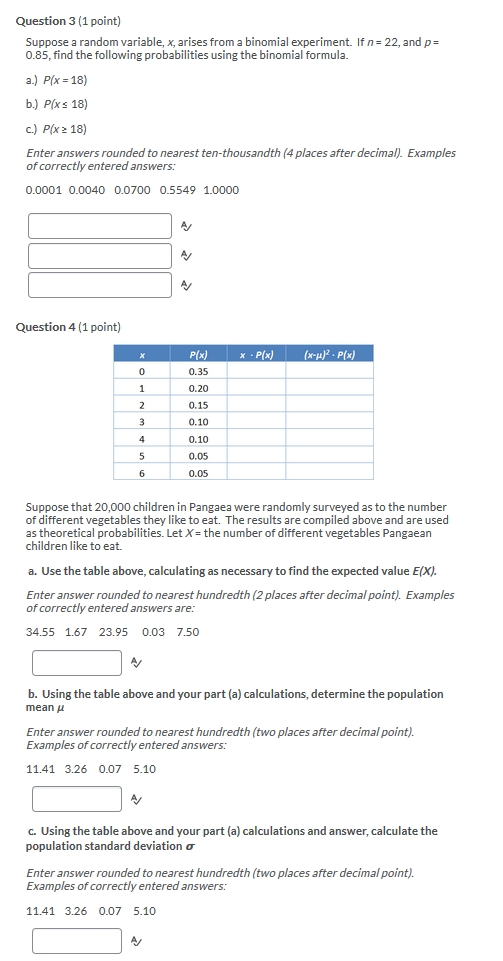
Question 2 (1 point) In 2008, there were 507 children in Arizona out of 32,601 who were diagnosed with Autism Spectrum Disorder (ASD) ("Autism and developmental," 2008). Nationally 1 in 88 children are diagnosed with ASD ("CDC features -" 2013). Is there sufficient data to show that the incident of ASD is more in Arizona than nationally? Test at the 1% level (i) Which of the following statements correctly defines the null hypothesis Ho? A. p= 0.011 B. M = 507 C. H 0.011 Enter letter corresponding to correct answer (iii) Enter the level of significance crused for this test: Enter in decimal form. Examples of correctly entered answers: 0.01 0.02 0.05 D.10 (iv) Determine p Enter in decimal form to nearest ten-thousandth. Examples of correctly entered answers: 0.0001 0.0020 0.0500 0.3000 0.7115 (v) Do values for np and no both exceed 5? Enter YES or NO for answer (vi) Calculate and enter test statistic Enter value in decimal form rounded to nearest thousandth, with appropriate sign (no spaces). Examples of correctly entered answers: -2.014 -0.370 +0.600 +1.009 (vii) Using tables, calculator, or spreadsheet: Determine and enter p-value corresponding to test statistic Enter value in decimal form rounded to nearest thousandth. Examples of correctly entered answers: 0.000 0.001 0.030 0.600 0.814 1.000 (vili) Comparing p-value and orvalue, which is the correct decision to make for this hypothesis test? A. Reject Ho B. Fail to reject Ho C. Accept Ho D. Accept HA Enter letter corresponding to correct answer. (ix) Select the statement that most correctly interprets the result of this test: A. The result is statistically significant at .01 level of significance. Evidence supports the claim that the proportion of Arizona children in 2008 with ASD is more than the national proportion. B. The result is statistically significant at.01 level of significance. There is not enough evidence to show that the proportion of Arizona children in 2008 with ASD is not more than the national proportion. C. The result is not statistically significant at.01 level of significance. There is not enough evidence to show that the proportion of Arizona children in 2008 with ASD is more than the national proportion. D. The result is not statistically significant at .01 level of significance. Evidence supports the claim that the proportion of Arizona children in 2008 with ASD is not more than the national proportion. Enter letter corresponding to most correct answerQuestion 3 (1 point) Suppose a random variable, x, arises from a binomial experiment. If n = 22, and p= 0.85, find the following probabilities using the binomial formula. a.) P(x =18) b.) P(x= 18) C.) P(x = 18) Enter answers rounded to nearest ten-thousandth (4 places after decimal). Examples of correctly entered answers: 0.0001 0.0040 0.0700 0.5549 1.0000 Question 4 (1 point) P(x) x - P(x) (x-[)? . P(x) 0.35 1 0.20 2 0.15 3 0.10 4 0.10 5 0.05 6 0.05 Suppose that 20,000 children in Pangaea were randomly surveyed as to the number of different vegetables they like to eat. The results are compiled above and are used as theoretical probabilities. Let X= the number of different vegetables Pangaean children like to eat. a. Use the table above, calculating as necessary to find the expected value E(X). Enter answer rounded to nearest hundredth (2 places after decimal point). Examples of correctly entered answers are: 34.55 1.67 23.95 0.03 7.50 b. Using the table above and your part (a) calculations, determine the population mean Enter answer rounded to nearest hundredth (two places after decimal point). Examples of correctly entered answers: 11.41 3.26 0.07 5.10 C. Using the table above and your part (a) calculations and answer, calculate the population standard deviation o Enter answer rounded to nearest hundredth (two places after decimal point). Examples of correctly entered answers: 11.41 3.26 0.07 5.10
Step by Step Solution
There are 3 Steps involved in it

Get step-by-step solutions from verified subject matter experts