







Question: If the posterior function is B(n +3, x;+2), then Bay's estimate for 0= n+3 j = 1 n+ 2x;+5 j = 1 Select one:
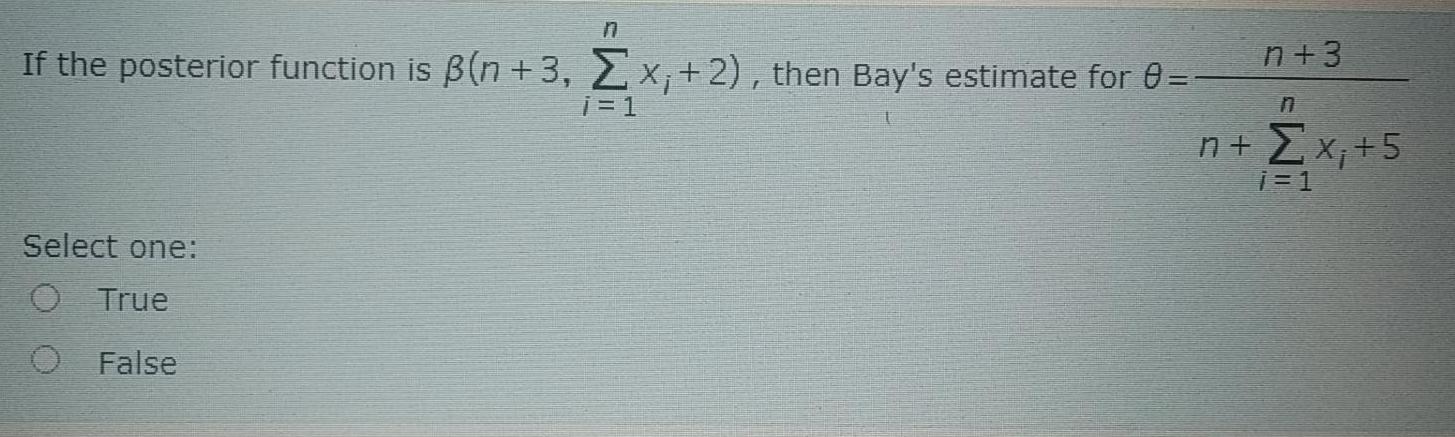
If the posterior function is B(n +3, x;+2), then Bay's estimate for 0= n+3 j = 1 n+ 2x;+5 j = 1 Select one: O True O False
Step by Step Solution
★★★★★
3.27 Rating (147 Votes )
There are 3 Steps involved in it
1 Expert Approved Answer
Step: 1 Unlock

Question Has Been Solved by an Expert!
Get step-by-step solutions from verified subject matter experts
Step: 2 Unlock
Step: 3 Unlock
Document Format (2 attachments)

6363f4075bfeb_238835.pdf
180 KBs PDF File

6363f4075bfeb_238835.docx
120 KBs Word File
 Study Help