







Question: Question 3. (2 marks) An organic sample from a Chinchorro mummy was found to con- tain 54.29% of the relative proportion of carbon-14 found in
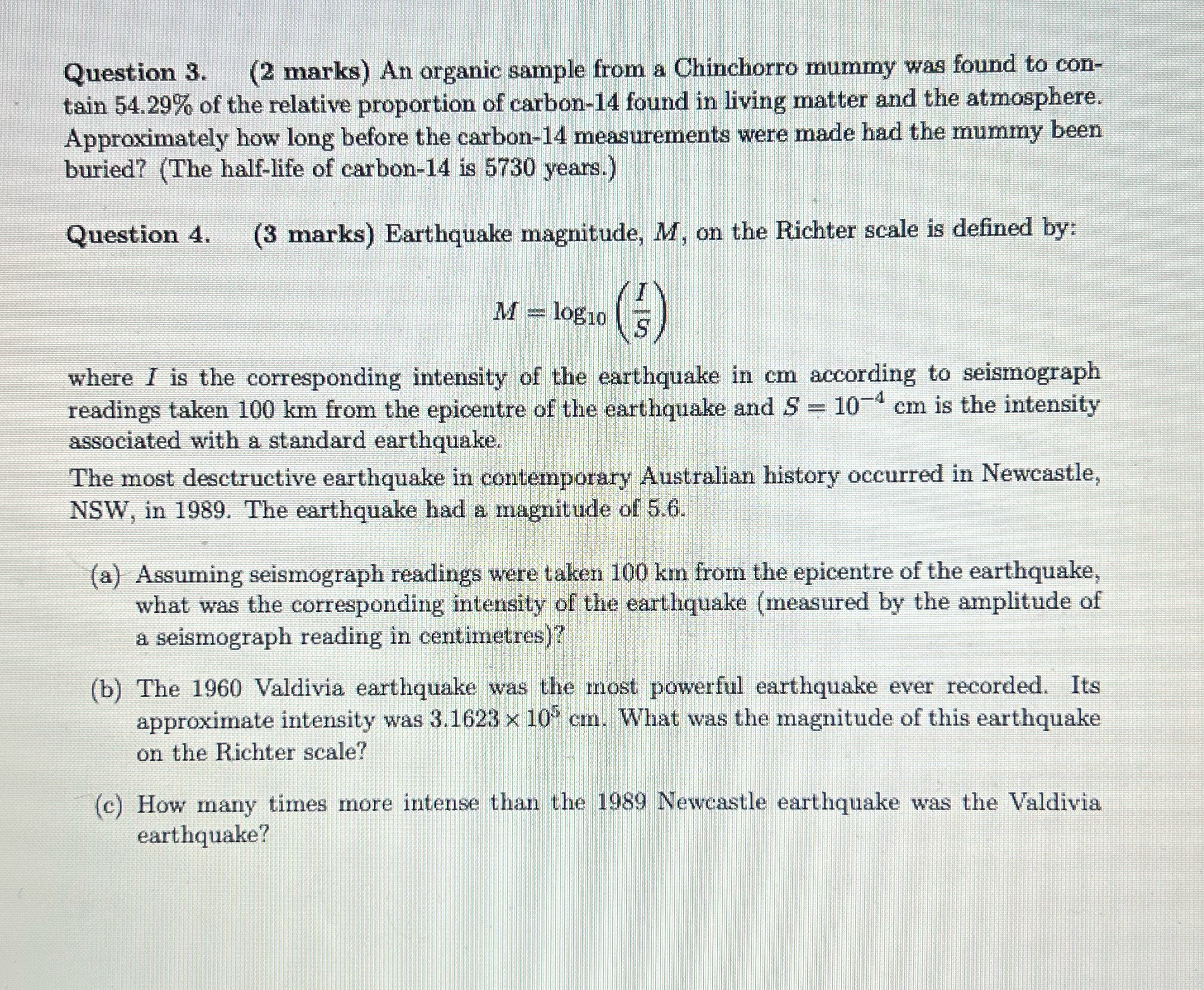
Question 3. (2 marks) An organic sample from a Chinchorro mummy was found to con- tain 54.29% of the relative proportion of carbon-14 found in living matter and the atmosphere. Approximately how long before the carbon-14 measurements were made had the mummy been buried? (The half-life of carbon-14 is 5730 years.) Question 4. (3 marks) Earthquake magnitude, M, on the Richter scale is defined by: M = log10 where I is the corresponding intensity of the earthquake in cm according to seismograph readings taken 100 km from the epicentre of the earthquake and S = 10-* cm is the intensity associated with a standard earthquake. The most desctructive earthquake in contemporary Australian history occurred in Newcastle, NSW, in 1989. The earthquake had a magnitude of 5.6. (a) Assuming seismograph readings were taken 100 km from the epicentre of the earthquake, what was the corresponding intensity of the earthquake (measured by the amplitude of a seismograph reading in centimetres)? (b) The 1960 Valdivia earthquake was the most powerful earthquake ever recorded. Its approximate intensity was 3.1623 x 10" cm. What was the magnitude of this earthquake on the Richter scale? (c) How many times more intense than the 1989 Newcastle earthquake was the Valdivia earthquake
Step by Step Solution
There are 3 Steps involved in it

Get step-by-step solutions from verified subject matter experts
 Study Help