







Question: QUESTION 3 2 points Save Answer Bob has two random variables X and Y which he assumes are independent. He is interested in T =
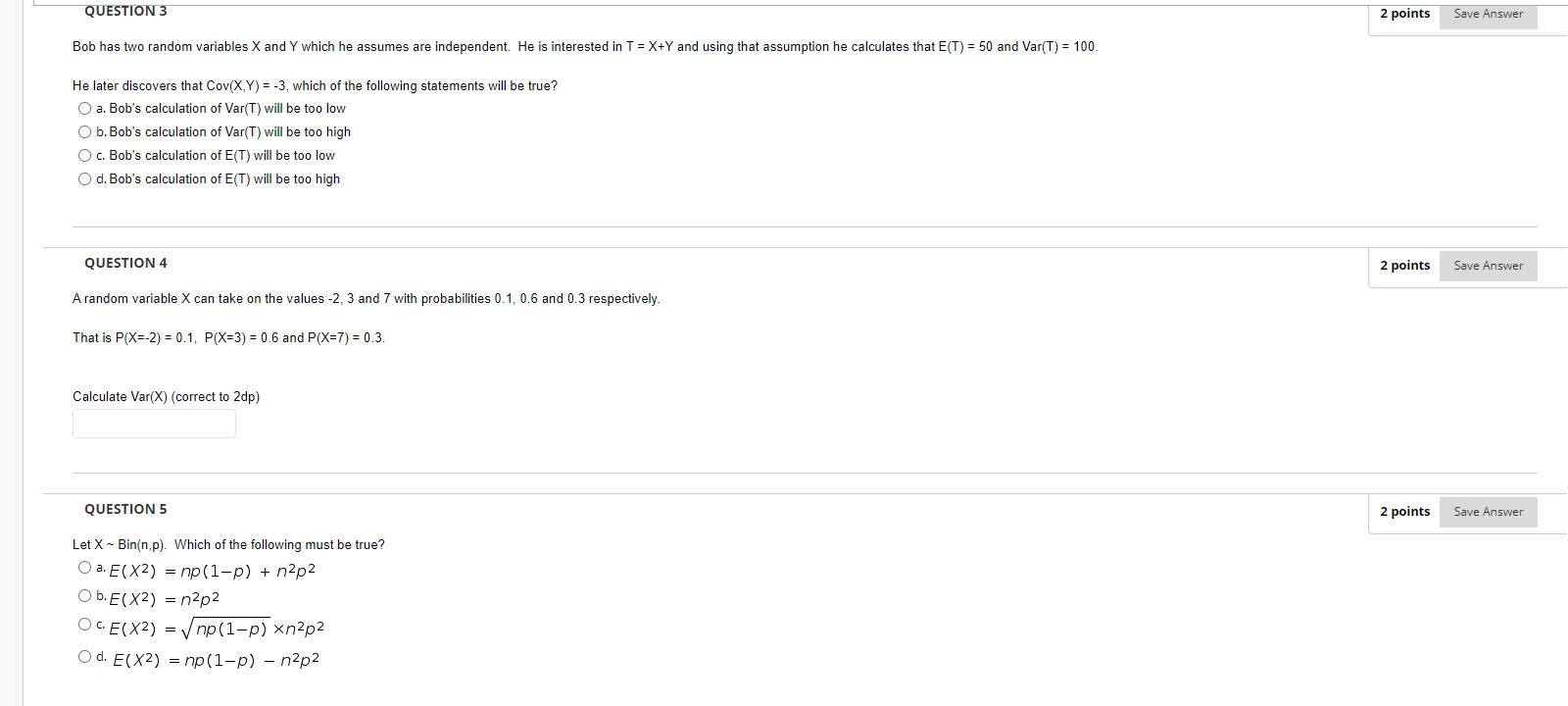
QUESTION 3 2 points Save Answer Bob has two random variables X and Y which he assumes are independent. He is interested in T = X+Y and using that assumption he calculates that E(T) = 50 and Var(T) = 100. He later discovers that Cov(X,Y) = -3, which of the following statements will be true? O a. Bob's calculation of Var(T) will be too low O b. Bob's calculation of Var(T) will be too high O c. Bob's calculation of E(T) will be too low O d. Bob's calculation of E(T) will be too high QUESTION 4 2 points Save Answer A random variable X can take on the values -2, 3 and 7 with probabilities 0.1, 0.6 and 0.3 respectively. That is P(X=-2) = 0.1, P(X=3) = 0.6 and P(X=7) = 0.3. Calculate Var(X) (correct to 2dp) QUESTION 5 2 points Save Answer Let X ~ Bin(n,p). Which of the following must be true? O a. E(X2) = np(1-p) + n2p2 O b. E (X2 ) = 12p2 O c. E(X2) = np(1-p) xn2p2 O d. E(X2) = np(1-p) - n2p2
Step by Step Solution
There are 3 Steps involved in it

Get step-by-step solutions from verified subject matter experts
 Study Help