







Question: Question 3 (20 Marks) Critically discuss the extent to which Ravesh and Sizwe demonstrate commitment as leaders to ethics within the organisation Class: Human Resource
Question 3 (20 Marks) Critically discuss the extent to which Ravesh and Sizwe demonstrate commitment as leaders to ethics within the organisation
Class: Human Resource Ethics in Business
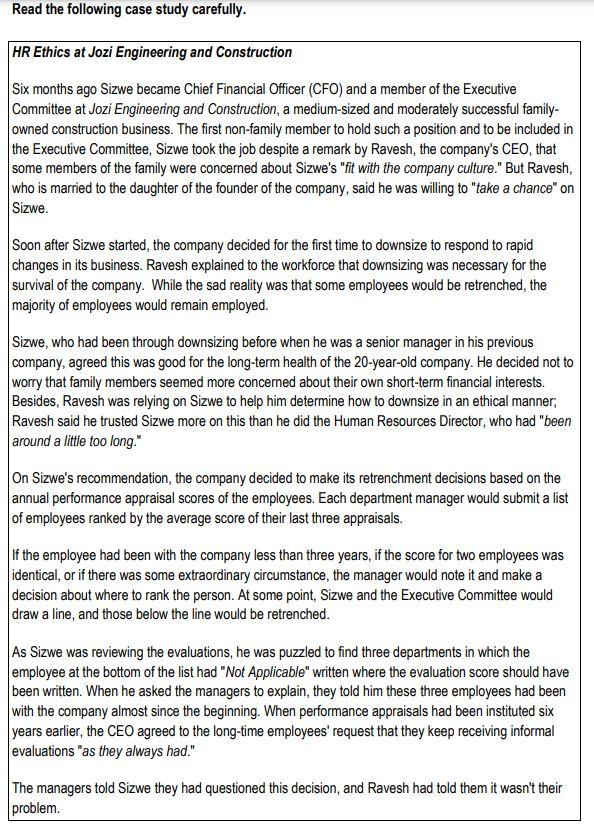
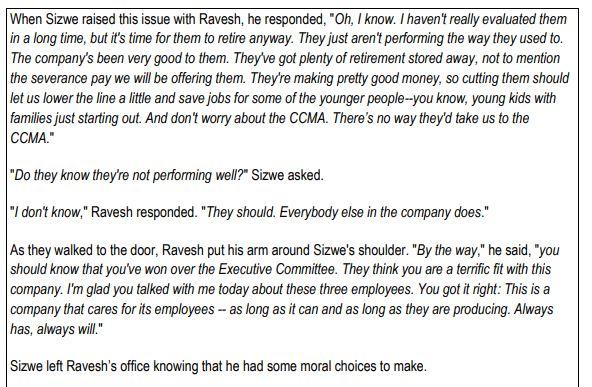
Read the following case study carefully. HR Ethics at Jozi Engineering and Construction Six months ago Sizwe became Chief Financial Officer (CFO) and a member of the Executive Committee at Jozi Engineering and Construction, a medium-sized and moderately successful family- owned construction business. The first non-family member to hold such a position and to be included in the Executive Committee, Sizwe took the job despite a remark by Ravesh, the company's CEO, that some members of the family were concerned about Sizwe's "fit with the company culture." But Ravesh, who is married to the daughter of the founder of the company, said he was willing to "take a chance" on Sizwe. Soon after Sizwe started, the company decided for the first time to downsize to respond to rapid changes in its business. Ravesh explained to the workforce that downsizing was necessary for the survival of the company. While the sad reality was that some employees would be retrenched, the majority of employees would remain employed. Sizwe, who had been through downsizing before when he was a senior manager in his previous company, agreed this was good for the long-term health of the 20-year-old company. He decided not to worry that family members seemed more concerned about their own short-term financial interests. Besides, Ravesh was relying on Sizwe to help him determine how to downsize in an ethical manner, Ravesh said he trusted Sizwe more on this than he did the Human Resources Director, who had "been around a little too long." On Sizwe's recommendation, the company decided to make its retrenchment decisions based on the annual performance appraisal scores of the employees. Each department manager would submit a list of employees ranked by the average score of their last three appraisals. If the employee had been with the company less than three years, if the score for two employees was identical, or if there was some extraordinary circumstance, the manager would note it and make a decision about where to rank the person. At some point, Sizwe and the Executive Committee would draw a line, and those below the line would be retrenched. As Sizwe was reviewing the evaluations, he was puzzled to find three departments in which the employee at the bottom of the list had "Not Applicable" written where the evaluation score should have been written. When he asked the managers to explain, they told him these three employees had been with the company almost since the beginning. When performance appraisals had been instituted six years earlier, the CEO agreed to the long-time employees' request that they keep receiving informal evaluations as they always had." The managers told Sizwe they had questioned this decision, and Ravesh had told them it wasn't their problem. When Sizwe raised this issue with Ravesh, he responded, "Oh, I know. I haven't really evaluated them in a long time, but it's time for them to retire anyway. They just aren't performing the way they used to. The company's been very good to them. They've got plenty of retirement stored away, not to mention the severance pay we will be offering them. They're making pretty good money, so cutting them should let us lower the line a little and save jobs for some of the younger people--you know, young kids with families just starting out. And don't worry about the CCMA. There's no way they'd take us to the |." "Do they know they're not performing well?" Sizwe asked. "I don't know," Ravesh responded. "They should. Everybody else in the company does." As they walked to the door, Ravesh put his arm around Sizwe's shoulder. "By the way," he said, "you should know that you've won over the Executive Committee. They think you are a terrific fit with this company. I'm glad you talked with me today about these three employees. You got it right: This is a company that cares for its employees -- as long as it can and as long as they are producing. Always has, always will." Sizwe left Ravesh's office knowing that he had some moral choices to makeStep by Step Solution
There are 3 Steps involved in it
1 Expert Approved Answer
Step: 1 Unlock

Question Has Been Solved by an Expert!
Get step-by-step solutions from verified subject matter experts
Step: 2 Unlock
Step: 3 Unlock
 Study Help