







Question: Question 3 CS 2 8 0 students: Answer parts ( a ) to ( c ) ( ( 1 0 + 1 0 +
Question
CS students: Answer parts a to c
CS students: Answer all parts
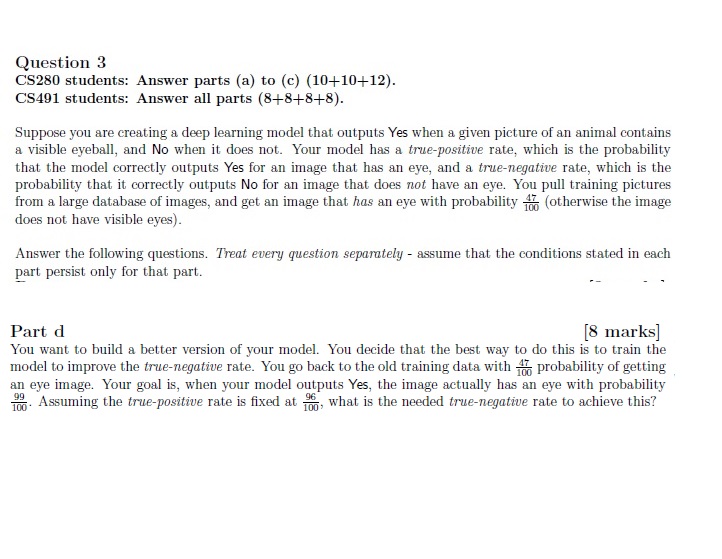
Suppose you are creating a deep learning model that outputs Yes when a given picture of an animal contains a visible eyeball, and No when it does not. Your model has a truepositive rate, which is the probability that the model correctly outputs Yes for an image that has an eye, and a truenegative rate, which is the probability that it correctly outputs No for an image that does not have an eye. You pull training pictures from a large database of images, and get an image that has an eye with probability fracotherwise the image does not have visible eyes
Answer the following questions. Treat every question separately assume that the conditions stated in each part persist only for that part.
Part d
marks
You want to build a better version of your model. You decide that the best way to do this is to train the model to improve the truenegative rate. You go back to the old training data with frac probability of getting an eye image. Your goal is when your model outputs Yes, the image actually has an eye with probability frac Assuming the truepositive rate is fixed at frac what is the needed truenegative rate to achieve this?
Step by Step Solution
There are 3 Steps involved in it
1 Expert Approved Answer
Step: 1 Unlock

Question Has Been Solved by an Expert!
Get step-by-step solutions from verified subject matter experts
Step: 2 Unlock
Step: 3 Unlock
 Study Help