







Question: Question 3 Discuss how the need for control over foreign operations varies with firms strategies and core competencies. What are the implications for the choice
Question 3 Discuss how the need for control over foreign operations varies with firms strategies and core competencies. What are the implications for the choice of entry mode? [20 marks]
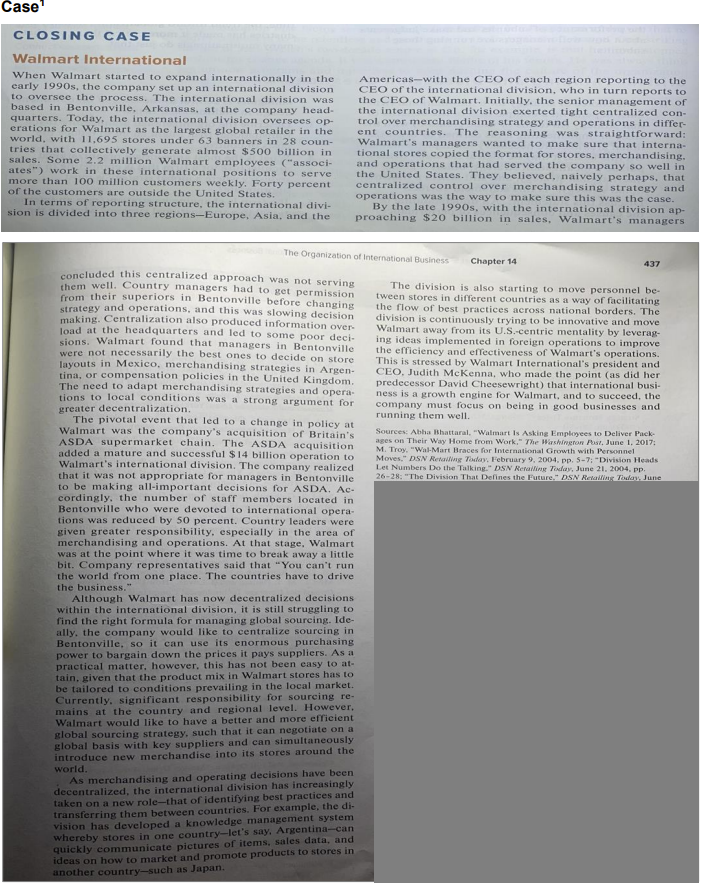
Case CLOSING CASE Walmart International When Walmart started to expand internationally in the carly 1990s, the company set up an international division to oversee the process. The international division was based in Bentonville, Arkansas, at the company head quarters. Today, the international division oversees op- erations for Walmart as the largest global retailer in the world, with 11,695 stores under 63 banners in 28 coun- tries that collectively generate almost $500 billion in sales. Some 2.2 million Walmart employees (associ- ates") work in these international positions to serve more than 100 million customers weekly. Forty percent of the customers are outside the United States. In terms of reporting structure, the international divi- sion is divided into three regions-Europe, Asia, and the Americas-with the CEO of each region reporting to the CEO of the international division, who in turn reports to the CEO of Walmart. Initially, the senior management of the international division exerted tight centralized con- trol over merchandising strategy and operations in differ- ent countries. The reasoning was straightforward: Walmart's managers wanted to make sure that interna. tional stores copied the format for stores, merchandising. and operations that had served the company so well in the United States. They believed, naively perhaps, that centralized control over merchandising strategy and operations was the way to make sure this was the case. By the late 1990s, with the international division ap- proaching $20 billion in sales, Walmart's managers The Organization of International Business Chapter 14 437 concluded this centralized approach was not serving them well. Country managers had to get permission The division is also starting to move personnel be- from their superiors in Bentonville before changing tween stores in different countries as a way of facilitating strategy and operations, and this was slowing decision the flow of best practices across national borders. The making. Centralization also produced information over- division is continuously trying to be innovative and move load at the headquarters and led to some poor deci. Walmart away from its U.S. centric mentality by leverag- sions. Walmart found that managers in Bentonville ing ideas implemented in foreign operations to improve were not necessarily the best ones to decide on store the efficiency and effectiveness of Walmart's operations. layouts in Mexico, merchandising strategies in Argen- This is stressed by Walmart International's president and tina, or compensation policies in the United Kingdom. CEO, Judith McKenna, who made the point (as did her The need to adapt merchandising strategies and opera- predecessor David Cheesewright) that international busi- tions to local conditions was a strong argument for ness is a growth engine for Walmart, and to succeed, the greater decentralization. company must focus on being in good businesses and The pivotal event that led to a change in policy at running them well. Walmart was the company's acquisition of Britain's Sources: Abha Bhattaral. "Walmart Is Asking Employees to Deliver Pack ASDA supermarket chain. The ASDA acquisition ages on Their Way Home from Work." The Washington Post, June 1, 2017: added a mature and successful $ 14 billion operation to M. Troy, "Wal-Mart Braces for International Growth with Personnel Moves," DSN Reway, February 9, 2004. pp. 5-7; "Division Heads Walmart's international division. The company realized Let Numbers Do the Talking DSN Rerailing Today, June 21, 2004, pp. that it was not appropriate for managers in Bentonville 26-28: "The Division That Defines the Future." DSN Relalang Today, June to be making all-important decisions for ASDA. Ac- cordingly, the number of staff members located in Bentonville who were devoted to international opera- tions was reduced by 50 percent. Country leaders were given greater responsibility, especially in the area of merchandising and operations. At that stage. Walmart was at the point where it was time to break away a little bit. Company representatives said that "You can't run the world from one place. The countries have to drive the business." Although Walmart has now decentralized decisions within the international division, it is still struggling to find the right formula for managing global sourcing. Ide- ally, the company would like to centralize sourcing in Bentonville, so it can use its enor ous purchasing power to bargain down the prices it pays suppliers. As a practical matter, however, this has not been easy to at tain, given that the product mix in Walmart stores has to be tailored to conditions prevailing in the local market. Currently. significant responsibility for sourcing re- mains at the country and regional level. However, Walmart would like to have a better and more efficient global sourcing strategy, such that it can negotiate on a global basis with key suppliers and can simultaneously introduce new merchandise into its stores around the world. As merchandising and operating decisions have been decentralized, the international division has increasingly taken on a new role-that of identifying best practices and transferring them between countries. For example, the di- vision has developed a knowledge management system whereby stores in one country-let's say. Argentina-can quickly communicate pictures of items, sales data, and ideas on how to market and promote products to stores in another country-such as JapanStep by Step Solution
There are 3 Steps involved in it
1 Expert Approved Answer
Step: 1 Unlock

Question Has Been Solved by an Expert!
Get step-by-step solutions from verified subject matter experts
Step: 2 Unlock
Step: 3 Unlock
 Study Help