







Question: Question 3 - Distance Vector 3-step routing algorithm In Week 8, the algorithm used to calculate shortest path using RIP is discussed, and the
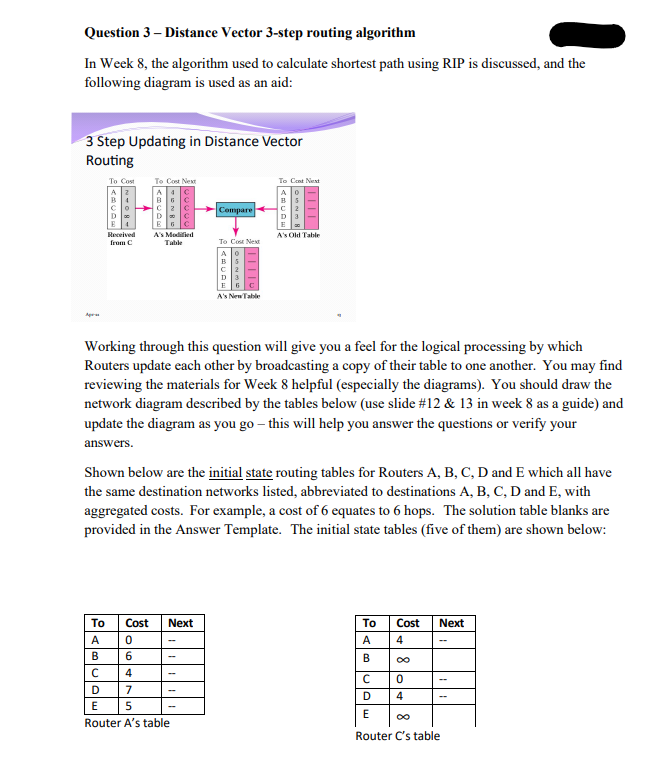
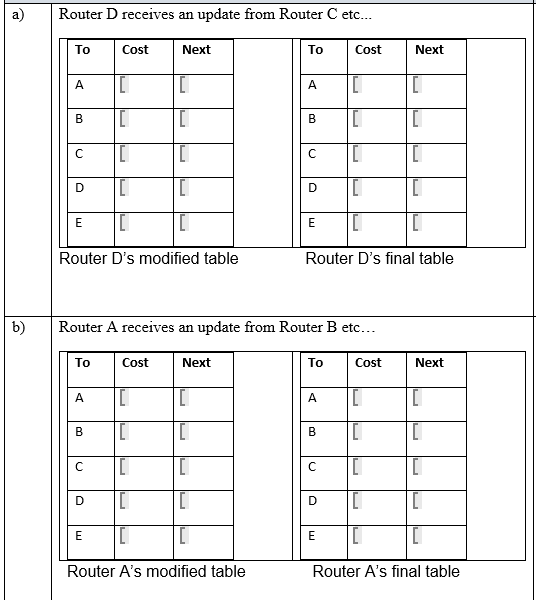
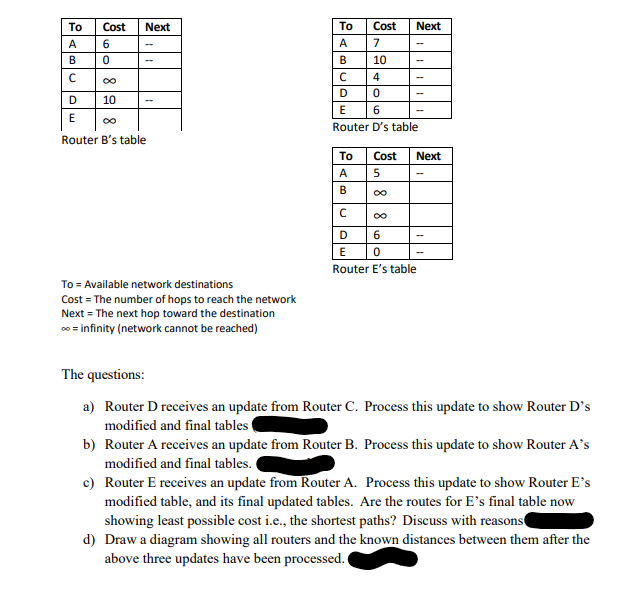
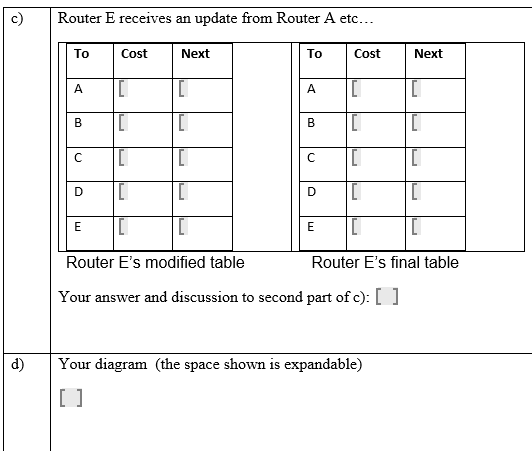
Question 3 - Distance Vector 3-step routing algorithm In Week 8, the algorithm used to calculate shortest path using RIP is discussed, and the following diagram is used as an aid: 3 Step Updating in Distance Vector Routing To Cost To Cost Next To Cost Next A 0 Compare D R DC C2 D3 Received from C A's Modified Table A's Old Table To Cost Next A's New Table Working through this question will give you a feel for the logical processing by which Routers update each other by broadcasting a copy of their table to one another. You may find reviewing the materials for Week 8 helpful (especially the diagrams). You should draw the network diagram described by the tables below (use slide #12 & 13 in week 8 as a guide) and update the diagram as you go - this will help you answer the questions or verify your answers. Shown below are the initial state routing tables for Routers A, B, C, D and E which all have the same destination networks listed, abbreviated to destinations A, B, C, D and E, with aggregated costs. For example, a cost of 6 equates to 6 hops. The solution table blanks are provided in the Answer Template. The initial state tables (five of them) are shown below: Cost Next To Cost Next A 0 - A 4 B 6 - B C 4 - C 0 D 7 - D 4 E 5 E 00 Router A's table Router C's table G b) Router D receives an update from Router C etc... To Cost Next To Cost Next A | C | A [ [[] B [ B | [] C [ C D E Router D's modified table D [ E [ Router D's final table Router A receives an update from Router B etc... To Cost Next A [ To Cost Next A [ B [ B C C C D E [ [ Router A's modified table [ D [ [[ E Router A's final table To Cost A 6 - B 0 - C 00 D 10 E Router B's table Next To Cost Next A 7 B 10 - C 4 - D 0 E 6 Router D's table To Cost Next A 5 B 00 C D 6 E 0 Router E's table To = Available network destinations Cost = The number of hops to reach the network Next = The next hop toward the destination = infinity (network cannot be reached) The questions: a) Router D receives an update from Router C. Process this update to show Router D's modified and final tables ( b) Router A receives an update from Router B. Process this update to show Router A's modified and final tables. c) Router E receives an update from Router A. Process this update to show Router E's modified table, and its final updated tables. Are the routes for E's final table now showing least possible cost i.e., the shortest paths? Discuss with reasons d) Draw a diagram showing all routers and the known distances between them after the above three updates have been processed. Router E receives an update from Router A etc... To Cost Next To Cost Next A [ | C | A [ B [ B [ C [ [ C [ D L D [ E [ E C [ Router E's modified table Router E's final table Your answer and discussion to second part of c): [ ] d) Your diagram (the space shown is expandable) [ ]
Step by Step Solution
There are 3 Steps involved in it
Unquestionably Here is a little by little explanation of the Distance Vector 3step controlling computation used in the Coordinating Information Show T... View full answer

Get step-by-step solutions from verified subject matter experts
 Study Help