







Question: Question 3 : In this exercise, we will examine how capacity affects overall performance. In general, cache access time is proportional to capacity. Assume that
Question :
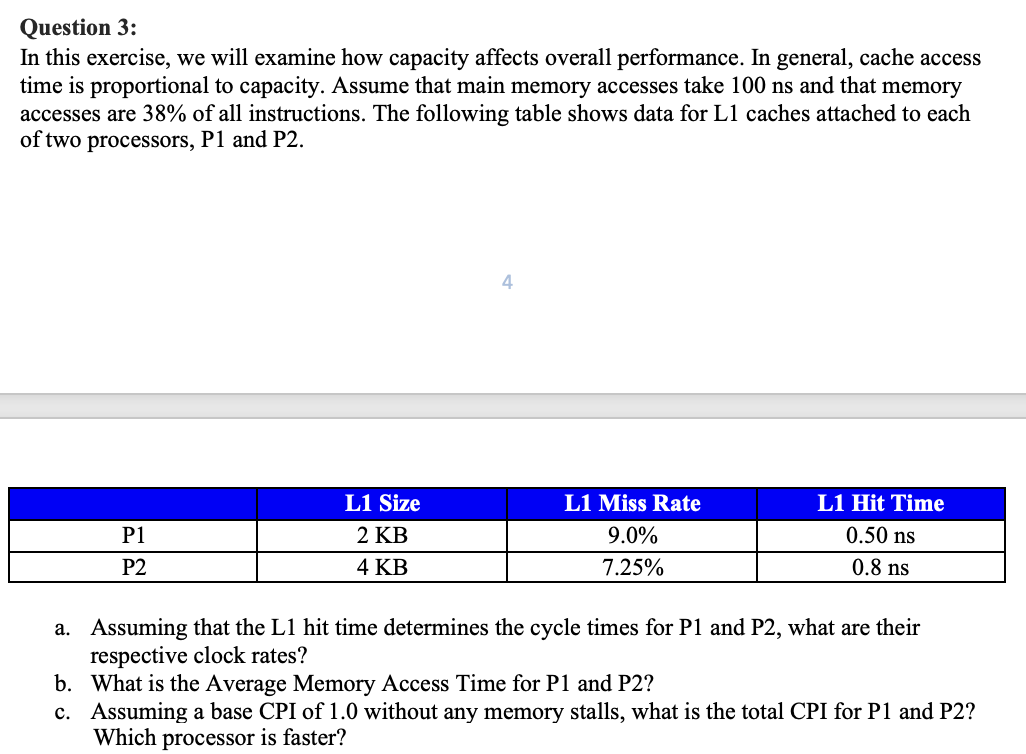
In this exercise, we will examine how capacity affects overall performance. In general, cache access time is proportional to capacity. Assume that main memory accesses take ns and that memory accesses are of all instructions. The following table shows data for L caches attached to each of two processors, P and P
L Size L Miss Rate L Hit Time
P KB ns
P KB ns
a Assuming that the L hit time determines the cycle times for P and P what are their respective clock rates?
b What is the Average Memory Access Time for P and P
c Assuming a base CPI of without any memory stalls, what is the total CPI for P and P
Which processor is faster?Question :
In this exercise, we will examine how capacity affects overall performance. In general, cache access
time is proportional to capacity. Assume that main memory accesses take and that memory
accesses are of all instructions. The following table shows data for L caches attached to each
of two processors, P and P
a Assuming that the L hit time determines the cycle times for P and P what are their
respective clock rates?
b What is the Average Memory Access Time for P and P
c Assuming a base CPI of without any memory stalls, what is the total CPI for P and P
Which processor is faster?
Step by Step Solution
There are 3 Steps involved in it
1 Expert Approved Answer
Step: 1 Unlock

Question Has Been Solved by an Expert!
Get step-by-step solutions from verified subject matter experts
Step: 2 Unlock
Step: 3 Unlock
 Study Help