







Question: Question 3: Max-flow Network Consider the network flow problem with the following edge capacities, cau.v), and costs, cost(u.v), for edge (w.v): s and t are
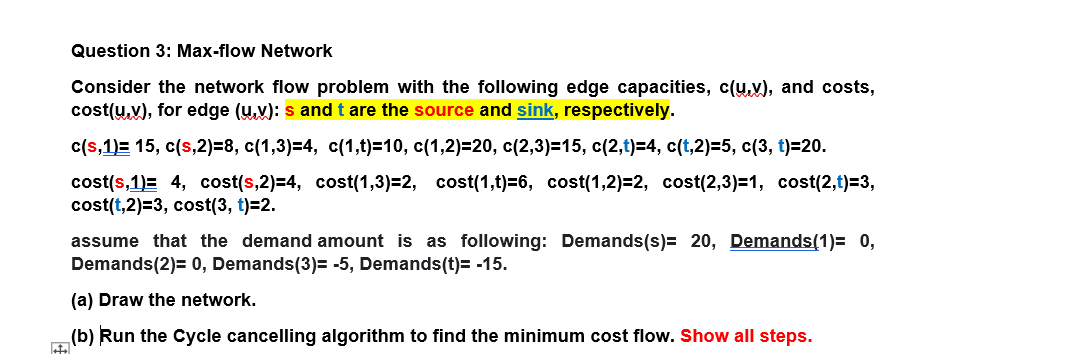
Question 3: Max-flow Network Consider the network flow problem with the following edge capacities, cau.v), and costs, cost(u.v), for edge (w.v): s and t are the source and sink, respectively. c(s,1)= 15, c(s,2)=8, C(1,3)=4, c(1,t)=10, c(1,2)=20, C(2,3)=15, C(2,6)=4, c(t,2)=5, (3, t)=20. cost(s,1)= 4, cost(s,2)=4, cost(1,3)=2, cost(1,t)=6, cost(1,2)=2, cost(2,3)=1, cost(2,t)=3, cost(t,2)=3, cost(3, t)=2. assume that the demand amount is as following: Demands(s)= 20, Demands(1)= 0, Demands(2)= 0, Demands(3)= -5, Demands(t)= -15. (a) Draw the network. (b) Run the Cycle cancelling algorithm to find the minimum cost flow. Show all steps. Question 3: Max-flow Network Consider the network flow problem with the following edge capacities, cau.v), and costs, cost(u.v), for edge (w.v): s and t are the source and sink, respectively. c(s,1)= 15, c(s,2)=8, C(1,3)=4, c(1,t)=10, c(1,2)=20, C(2,3)=15, C(2,6)=4, c(t,2)=5, (3, t)=20. cost(s,1)= 4, cost(s,2)=4, cost(1,3)=2, cost(1,t)=6, cost(1,2)=2, cost(2,3)=1, cost(2,t)=3, cost(t,2)=3, cost(3, t)=2. assume that the demand amount is as following: Demands(s)= 20, Demands(1)= 0, Demands(2)= 0, Demands(3)= -5, Demands(t)= -15. (a) Draw the network. (b) Run the Cycle cancelling algorithm to find the minimum cost flow. Show all steps
Step by Step Solution
There are 3 Steps involved in it

Get step-by-step solutions from verified subject matter experts
 Study Help